Mongolian Bow vs English Longbow: 36% More Energy From the Same Pull
Pound for pound, a horn-and-sinew Mongolian bow stores about 36% more energy than a yew longbow in my calibrated model, and throws the same arrow roughly 15–20 fps faster. That part of the legend holds. The part where either bow punches through a steel breastplate does not. Here are the numbers, the siyah mechanics behind them, and two tools to run your own.


Core Insight: At the same draw weight the Mongolian bow is the stronger machine and the English longbow is the simpler one. My model, calibrated against published 80 lb yew-bow shots, puts the horn bow 15–20 fps ahead with the same arrow. Neither bow reliably defeats good 2 mm steel plate. Pick by how you shoot, not by the legend.
- Material physics: horn on the belly takes compression, sinew on the back takes tension, and the wood core just holds them apart. A yew self-bow asks one stave to do all three jobs, so it has to be long.
- Stored energy: about 133 J (1.66 J per lb) for an 80 lb Mongolian bow at 28″ against about 97 J (1.22 J per lb) for an 80 lb yew longbow. There’s your 1.36×, and the siyahs bank most of it in the first half of the draw.
- Chronograph-style speed: 10 GPP (800 gr): 191 vs 171 fps. 15 GPP war arrow (1,200 gr): 161 vs 146 fps, with 0.856 vs 0.775 slug·ft/s of momentum. Modeled, 80 lb at 28″.
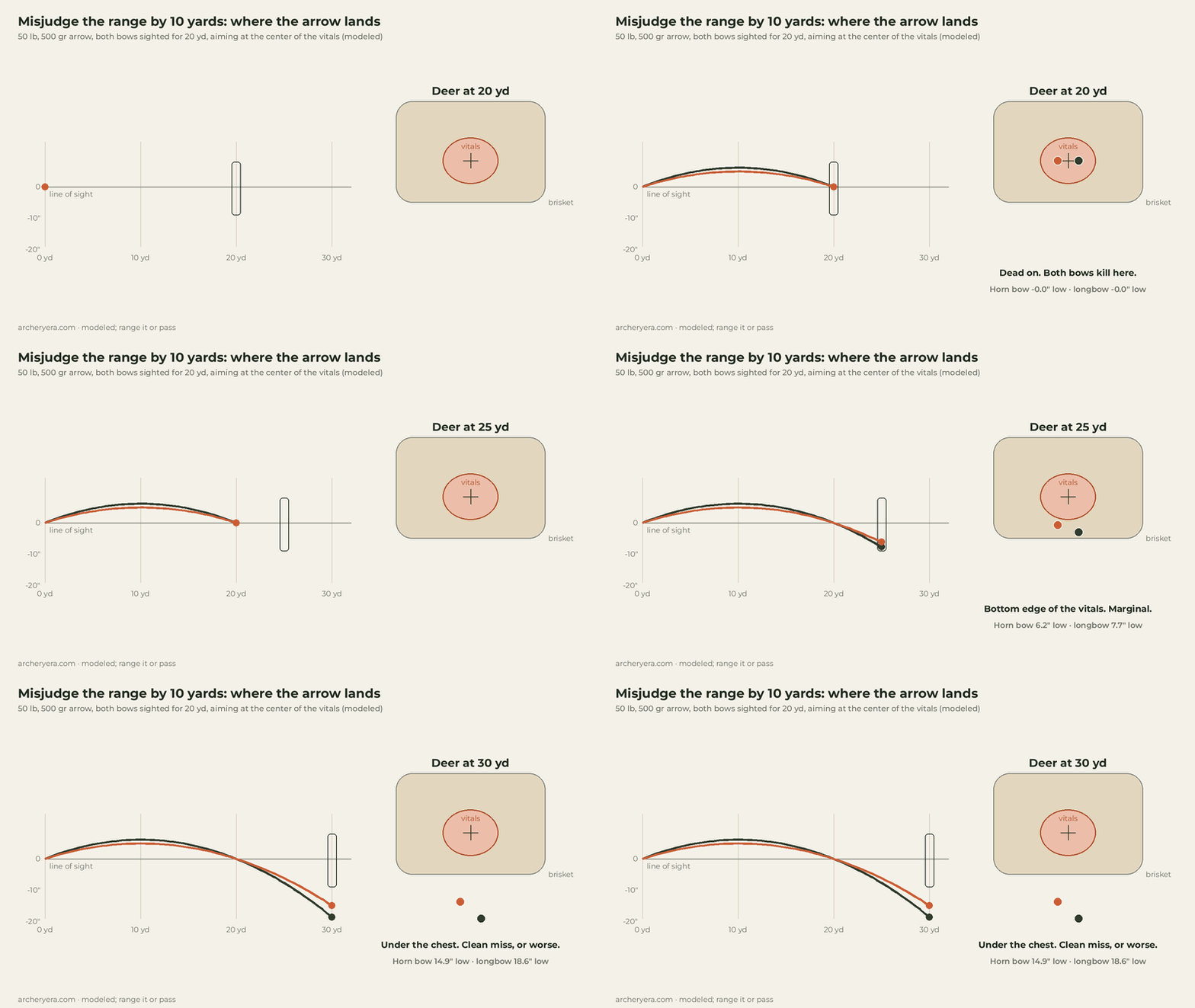
- For a whitetail hunter: at 50 lb with a 500-grain arrow zeroed at 20 yards, misjudge a 30-yard deer and the horn bow hits about 15″ low, the straight longbow about 19″. Both kill deer. The horn bow forgives a bad range call a little better.
- Release: a thumb ring lets a 58″ horn bow reach a 31″ draw with zero finger pinch at a tight 107° string angle. A three-finger Mediterranean draw needs the longbow’s length to keep the string open near 139°.
Mongolian bow (~58″, horn/sinew/bamboo)
Ideal For: Mounted and moving archery, thumb-ring shooters, long draws on a short bow, flight shooting, and anyone chasing the most arrow speed per pound.
English longbow (68–76″, yew or laminated)
Ideal For: Warbow and heavy-arrow shooting, Mediterranean (split or three-under) release, wet climates, reenactment, and archers who want a bow that forgives neglect.
Which Bow Fits How You Actually Shoot: Mongolian or English Longbow?
It comes down to four things: where you shoot from, how heavy a bow you pull, which release you use, and how much care you will give the bow. A thumb-ring archer on the move belongs on a horn bow. A three-finger shooter with heavy arrows and wet weather belongs on a longbow. Everyone else sits in between.
Pick an answer in each group. The bar shows the split, and the cards hand you a starting arrow weight, a spine window and the reasoning a bowyer would give you across the bench.
Pick your answers above.
Starting arrow weight
Spine window (wood, 28″ arrow)
Modeled speed, both bows
Bowyer rationale:
How does the match tool score and estimate?
The split starts at 50/50 and moves with each answer: shooting style carries the most weight (up to ±30 points), then release (±18), maintenance (±14) and draw weight (±12). It is clamped to 6–94% so it never pretends to be certain. It is a planning heuristic, not a fitting.
Arrow weight uses a grains-per-pound target by style (horseback 9–11, target 8–10, hunting 10–12, warbow 15–18 GPP) at the middle of your weight band. Speed comes from this page’s bow model (see the force-draw calculator). The spine window is a starting point for wood shafts: roughly your draw weight at your draw, −5 to +10 lb for heavy heads. Confirm it with the wood arrow spine calculator and a bare-shaft test.
Did Mongolian Bows Shoot Faster Than English Longbows at the Same Draw Weight?
Yes, by about 15 to 20 fps at 80 lb in my model. The horn bow stores 36% more energy, but horn and sinew waste more of it as heat, so it converts 66–72% into the arrow against 72–81% for the yew bow. The lead is widest with light arrows and narrows as the arrow gets heavier.
| Arrow load | Mongolian (58″, 80#) | English longbow (72″, 80#) | ||||
|---|---|---|---|---|---|---|
| Launch fps | @20 yd: fps · KE · p | @100 yd: fps · KE · p | Launch fps | @20 yd: fps · KE · p | @100 yd: fps · KE · p | |
| 10 GPP (800 gr) | 191 | 188 · 63.1 · 0.669 | 178 · 56.5 · 0.633 | 171 | 169 · 50.5 · 0.599 | 160 · 45.2 · 0.567 |
| 12 GPP (960 gr) | 177 | 175 · 65.1 · 0.745 | 166 · 58.8 · 0.708 | 159 | 157 · 52.8 · 0.671 | 150 · 47.7 · 0.637 |
| 15 GPP (1,200 gr) | 161 | 159 · 67.2 · 0.846 | 152 · 61.4 · 0.809 | 146 | 144 · 55.2 · 0.767 | 138 · 50.4 · 0.733 |
| 18 GPP (1,440 gr) | 148 | 147 · 68.7 · 0.937 | 141 · 63.3 · 0.899 | 135 | 133 · 56.9 · 0.853 | 128 · 52.4 · 0.818 |
Modeled, 80 lb at 28″. KE in ft-lb (grains × fps² ÷ 450,240); p is momentum in slug·ft/s (grains × fps ÷ 225,218). Downrange decay assumes a heavy bodkin-style arrow losing about 6% of its speed over 100 m, the figure used in a well-sourced review of war-arrow energy loss; lighter shafts lose a little more.
Two things in that table surprise people (the arrow weight vs speed guide explains the first). First, heavier arrows carry more energy, not less: at 18 GPP the horn bow puts 8% and the longbow 12% more energy into the arrow than at 10 GPP. Second, the horn bow’s 15 GPP arrow still beats the longbow’s 18 GPP arrow on energy at 100 yards (61.4 vs 52.4 ft-lb). That is what a third more stored energy buys you.
My opinion, for what it is worth: the Mongol advantage was never about the first volley. A 1,200-grain arrow at 161 instead of 146 fps drops noticeably less over 200 yards, and on horseback, shooting while moving, flatter is everything. The arrow trajectory visualizer will show you the arc difference in a minute.
One caveat the forums skip. Nobody wrote down Mongol draw weights in pounds, so every “Mongol bows pulled 160 lb” claim is a modern guess. What survives is distance: a 1226 inscription records Esungge, Genghis Khan’s nephew, hitting a mark at 335 alds, roughly 536 m, on the stele now kept in the Hermitage. That is flight shooting with a light arrow, not a war volley. It still says a lot about the bow, and about the legendary archers who grew up on it.
Put your own arrow weight and chronograph reading into the Kinetic Energy & Momentum Calculator to see what your setup carries downrange and where it lands against game-size thresholds. For single numbers, the arrow momentum calculator and arrow kinetic energy calculator are faster, and the momentum vs kinetic energy guide explains which one predicts penetration.
Open the Kinetic Energy & Momentum Calculator →Which Bow Has More Hand Shock?
The longbow, on paper. After the arrow leaves, whatever energy is still moving in the limbs has to stop somewhere, and a good part of it stops in your bow hand. At 80 lb with a 10 GPP arrow my model leaves 16.2 ft-lb moving in the longbow’s heavy limbs against 13.4 ft-lb in the horn bow’s. That is about 21% more to absorb.
The horn bow gets rid of its extra through a different door. Horn and sinew are damped materials: about 19.6 ft-lb turns into heat inside the limbs against 3.6 in yew. So the longbow tends to “thump,” and the horn bow feels crisp but can slap if the string is too light or the siyahs hit string bridges. A heavier arrow shrinks both: at 18 GPP the leftover drops to 10.1 and 8.0 ft-lb.
| Where the energy goes (80#, 800 gr) | Mongolian | English longbow |
|---|---|---|
| Into the arrow | 64.8 ft-lb (66%) | 52.0 ft-lb (72%) |
| Left moving in limbs and string (shock, noise) | 13.4 ft-lb | 16.2 ft-lb |
| Lost as heat in the limbs | 19.6 ft-lb | 3.6 ft-lb |
I would not put a millisecond figure on either bow’s vibration. That depends on the string, the tiller and the archer’s grip far more than on the material. The energy split is the part the physics can defend.
Could an English Longbow or Mongolian Bow Penetrate Steel Plate Armor?
Not good steel plate hit square on. Tests put the energy needed to defeat 2 mm steel above 180 J, and even a 160 lb longbow delivers about 110–125 J at close range. Both bows can beat mail, textile armor and thin soft iron at short range. The horn bow has a clear margin on mail; the longbow is borderline.
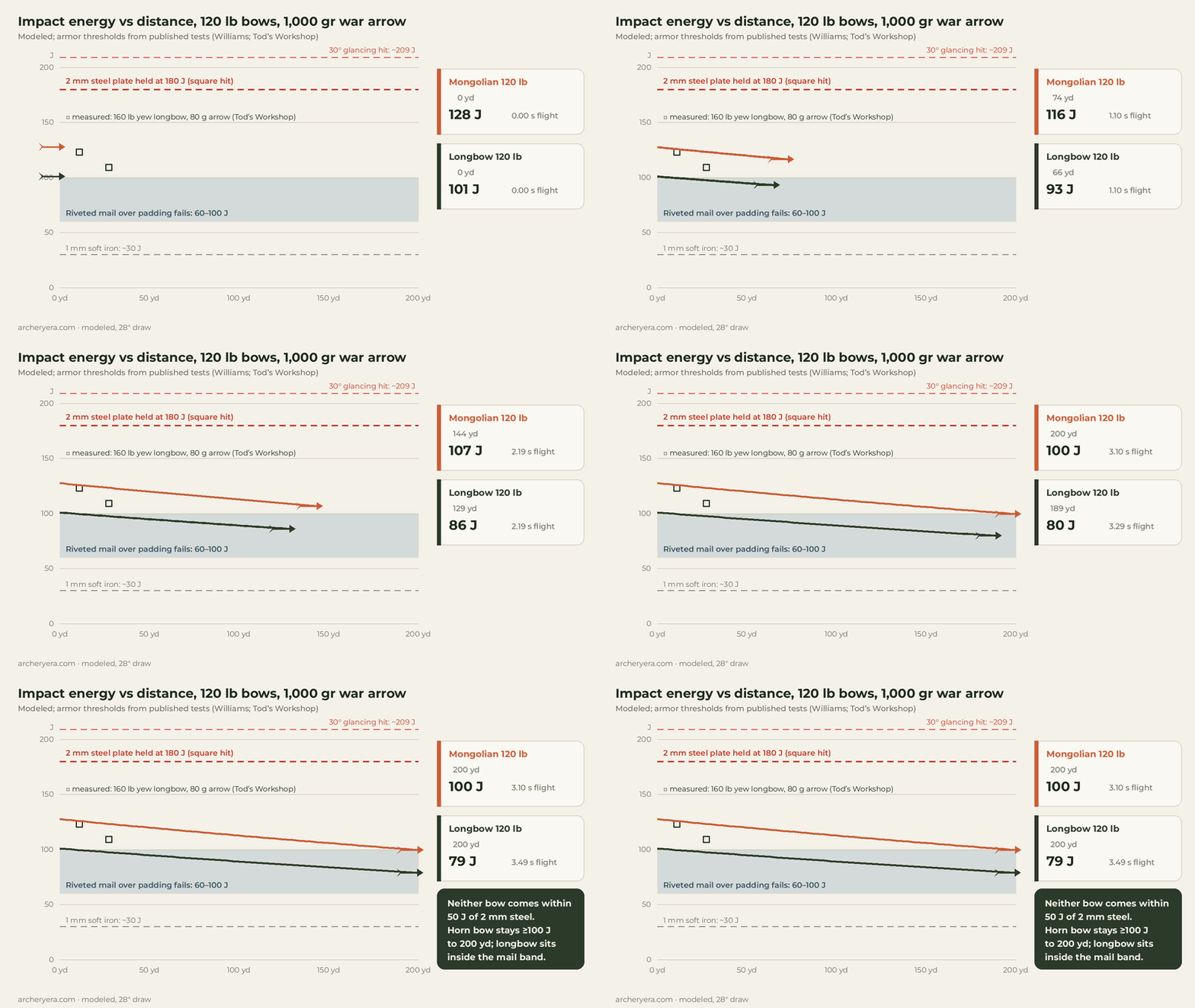
The best recent test is Tod’s Workshop’s arrows-against-a-breastplate trial. Joe Gibbs shot a 160 lb yew longbow with 80 g (1,235 gr) wrought-iron-headed arrows, measured at 123 J at 10 m and 109 J at 25 m. The breastplate, modeled on a c. 1390 piece, was 2.5 mm at the center and 1.5 mm at the sides, in 0.5% carbon steel. The arrows shattered and dented it. None went through.
For thresholds I lean on Alan Williams’ figures as summarized in that same review of archery against armor: mail over padding failing somewhere between 60 and 100 J, 1 mm soft iron plate at about 30 J, and 2 mm steel plate withstanding 180 J. A 30° glancing hit needs about 16% more; 45° needs about 42% more.
| Armor type (threshold) | Mongolian impact / margin (J) | Longbow impact / margin (J) | Lethality delta | Key kinetic factor |
|---|---|---|---|---|
| Padded gambeson / leather (16-layer linen: ~50 J, spear test) | 123 J / +73 | 97 J / +47 | Both defeat it; horn bow with more to spare | Energy, and a narrow bodkin that parts the weave |
| Riveted mail over padding (60–100 J) | 123 J / +23 to +63 | 97 J / −3 to +37 | Horn bow defeats it; longbow borderline | Point concentration on one ring, then energy through the padding |
| 1 mm soft iron plate (~30 J) | 123 J / +93 | 97 J / +67 | Both defeat it | Metal quality matters more than thickness |
| 1.5 mm munition-grade plate (no clean figure) | 123 J / ? | 97 J / ? | Can’t call it; depends on hardness and angle | Tod’s 1.5 mm side plates still stopped 109–123 J |
| 2 mm hardened steel plate (>180 J square on) | 123 J / −57 | 97 J / −83 | Neither; a glancing hit makes it worse (>209 J at 30°) | Hardness and curvature; the arrowhead fails first |
Modeled at 120 lb and 28″ with a 1,000-grain arrow, impact energy at 30 yards: 123 J (202 fps, 0.897 slug·ft/s) for the horn bow and 97 J (180 fps, 0.798) for the longbow. I show the margin in joules instead of “millimeters of penetration” on purpose. Nobody has a validated formula that turns arrow energy into a depth behind steel plate, and a made-up depth would be worse than none.
Point shape matters as much as joules. A narrow bodkin concentrates the hit on one mail ring; a broad head spends energy cutting cloth. The guide to arrow and point types covers the shapes, and FOC vs penetration shows why a heavy, front-loaded arrow keeps going after the first layer. If you are weighing the other medieval answer to plate, the crossbow vs longbow comparison runs the same kind of numbers.
“Bodkins went straight through knights’ armor at Agincourt.”
Good plate, hit square, mostly held. Arrows killed horses, found gaps at the joints and visors, beat mail and cloth, and wore men down. Lethal enough. Just not the story of a steel-piercing needle.
Why Does a Horn-Sinew Mongolian Bow Store More Energy Than a Yew Longbow?
Because each material does only the job it is best at. Horn on the belly handles huge compression, sinew on the back handles huge stretch, and a thin bamboo or wood core keeps them apart. A yew longbow makes one stave carry compression and tension together, so it needs length to keep the strain safe, and that length is heavy.

The yew longbow is cleverer than it looks. Bowyers keep a strip of pale sapwood on the back because it is good in tension, and the dark heartwood on the belly because it resists crushing. It is a natural two-layer laminate in one stave. Still, wood has a low strain ceiling; the compression strength of wood parallel to the grain is the number that decides how far a yew belly can bend. Ask it to bend further and the belly crushes or “takes set.”
So the longbow grows long. The longbows recovered from the Mary Rose run 1,839 to 2,113 mm (about 72–83″), D-shaped, roughly 35 mm wide and 33 mm deep at the center, with estimated draw weights of 65 to 175 lb and a peak near 110. One of those Mary Rose bows sits in the Royal Armouries collection today.
The Mongol bow was built from bamboo, horn and sinew bound with animal glue, wrapped in birch bark against moisture and kept in a leather case. Horn will compress far past what yew survives. Sinew will stretch far past it too. The catch is water: horn loses most of its stiffness and strength as its moisture content climbs, which is why the birch bark and the leather case were never decoration. So a 58″ bow can be bent into deep reflex, strung backward, and drawn 31″ without breaking.
| Layer | Mongolian bow | English longbow | What it means at full draw |
|---|---|---|---|
| Belly (compression) | Water-buffalo or ibex horn | Yew heartwood | Horn takes far more squeeze before it crushes; heartwood sets first. |
| Back (tension) | Layers of shredded sinew in glue | Yew sapwood | Sinew stretches further; sapwood is the one part of the longbow that rarely fails. |
| Core | Thin bamboo or wood | (same stave) | The composite core is a spacer, not a spring. |
| Tips | Rigid wooden siyahs | Horn nocks on a working limb | Siyahs act as levers and do not bend; longbow tips keep flexing and carry mass. |
| Weak spot | Moisture, heat, hide glue creep | Set and string follow | One fails in bad weather, the other fails from being overdrawn. |
Force-Draw Curve & Stored Energy Calculator
Slide the draw weight, your draw length and your arrow. The tool integrates each bow’s force-draw curve (the area under a force-draw curve is the energy the bow stores), then splits that energy between the arrow and the moving limbs.
What is under the hood of this calculator?
Force-draw curves: Mongolian F = W × ((x − 6)/22)^0.50, stacking from 30.5″ (+4 × (x − 30.5)^1.6 lb per 80 lb of rating). Longbow F = W × ((x − 7)/21)^0.95, stacking from 31″ (+3 lb per inch per 80 lb). Stored energy is the numerical integral of F from brace to your draw.
Arrow speed: v = √(450240 × E × k ÷ (grains + mv)), with a hysteresis factor k of 0.80 (horn and sinew turn more energy into heat) or 0.95 (yew), and a virtual limb mass mv of 165 or 250 grains per 80 lb of draw weight. KE = grains × fps² ÷ 450,240; momentum = grains × fps ÷ 225,218.
The site-wide conventions behind these formulas are on the calculator methodology page.
Calibration: the longbow model gives 173 fps and 70 J for an 80 lb yew bow and a 772-grain (50 g) arrow, against the 53 m/s (174 fps) and 70 J that E. McEwen reported. At 160 lb with an 80 g arrow it reads about 7% hotter than a measured shot (see the armor section). The Mongolian model gives 172 fps at 60 lb with a 50 g arrow; Kooi’s replica Tartar composite drawn to 81.3 cm shot the same arrow at 51 m/s (167 fps).
Run the default 80 lb, 28″, 800 gr case and the pattern is plain. The horn bow banks about 133 J and the yew bow about 97 J. Yet the horn bow puts only about 66% of that into the arrow against 72% for the longbow. Horn and sinew are lossy. They win anyway, because they start with so much more.
Why Do Mongolian Bows Have Rigid Wooden Ends (Siyahs)?
Siyahs are stiff levers at the limb tips. Braced, they sit almost in line with the string, so the short working limbs load up fast. As you draw, they rotate toward 90° to the string and the lever gets longer, so each extra inch adds less weight. The bow feels heavy early and soft near anchor.
Think of each siyah as a crank arm. Draw force at the string equals the limb’s bending moment divided by the effective lever length. Early on the string pulls almost along the siyah, the lever is short, and the limb has to work hard. Near full draw the string meets the siyah close to square, the lever is at its longest, and the same limb moment turns into less draw force. Hence the “cam-like” feel people describe.
It only works up to 90°. Past it, the lever shortens again and the bow stacks. My reference Mongolian bow reaches that point at 30.5″; a real bow reaches it wherever its bowyer set the siyah angle and length. Mongol-era bows had smaller siyahs and less prominent string bridges than later Manchu-style bows, which is worth knowing before you buy a “Mongolian” bow that is really a Qing pattern.
There is a mass story too. A rigid siyah is light and does not bend, so the working limb is short and quick. A longbow limb keeps flexing all the way to the nock and carries its own tip mass through the shot. In my model that is 165 vs 250 grains of virtual limb mass at 80 lb. Every grain of it steals energy from a light arrow.

| Metric (modeled, 80# at 28″) | Mongolian (58″) | English longbow (72″) |
|---|---|---|
| Stored energy | 132.6 J (97.8 ft-lb) | 97.3 J (71.8 ft-lb) |
| Stored energy per lb of draw | 1.66 J/lb | 1.22 J/lb |
| Draw weight at 20″ | 63.8 lb | 50.7 lb |
| Slope near anchor (27–28″) | ~1.8 lb/in | ~3.6 lb/in |
| Stacking onset | 30.5″ (siyahs pass 90°) | 31″ |
| Draw weight at 30″ / 32″ | 83.6 / 94.6 lb | 87.2 / 97.4 lb |
Why Are English Longbows So Long Compared to Composite Horn Bows?
Because wood cannot bend as far as horn and sinew without damage. To keep the strain in a yew belly safe at a 28–30″ draw, the bowyer spreads the bend over six feet or more of stave. Shorten a self-bow and every inch of limb has to bend harder. It takes set, or it breaks.
“The longbow was the primitive option.”
It was the scalable option. A yew stave, a hemp string and a few days’ work armed a whole county. A horn bow needed months of curing between layers. England could build tens of thousands of longbows; no one could build tens of thousands of horn bows in a hurry outside the steppe. The famous bows of history page follows both traditions further back.
Thumb Ring vs Mediterranean Draw: What Changes at Full Draw?
A thumb draw hooks the string with the thumb alone, locked by the middle finger and protected by a ring, and the arrow sits on the thumb side of the bow. A Mediterranean draw uses three fingers. The thumb puts one smooth contact on the string, so a short bow’s tight string angle stops pinching.
That single contact point is why a Mongolian bow can be short. A three-finger hook squeezes the string between fingertips, and the sharper the angle the harder the squeeze. With a ring there is nothing to squeeze. Mongolia still shoots this way at Naadam, the national festival where archery is one of the three contests. The thumb lock presses the tip of the thumb against the side of the middle finger, the index finger rests on top, and the arrow sits on the knuckle of the bow-hand thumb, on the opposite side from a Mediterranean shooter.
I use the same string-angle model as the rest of the site: 104° + 1.75° per inch of bow length over 52″ at a 28″ draw, minus about 2.5° for every extra inch of draw.
How much of the thumb draw’s speed comes from the release itself? Less than you’d think: in the thumb ring vs three-finger speed and string pinch case study, about 16.6 of an 18 fps gain is simply the longer anchor.
| Setup | String angle | Finger pinch index | Verdict |
|---|---|---|---|
| Mongolian 58″, fingers, 28″ | 114.5° | 93 | Workable, but you feel it |
| Mongolian 58″, fingers, 31″ | 107° | 98 | Sore fingers by the second dozen |
| Mongolian 58″, thumb ring, 31″ | 107° | n/a (one contact) | What the bow was built for |
| Longbow 72″, fingers, 28″ | 139° | 84 | Gentle |
| Longbow 72″, fingers, 30″ | 134° | 86 | Still gentle, typical warbow draw |
Pinch index is 100 × sin 52° ÷ sin(θ/2), the same scale as the composite bow vs longbow comparison: 100 is a 52″ bow at 28″ on fingers. The Mary Rose arrows point to 28–30″ draws. Mongol arrows ran 80–100 cm (about 30–40″) long. Arrow length is not draw length, but nobody cuts 36-inch shafts for a 28-inch draw.


Can You Hunt Whitetail or Elk With a Mongolian Bow or an English Longbow?
Yes, with either one, wherever your state’s draw-weight rule is met and the arrow is tuned. At 50 lb both push a 500–600 grain arrow through a whitetail at 20 yards. The horn bow flies flatter; the longbow is quieter and shrugs off rain. The release you already shoot matters more than the bow.
Here is what the model says for the hunting weights most of us actually pull, not warbow weights. Each arrow is zeroed at 20 yards, and the last column shows how far low it lands if the deer is really at 25 or 30.
| Build (28″ draw, modeled) | Mongolian: fps · KE@20 · p@20 | Longbow: fps · KE@20 · p@20 | Low at 25 / 30 yd (zeroed at 20) |
|---|---|---|---|
| 50 lb, 500 gr (10 GPP) | 191 · 39.1 · 0.417 | 171 · 31.4 · 0.373 | 6.2 / 14.9″ vs 7.7 / 18.6″ |
| 50 lb, 600 gr (12 GPP) | 177 · 40.4 · 0.464 | 159 · 32.8 · 0.418 | 7.2 / 17.3″ vs 8.9 / 21.4″ |
| 60 lb, 600 gr (10 GPP) | 191 · 47.1 · 0.501 | 171 · 37.7 · 0.448 | 6.2 / 14.9″ vs 7.7 / 18.5″ |
| 60 lb, 700 gr (11.7 GPP) | 179 · 48.4 · 0.548 | 161 · 39.2 · 0.493 | 7.0 / 16.9″ vs 8.7 / 20.8″ |
KE in ft-lb, p in slug·ft/s. The longbow here is the straight 72″ D-section bow from the rest of this page. Most American longbow hunters carry a 62–64″ reflex-deflex hybrid, and that closes most of the speed gap; the composite bow vs longbow page runs those numbers. Check your state in the minimum draw weight by state table, and the draw weight & kinetic energy for deer guide for what those KE numbers mean on a whitetail.
Four inches at 30 yards sounds small until it is the difference between lungs and liver. Still, my honest take: nobody should be shooting a trad bow at an unmeasured 30-yard deer. Range it, or pass. Inside 20 yards the two bows kill the same. If you shoot without sights, the guide to aiming a bow without sights covers gap and instinctive methods for exactly this problem.
- Feathers, not vanesA true horse bow and a true English longbow both have no shelf; you shoot off the hand. Vanes skid off your knuckle and kick; the feathers vs vanes breakdown explains why. Use feathers, and a horse bow shooter on a thumb draw puts the arrow on the thumb side, so tune bare shafts before you trust any chart.
- Noise at the shotMany horse bows have string bridges near the siyahs, and the string slaps them at the end of the shot. Fur or leather silencers on the bridges and a heavier arrow quiet it. A long wooden longbow gives a duller thump, and on a jumpy whitetail that matters. The sound vs arrow flight time calculator shows how little 20 fps buys you against a deer that drops at the noise.
- Cold morningsA thumb ring over a glove rarely works. Most thumb shooters hunt with a bare ring hand or a thin leather glove sized for the ring. Horn bows also want warming before you string them; do it inside your coat, not on the tailgate.
- StringingUse a stringer on both. A heavily reflexed horse bow can flip a limb sideways if you force it, and the step-through method twists longbow limbs over time.
- Tree-stands and blindsA 58″ bow clears a pop-up blind roof and a stand rail where a 72″ bow needs canting. The shortbow vs longbow page has the clearance numbers.
For elk, I would not go under 60 lb and 650 grains with either bow, and I would want a sharp, cut-on-contact fixed head. Balance the arrow in the FOC & balance point optimizer before you pick the head weight.

What Are You Actually Buying When a Bow Says “Mongolian”?
Usually not horn. Most bows sold in the US as “Mongolian” or “horse bows” are fiberglass or wood-and-glass laminates shaped like one. Nothing wrong with that for a hunter; it just isn’t the bow in this page’s physics.
| What it is | How it behaves | Who it suits |
|---|---|---|
| Fiberglass / synthetic horse bow | Shape of a Mongolian bow, none of the humidity trouble. Usually slower than real horn, often more hand shock. | Learning the thumb draw, rough use, wet camps. |
| Wood-and-glass laminated horse bow | Closer to real performance, still weather-tough. Siyahs are often glued-on hardwood. | Hunters who want horse-bow geometry on a working bow. |
| True horn-sinew bow | The bow modeled here. Fast and sweet at anchor, but made to order over many months and it needs humidity care. | Collectors, historical shooters, dry-climate archers who will baby it. |
| Laminated “English” longbow | Straight or R/D, often bamboo or glass backed. Tough and consistent. | Most US longbow hunters. |
| Self-yew English longbow | The Mary Rose type. Honest and quiet, will take set if overdrawn, prefers heavy arrows. | Warbow shooters and reenactors. |
What Do Traditional Archers Say About Mongolian Bows vs Longbows?
The same debates come back every season. On ArcheryTalk: Mongolian bow or longbow for hunting, Mongolian horse bow, anyone and questions about the Mongolian draw. On TradTalk, a long thread weighing a recurve or R/D longbow against a Mongolian bow. Deeper history lives in the journal of the Society of Archer-Antiquaries.
- Top praised (Mongolian): speed from a short bow, and a draw that feels lighter at anchor than the marked weight.
- Top praised (longbow): it just keeps working, wet or dry, and it forgives a sloppy bow hand.
- Common friction point: learning the thumb draw from scratch and finding a true horn bow (most sold as “Mongolian” are fiberglass laminates); on the longbow side, hand shock and a slower arrow.
| Trait | Mongolian (1–10) | Longbow (1–10) | What drives the score |
|---|---|---|---|
| Draw smoothness | 8.5 | 8.0 | Siyahs soften the last inches; the heavy early draw costs half a point. |
| Maintenance in the field | 4.0 | 9.5 | Hide glue, horn and sinew against one piece of wood. |
| Weather resistance | 3.5 | 8.5 | Humidity softens horn and glue; yew shrugs off a wet day if finished. |
| Shock-free feel | 7.0 | 6.0 | Less energy left moving in light limbs; string bridges can add a slap. |
| Speed per pound | 9.5 | 6.0 | The 1.36× stored-energy gap. |
| Compactness / horseback | 9.5 | 2.5 | About 14″ less bow, and it clears a horse’s neck. |
These scores are my editorial synthesis of the threads above and the model on this page, not a formal survey. If your own range days disagree, tell me on the contact page.
Where I part ways with the crowd: people blame the horse bow for being “inconsistent” when the real problem is the arrow. A short bow shot off the hand, on the thumb side, asks a lot of spine. Run your shafts through the wood arrow spine calculator before you blame the bow.
- Avoid If: the bow will live in a truck, you shoot in steady rain, you want a warbow above 100 lb, or you want to shoot three-finger at 30″+ on a 58″ bow. A fiberglass Mongolian-pattern bow copies the shape without the moisture problem.
- Avoid If: you plan to shoot from horseback, from tight blinds, or you want the flattest arrow at a light draw weight.
Frequently Asked Questions
Which bow was more powerful: the Mongolian bow or the English longbow?
At the same draw weight, the Mongolian bow. My model puts an 80 lb horn bow at 132.6 J of stored energy against 97.3 J for an 80 lb yew longbow, about 1.36×. But English warbows were often drawn at 100–175 lb, so a heavy longbow could out-hit a lighter horn bow.
Why do Mongolian bows have rigid wooden ends (siyahs)?
Siyahs are stiff levers. They let short, reflexed limbs load up fast early in the draw, then rotate toward 90° to the string so the last inches add only about 1.8 lb per inch instead of the longbow’s 3.6. They also stay light, so the limbs return faster.
Did Mongolian bows shoot faster than English longbows at the same draw weight?
Yes. At 80 lb my model gives 191 vs 171 fps with an 800-grain arrow and 161 vs 146 fps with a 1,200-grain war arrow. The horn bow wastes more energy as heat, but it starts with about a third more, so it still wins by 15–20 fps.
What is the difference between a thumb ring draw and a Mediterranean release?
A thumb draw hooks the string with the thumb, locked by the middle finger and protected by a ring, and the arrow sits on the thumb side of the bow. A Mediterranean draw uses three fingers with the arrow on the other side. The ring gives one smooth contact, so a short bow’s tight string angle no longer pinches.
Why are English longbows so long compared to composite horn bows?
Wood cannot bend as far as horn and sinew without crushing or taking set. To keep yew safe at a 28–30″ draw, the bend has to be spread over a long stave. The Mary Rose bows run about 72–83″; a horn bow can be around 58″ and still take a 31″ draw.
Can you hunt deer with a Mongolian horse bow?
Yes, where your state’s draw-weight minimum is met and the arrows are tuned. At 50 lb my model puts a 500-grain arrow from a horn bow at 191 fps with 39 ft-lb at 20 yards, plenty for whitetail. Shoot feathers off the hand, silence the string bridges, and keep shots inside the range you have measured.
Could an English longbow or Mongolian bow penetrate steel plate armor?
Not good steel plate hit square on. Around 180 J is not enough to defeat 2 mm steel, and a 160 lb longbow measured about 123 J at 10 m in Tod’s Workshop test, where every arrow broke on the breastplate. Both bows can defeat mail, padded cloth and thin soft iron at close range.
Our Final Take: The Mongolian bow is the better engine: about 36% more stored energy per pound and 15–20 fps more with the same arrow. The English longbow is the better tool for a whole army, or for one archer in bad weather: simple, tough, and happy at warbow weights.
👉 Recommendation: If you shoot a thumb ring, want to shoot on the move, or want the flattest arrow per pound, get a horn-pattern bow built for your draw and keep it dry. If you shoot three fingers, heavy arrows, or reenact, a yew or laminated longbow at 28–30″ is the call.
For a whitetail hunter who has never shot either: start with the longbow. Not because it is better, but because it is one new skill instead of two. Add the thumb ring and the horse bow later, once your release is honest.
Before you order either, measure your true draw length with the draw length calculator and match bow length with the bow size calculator. Pick arrows from the wood spine calculator, then paper-tune the setup. Want the modern-hunting angle on horn bows? The composite bow vs longbow and yumi vs longbow pages use the same model. New tools come out through the email list at the bottom of this page, and if you want to argue which bow you would carry, bring it to the ArcheryEra subreddit.
Hey, what's up? Burak here. Archery addict, board game geek, Daft Punk fan.