
Thumb Ring vs Three-Finger Release: 178 vs 196 FPS, and Why the Ring Isn’t the Reason
Same 55# bow, same 450-grain arrow, two releases. The three-finger Mediterranean hook at a 28″ draw sends it at 178 fps. A thumb ring anchored back by the ear at 30″ sends it at 196 fps — +10.1% speed, +21.2% kinetic energy. Here is where that gain actually comes from, what string pinch costs you on a short bow, and a calculator that runs the numbers for your own draw.

Core Insight: A thumb ring does not make the bow faster by itself. It makes you longer. The thumb draw usually anchors behind the jaw or at the ear, which buys 1–2″ of draw length, and every inch on a trad bow is worth roughly 8–12 fps. In the benchmark case — 55# at 28″, 450 gr — that is 178 fps (31.6 ft-lb) on three fingers versus 196 fps (38.3 ft-lb) on the ring. The ring’s second win is geometric: a single contact point doesn’t pinch the nock on a short horsebow, where three fingers lose about 2.5 fps to drag below ~52″ tip-to-tip. Target archer on a 66″ ILF rig? Stay on your tab. Blind hunter with a 50″ horsebow? The ring earns its learning curve.
Jump to: 30-second matrix · speed case study · how to switch · FPS & pinch calculator · ring vs tab buying guide
Ideal for the ring: short-bow hunters
Horsebows and 48–54″ recurves in ground blinds, where finger pinch is real and the arrow has to stay put.
Ideal for three fingers: scoring archers
String-walking barebow, Olympic recurve, anything with a sight or a crawl. Decades of tuning data assume fingers.
Ideal for testing both: long-armed shooters
If you already crowd your anchor on a 60″ bow, a thumb draw may be the cleanest way to use your wingspan.
If you came here from a compound, stop for a second. A thumb ring is a hard sleeve you wear on your thumb to hook a traditional bow’s string by hand. A thumb release (thumb-button or hinge) is a mechanical release aid that clips to a D-loop. Different gear, different page — for release-aid anchors and D-loop length, see the draw length guide’s release section. Everything below is about recurves, longbows and horsebows shot off the fingers or the thumb.
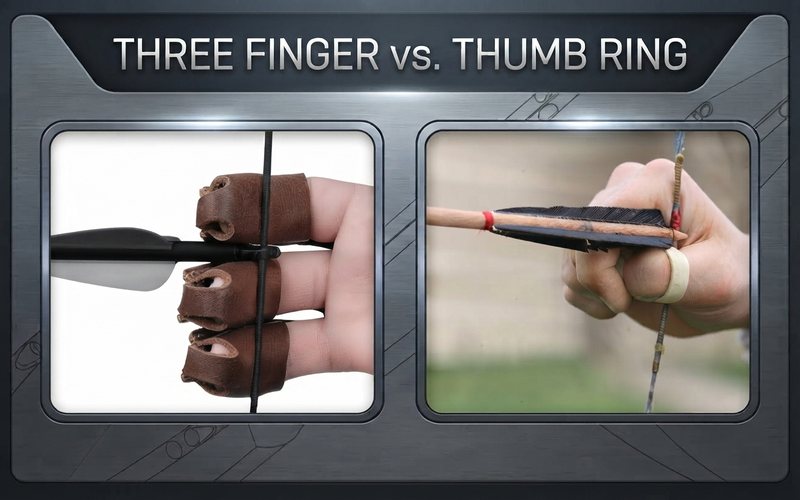
Thumb Ring or Three Fingers: Which Should You Shoot?
Short version first. Your bow, your discipline and where you hunt decide this faster than any technique argument on a forum.
| Your situation | Thumb ring | Three-finger (Med / 3-under) | Pick |
|---|---|---|---|
| Horsebow or recurve under 54″ | Clean release even at steep string angles | Nock pinch, ~2.5 fps drag loss, erratic nock height | Ring |
| Ground blind, seated shots | Arrow locked by thumb and index; short bow fits the window | Arrow can roll off the shelf on a counter-cant | Ring |
| Tree stand, whitetail at 5–25 yd | Works; bow side and arrow side flip (arrow on the right for a righty) | Works; every rest, shelf and plate on the market is built for it | Either |
| Barebow / string-walking scores | No crawl, no face-walk reference | 3-under + crawl is the whole system | Fingers |
| Olympic recurve with a sight | Not the norm; rest, plunger and clicker assume fingers | Split-finger tab, under-chin anchor | Fingers |
| Long draw on a mid-length bow | Ear anchor adds 1–2″ and ~8–12 fps per inch | Corner-of-mouth anchor caps your draw | Ring |
| Starting from zero, want groups this month | Steeper curve; the lock and release take weeks to settle | Every coach and club can fix your form | Fingers |
Green = thumb ring has the edge, orange = three fingers, gold = pick by habit. “Med” = Mediterranean (split finger: one finger above the nock, two below).
I think the thumb ring gets sold on the wrong claim. “Cleaner release, faster arrow” is mostly the anchor talking. Put a three-finger shooter at the same 30″ and the gap shrinks to the pinch loss — a couple of fps on a short bow, zero on a long one. The ring’s real case is short bows and blinds. Outside that, it’s a style choice, and a good one.
How Much Speed Would a Thumb Draw Add to My Bow?
Plug in your own bow. The calculator runs the same stored-energy model as the case study, applies the fps-per-inch rule to your thumb-draw gain, and checks both releases against the string-pinch zones explained further down.
How to use: set your bow’s marked weight, your arrow, your finger draw length and your tip-to-tip length. Move the thumb-draw slider to how much further your ear anchor reaches.
Modeled estimate for a traditional recurve or longbow. Draw weight is assumed to climb ~4.5% per inch past 28″; string angle uses the site-wide model (104° at 52″/28″, +1.75° per inch of bow, −2.5° per inch of draw). A chronograph beats every number here.
Run your full arrow speed model → Check pass-through on your game →
Under the hood: the five lines of math behind the calculator
Traditional limbs gain roughly 2–3 lb per inch; 4.5% of the marked weight per inch covers most 40–60# bows.
Stored energy × efficiency = arrow energy, then back to fps. Calibrated so the case-study bow returns exactly 178 fps.
The shop rule you set with the slider. The output also shows the pure stored-energy answer for the longer draw, so you can see how much of the gain the rule is claiming.
Full-draw string angle, the same model used across ArcheryEra. Fingers: low pinch at 118°+, moderate 111–118°, high 104–111°, severe below 104°. Thumb ring: low at 92°+, moderate 85–92°, high below 85°.
Zero on a comfortable bow, ~2.5 fps at a 52″ bow and 28″ draw, capped at 4 fps. 3-under takes 80% of that loss, since nothing sits above the nock.
Which Muscles Does a Thumb Draw Load Compared to Three Fingers?
The back does the pulling either way. Rhomboids and middle trapezius bring the shoulder blade toward the spine, and the posterior deltoid carries the elbow around. That part barely changes.
The hand is where the two releases split. A three-finger hook hangs the whole draw weight off flexor digitorum superficialis and profundus — the forearm muscles that curl fingers two through four. A thumb draw hands that job to flexor pollicis longus (the thumb’s own curl) and to the small muscles that clamp the index finger over the thumbnail.
One thing forums argue about: which finger locks the thumb. In the Mongolian lock the thumb tip presses against the middle finger with the index resting on top; in the Turkish and Manchu styles the index curls over the thumbnail. ATARN’s thumb ring FAQ teaches the index-over-thumb version. Both work. Pick one and never mix them mid-session, because the lock changes where the thumb opens.
The release is a different story too. EMG work on recurve archers by Ertan and colleagues (Human Movement Science, 2003) found that trained finger shooters don’t just relax — they actively fire the extensor digitorum while flexor digitorum superficialis lets go, and elite archers did it about 100 ms after the clicker versus ~200 ms for beginners. The thumb release swaps that for one joint opening. Fewer moving parts. Less to time.
What does that mean on the range? Two things. Fingers fatigue across three joints, so a long 3D course shows up as a creeping, stringy release. The thumb fatigues in one spot — the pad and the joint under the ring — so a badly fitted ring shows up as pain within 30 arrows, not as drift. ATARN’s thumb ring notes warn that the thumb swells after about ten shots, which is why a ring that fits snug when cold often bites by the second end.
Does a Thumb Ring Shoot Faster? The Speed Case Study
Yes — and the reason is draw length, not magic in the ring. To be clear about what the numbers are: 178 and 196 fps are a benchmark pair for a typical 55# hunting recurve, not a log from one afternoon on one chronograph. Everything else in this section is math you can check, and there’s a test you can run yourself right after it.
Benchmark setup
- One traditional bow, 55# marked at 28″, 60″ tip to tip (long enough that fingers don’t pinch)
- One 450 gr arrow for both releases: 8.2 gpp at the finger draw
- Three-finger Mediterranean, corner-of-mouth anchor: 28″
- Thumb ring, index-lock, extended ear anchor: 30″
How I checked the numbers
- Kinetic energy = grains × fps² ÷ 450,240
- Momentum = grains × fps ÷ 225,218
- Draw weight gains ~4.5% per inch past 28″ (55# → ~60# at 30″)
- Modeled stored energy (brace 7.5″, recurve curve factor 1.1) at a constant 61% efficiency
| Metric | 3-finger Mediterranean (28″) | Thumb ring (30″) | Change |
|---|---|---|---|
| Arrow speed | 178 fps | 196 fps | +18 fps (+10.1%) |
| Kinetic energy | 31.6 ft-lb | 38.3 ft-lb | +21.2% |
| Momentum | 0.356 slug-ft/s | 0.392 slug-ft/s | +10.1% |
| Draw weight at anchor | 55 lb | ~60 lb (modeled) | +5 lb |
| Stored energy | 51.7 ft-lb (modeled) | 61.8 ft-lb (modeled) | +19.6% |
| Grains per pound | 8.2 | 7.5 | lighter per pound |
| FPS per extra inch | 18 fps ÷ 2″ = 9 fps/inch | inside the 8–12 rule | |
Speeds are the benchmark pair this page is built on, not a single measured session. Draw weight, stored energy and the model check below are modeled.
Here’s the part the ring’s fans skip. Run the same bow to 30″ with no change in release at all and the stored-energy model lands at 194.6 fps. The benchmark shows 196. So about 16.6 of the 18 fps come from the two inches, and roughly 1.4 fps is left over for a cleaner exit. Small. Real, maybe. Not the headline.
The shop rule holds for this trad setup at ~9 fps/inch; compounds live toward the top of the range because the cam holds peak weight longer.
- Mark two arrows at full draw. Have a buddy mark the shaft at the back of the riser while you hold your finger anchor, then your thumb anchor. The gap between the marks is your real draw gain. Most people guess it wrong.
- Same arrow, same everything. One arrow weight, one bow, chrono 6–10 feet in front of the bow, indoors or with no wind.
- Five shots each, throw out the high and low. Average the middle three for fingers, then for thumb.
- Predict before you look. Gain in inches × 9 fps. If your thumb number beats the prediction by more than 2–3 fps on a bow under 56″, you’re probably seeing finger pinch go away. On a long bow, it should land within a couple of fps.
Send your numbers through the contact page. Real readings from real bows are how this benchmark gets replaced.
I’m a mechanical engineer, and the first thing I did with the 178/196 pair was try to break it. If a thumb ring really added 18 fps on its own, something would have to store more energy or hand more of it to the arrow — and a ring touches neither the limbs nor the string’s mass. Draw length does both. That’s why this page leans on the stored-energy model: it’s the one part of the argument you can check with a pencil, and it put 16.6 of the 18 fps on the extra two inches.
The assumption I trust least is the one holding that math up: a flat 61% efficiency and a draw weight that climbs a steady 4.5% per inch. Real limbs aren’t that polite past their rated draw — a longbow can start to stack, a good recurve can get more efficient — so the 1.4 fps “release bonus” sits inside the model’s error, and I wouldn’t bet on its sign. If you run the test above, don’t fixate on the speed gap. Watch whether it tracks your marked draw gain at about 9 fps an inch. If it does, the ring is a draw-length tool. If it runs well past that on a short bow, the pinch story is bigger than this page gives it credit for.
What Does +21% Kinetic Energy Mean at the Deer?
Less than the headline suggests. Kinetic energy rises with speed squared; momentum, which tracks penetration better, rises in a straight line. So +21% KE is really +10% push. I ran both arrows through the same penetration model the site’s pass-through calculator uses: feather fletching, 12% FOC, broadside, 20 yards.
| At 20 yards | Impact speed | KE | Deer (vitals 9″, through 15″) | Elk (vitals 14″, through 22″) |
|---|---|---|---|---|
| 3-finger, 3-blade fixed | 162 fps | 26.2 ft-lb | 14.9″ · sufficient, 0.1″ shy of through | 11.6″ · insufficient |
| Thumb ring, 3-blade fixed | 178 fps | 31.7 ft-lb | 16.4″ · pass-through | 12.8″ · insufficient |
| 3-finger, 2-blade cut-on-contact | 162 fps | 26.3 ft-lb | 19.4″ · pass-through | 15.2″ · sufficient |
| Thumb ring, 2-blade cut-on-contact | 179 fps | 31.9 ft-lb | 21.3″ · pass-through | 16.7″ · sufficient |
Modeled relative penetration (site ballistics model: momentum × head factor × FOC factor). A ranking tool, not a promise about any animal.
Read that table sideways, not down. Switching releases moved the deer line by 1.5″. Switching from a 3-blade to a 2-blade cut-on-contact head moved it by 4.5″. If penetration is the goal, the broadhead decision is three times bigger than the release decision. Set the arrow build first with the arrow weight calculator, then argue about thumbs. And for elk, I wouldn’t hunt this 450 gr arrow off a 55# stick with either release: most traditional elk builds run 10 gpp or heavier for a reason, and the table shows why.
Why Do Three Fingers Pinch the Nock on Short Bows?
Because the string folds into a sharper angle at full draw, and three fingers stacked around the nock sit on both legs of that angle. The shorter the bow and the longer the draw, the harder the fingers squeeze the nock between them. The arrow bows off the rest. Nock height wanders. Speed drops.
A thumb ring touches the string at one spot, under the nock. There is nothing above the nock to squeeze it.
In the benchmark’s terms, a three-finger hook on a bow under about 52″ loses ~2.5 fps to finger drag: skin or leather dragging along a string that is trying to snap forward at a steep angle. That’s small next to the anchor effect, but it arrives with worse things — nock pinch, a porpoising arrow, and a release that feels different every shot.
How Much Does Contact Area Change String Torque?
A thumb ring loads the string on a strip roughly 1.5 cm². A three-finger hook, tab or glove spreads it across 12–15 cm². That’s about 8–10× more material dragging on the string as it leaves.
Three fingers: big contact, big lever
- Contact spread over ~2″ of string, above and below the nock.
- Any uneven finger pressure twists the string — the classic source of left-right misses.
- At 60 lb (~267 N) holding weight: ~18–22 N/cm² on the tab. Comfortable.
Thumb ring: small contact, short lever
- One edge, one release point, one direction the string rolls off.
- Less surface to drag, so less string torque at the release.
- Same 267 N on ~1.5 cm²: ~178 N/cm² on the ring — why the ring has to be rigid and fitted.
That pressure number is the one beginners feel. It’s the reason a leather ring on a 60# bow is a bad idea for your thumb, and why horn, bone, brass and hard polymer rings dominate at higher weights.
How Do Thumb Ring and Three Fingers Compare in a Tree Stand or Blind?
This is where the choice stops being academic. A whitetail at 14 yards gives you one draw.
| Stealth factor | Thumb ring | Three-finger | Edge |
|---|---|---|---|
| Arrow security while waiting | Arrow sits in the thumb–index crotch, locked by the hand | Arrow rests on the shelf; a bump or a counter-cant rolls it off the rest | Ring |
| Short bow in a blind window | 48–54″ bows shoot clean with no pinch | Pinch forces a longer bow; limb tips hit the roof or window | Ring |
| Seated, twisting shot | Arrow sits right of the riser; a left tip leans it into the riser | A left tip (counter-cant) puts the arrow on the downhill side of the shelf | Ring |
| Draw motion | Longer draw path to an ear anchor: more movement | Shorter draw to corner of mouth | Fingers |
| Release noise | Hard rings can tick the string; leather-lined is silent | Calf-hair or leather tab is near silent | Even |
| Arrow side | Right side of the bow for a righty (left-hand bow side) | Left side on a standard shelf or rest | Habit |
| Follow-up shot | Nock, lock, draw: slower until trained | Nock, hook, draw: familiar to most | Fingers |
Can You Shoot a Thumb Ring With Gloves in Cold Weather?
Yes, with a fitting caveat. A ring sized to a bare thumb won’t fit over a glove, and a ring sized over a glove rolls when you take the glove off. Two setups make sense for a cold sit:
- Thin liner glove + a ring sized over it. The fit stays the same from first light to last, which is the whole point. Practice in that glove before the season.
- Leather-lined or leather tab-style ring worn over a fingerless glove, so the thumb pad sees leather, not frozen brass.
Three fingers have the easier winter. A tab slips over a glove. A shooting glove is a glove. The catch: numb fingertips release late and uneven, and three numb fingertips are worse than one numb thumb. Metal rings also get painfully cold — horn, bone and polymer hold body heat far better.
- Avoid if your season opens in six weeks. Plan on a full off-season before the thumb draw is hunt-ready.
- Avoid if you shoot a shelf-cut right-hand bow and aren’t ready to shoot off the hand on the “wrong” side.
- Avoid if you compete in barebow or Olympic recurve divisions. Check your division rules before you show up with one.
How Do I Switch to a Thumb Ring Without Wrecking a Season?
Treat it like learning to shoot again, because the hand is new, the arrow side is new and the tune is new. Here’s the order I’d do it in.
- Get a light bow first. 25–35# for the first month. Your thumb pad and the lock need to learn before your back does.
- Size the ring warm. Shoot ten arrows with fingers or a loose ring, then fit it. It should rotate with effort and never slide off; the lip sits under the pad, not the joint.
- Put the arrow on the right side (right-handed). A center-shot or ambidextrous riser makes this easy; a right-hand shelf bow means shooting off the top of your bow hand, which works but takes clearance tuning.
- Blank bale at 5 yards for two weeks. Eyes closed on some shots. You’re grooving the lock and a clean thumb opening, not groups.
- Start stiff, then tune. The string leaves toward the other side now, so bare-shaft reads flip, the same way a left-handed finger shooter’s do. Reset your nocking point, then walk the spine back with the recurve arrow spine calculator at your new, longer draw.
- Measure the new draw length with a marked arrow and check that your arrows are still long enough. Two extra inches will pull a 29″ arrow off the shelf.
- Move back and up in weight only when groups hold at 15 yards. For most people that’s weeks, not days. That’s why the warning above says off-season.
Signs the ring doesn’t fit
- A sore spot at the thumb joint after 20–30 arrows
- The ring spins during the draw
- String slap on the thumbnail or the bow-hand thumb
Signs the switch is working
- The thumb opens the same way shot after shot
- Bare shafts group with fletched at 15 yards
- You stop thinking about the lock at full draw
How Do Thumb Ring and Three Fingers Compare Point by Point?
| Criterion | Thumb ring | Mediterranean (split) | 3-under |
|---|---|---|---|
| String torque | Lowest: one ~1.5 cm² contact edge | Highest: 12–15 cm², uneven pressure twists the string | High, but the nock sits free above the index finger |
| Short A2A compatibility | Excellent down to ~48″ horsebows | Poor under ~54″; severe pinch under ~52″ at 28″ | Fair; less nock pinch, but the ring finger rides a steep string |
| Learning curve | Steep: ring fit, index lock, off-the-hand arrow, new aim picture | Gentle: the default most coaches teach | Gentle to moderate; crawls add a layer |
| Draw length capacity | +1–2″ with an ear or behind-the-ear anchor | Corner-of-mouth or under-chin; fixed by face | Same face anchors, eye closer to the arrow |
| Arrow security | Locked in the thumb–index crotch | Held by finger pressure against a shelf or rest | Same as split; slightly better nock control |
| Cold-weather usability | Good with a liner glove and a ring sized over it; metal rings run cold | Good: tab over glove, or a shooting glove | Good: same gear as split |
| Spine sensitivity | Lower; thumb shooters report arrows need to be stiff, not exact | High: archer’s paradox rewards exact dynamic spine | High |
| Aiming reference | Instinctive or gap; arrow on the far side changes the sight picture | Gap, instinctive, sight | Point-on and string-walking; eye right over the arrow |
- Sentiment: the ring gets discussed as a horsebow and Asiatic-bow skill, not as an upgrade for a shelf recurve. The threads that go well are the ones where the shooter changed the bow, the arrow side and the tuning together.
- Top praised: the clean, forgiving release. On ArcheryTalk’s thumb release thread, the point that keeps coming up is that the arrow leaves toward the brace-height line with no finger roll, so exact spine matters less.
- Common friction: arrow clearance on wide, shelf-cut handles and the aim picture with the arrow on the “wrong” side. Long-draw shooters trade anchor notes in PrimitiveArcher’s long-draw thumb anchoring thread; the catch nobody escapes is that 2 extra inches on a bow built for 28″ can push a self bow or longbow into stack.
Brass, Horn or Leather Ring — or Should You Keep a Tab?
Pick the ring by draw weight and climate, not by looks. The table sorts it.
| Gear | Best for | Strength | Trade-off |
|---|---|---|---|
| Brass / metal flat or lipped ring | Heavier bows, 50#+ horsebows | Rigid, thin, crisp release edge; lasts forever | Cold in winter; can tick on the string; zero give for a swelling thumb |
| Horn or bone lipped ring (Turkish/Asiatic style) | Traditional thumb draw, any weight | The lip protects the thumb pad; warm to the touch | Hand-fitted; a sloppy fit hurts within 30 arrows |
| Cylindrical ring (Chinese/Manchu style) | Lighter bows, form work | Easy to fit and rotate; forgiving to learn on | Less pad protection at higher weights |
| Leather or leather-lined ring | Beginners, under ~40#, cold sits | Silent, warm, adjustable | Compresses and grooves; soft release edge |
| Hard polymer / 3D-printed ring | Fit testing before a horn or brass ring | Easy to size in steps; light | Edge wears faster than brass or horn |
| Mediterranean split-finger tab | Olympic recurve, general trad | Consistent face, finger spacer, the target standard | Nock pinch on short bows |
| 3-under / string-walking tab | Barebow, face-walking | Crawl stitches give repeatable gaps | Only pays off if you actually crawl |
| Shooting glove | Instinctive hunters, cold mornings | Always on, doubles as a glove | Grooves in, and the release changes as it does |
First thumb ring? Size it after ten warm-up shots, when the thumb has swelled, and keep the thumbnail short — the index lock sits right behind it. For the history behind each style, the Eastern thumb ring traditions are worth an evening. And if you’re picking the bow too, the Mongolian bow vs English longbow breakdown covers the bows the ring was built for, while the bow size calculator tells you how short you can go on fingers.
Our final take: the thumb ring wins on short bows and in blinds, and its speed gain is really a draw-length gain. Three fingers win anywhere scores, sights or string-walking matter.
👉 Recommendation: if your bow is 60″ or longer and you anchor where you want, keep your tab and spend the effort on your aiming system. If you hunt a sub-54″ recurve or a horsebow, or your anchor already feels cramped, give a fitted horn or brass ring one off-season.
What Is the Bottom Line on Thumb Ring vs Three Fingers?
The benchmark gap is real — 178 vs 196 fps, 31.6 vs 38.3 ft-lb — but about 92% of it comes from two extra inches of draw. The release itself buys you a clean exit and freedom from string pinch below ~52″. Decide on the bow first, then the hand. Size a longer-draw trad setup with the draw length by height guide, and re-spine for the heavier effective weight with the recurve arrow spine calculator.
Frequently Asked Questions
Does a thumb ring make arrows faster than three fingers?
Only indirectly. In the benchmark case a 55# bow sent a 450 gr arrow at 178 fps on three fingers (28″ draw) and 196 fps on a thumb ring (30″ ear anchor). A stored-energy model puts about 16.6 of those 18 fps on the two extra inches of draw. The release itself adds a cleaner exit and, on short bows, avoids roughly 2.5 fps of finger drag.
How much faster is each extra inch of draw length?
Roughly 8 to 12 fps per inch. The case-study trad bow gained 9 fps per inch; compounds usually sit toward the top of the range. On a traditional bow the extra inch also adds about 2–3 lb of draw weight, so check arrow spine after a big anchor change.
What bow length causes string pinch with a three-finger release?
It depends on draw length. With the site-wide string-angle model, a 28″ draw moves into the severe finger-pinch zone below about 52″ tip to tip, and a 30″ draw gets there below about 55″. Bows around 60″ and longer are comfortable for most finger shooters at 28″.
Is a thumb ring better for bowhunting?
In ground blinds and with short horsebows or recurves, often yes: the arrow is held by the hand instead of a shelf, it sits on the side that a counter-cant presses into the riser, and a 48–54″ bow shoots clean. From a tree stand with a longer bow, three fingers work just as well and are faster to learn.
Is Mediterranean or 3-under better than a thumb ring?
For scoring, yes. Split-finger suits sights and under-chin anchors; 3-under is the base of string-walking barebow. A thumb ring gives no crawl or face-walk reference, so it fits instinctive and gap shooting, not those systems.
Can you shoot a thumb ring with gloves on?
Yes, if the ring is sized over the glove you will actually wear. A thin liner glove with a ring sized over it, or a leather-lined ring over a fingerless glove, are the common cold-weather setups. Metal rings get cold; horn, bone and polymer stay warmer.
Do I need different arrows for a thumb ring?
Usually a stiffer spine and sometimes longer shafts. The thumb draw adds 1–2″ of draw and 2–5 lb of holding weight on a traditional bow, and the string leaves toward the other side, so bare-shaft reads flip like a left-handed finger shooter's. Start stiff, reset the nocking point and re-tune.
Is a thumb ring the same as a thumb release?
No. A thumb ring is worn on the thumb to hook a traditional bow's string by hand. A thumb release is a thumb-button mechanical release aid for compound bows that clips to a D-loop.
What thumb ring material should a beginner buy?
Start with something easy to size, such as leather or a hard polymer ring, on a light bow. Move to a fitted horn, bone or brass ring once the index lock is consistent and your draw weight passes about 40 lb, since the ring carries roughly 8–10 times the pressure a tab does.
Hey, what's up? Burak here. Archery addict, board game geek, Daft Punk fan.