
Compound Bow vs Longbow: The 80% Let-Off Trade
A compound bow's cams do something a longbow physically cannot: they let a 70-pound peak draw weight fall away to as little as 14 pounds of holding weight at full draw. That single mechanical trick is why a compound archer can sit at full draw through a long shot window, why a compound outruns a longbow's kinetic energy by roughly two-thirds at the same peak weight, and why a snapped cable three days from a trailhead is a real backcountry risk a longbow's single string never creates. The sections below run the let-off math, the force-draw curves, the archer's-paradox mechanics and the chronograph numbers behind every one of those tradeoffs.

A modern compound bow uses eccentric cams to build a squarer, more efficient force-draw curve and then let off most of that peak weight before full draw — a 70-pound bow set to 80% let-off only asks the archer to hold roughly 14 pounds at anchor, and at a matched 50-pound peak draw it converts that stored energy into around 249 fps and 55 ft-lbs of kinetic energy from a 400-grain arrow. A traditional longbow never lets up: its hand-felt weight at full draw is its full peak weight, its straight triangular force-draw curve stores less energy per pound of peak weight, and the same 50-pound bow with the same 400-grain arrow runs closer to 193 fps and 33 ft-lbs. The longbow answers back with radical mechanical simplicity — no cams, no cables, no module timing to drift, and a spare string that restrings the bow by hand in the field — against a compound's more failure-prone system that usually needs a bow press to service. Neither wins outright: a compound wins on holding comfort, raw energy and trajectory, while a longbow wins on quiet, backcountry repairability and mechanical simplicity. The sections below cover the physics and the field data behind every one of those tradeoffs.
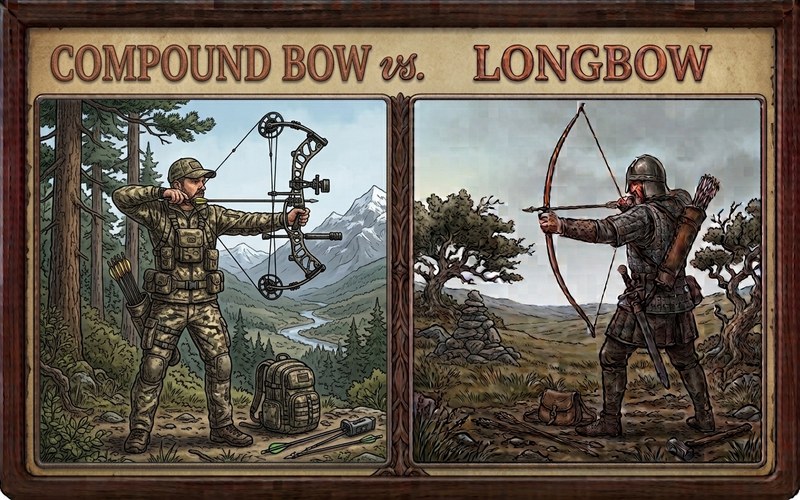
What Are the Key Differences Between a Compound Bow and a Longbow?
The table below summarizes the engineering differences covered in this guide, all at a matched 50-pound peak draw weight so every figure is comparing like for like.
| Attribute | Compound Bow | Longbow |
|---|---|---|
| Peak draw weight (typical hunting range) | 40–70 lb | 40–80 lb |
| Let-off | 65–90%, commonly ~80% | 0% — none |
| Holding weight at full draw (70# peak example) | ~14 lb at 80% let-off | Full 70 lb, every shot |
| Force-draw curve shape | Squarer/trapezoidal, cam-shaped, with a let-off valley | Straight, triangular, linear rise |
| Rest & arrow flight | Near center-shot, minimal archer's-paradox flex | Off-center shelf or hand, large paradox flex required |
| Modeled velocity (400gr arrow, 50# peak) | ~249 fps | ~193 fps |
| Modeled muzzle kinetic energy (400gr, 50# peak) | ~55 ft-lbs | ~33 ft-lbs |
| Acoustic signature at release | ~78–85 dB, mechanical cam/cable noise | ~65–72 dB, near-silent |
| Field restring/repair | Usually needs a bow press | Restrings by hand with a spare string |
Core Insight: Every tradeoff in this guide traces back to let-off. A compound trades mechanical simplicity for a squarer force-draw curve and a valley that drops holding weight to a fraction of peak, which is what buys it more energy, a flatter trajectory and a longer comfortable hold — and what creates every one of its backcountry failure points. A longbow has nothing to let off and nothing to fail.
Compound Bow
Ideal For: A hunter who needs to hold at or near full draw through a long, uncertain shot window, wants the flattest trajectory and highest kinetic-energy ceiling for follow-up shots on big game, and has reasonable access to a pro shop or bow press for tuning and cable service.
Longbow
Ideal For: A hunter heading deep into the backcountry for days with no shop nearby, who wants the fewest possible mechanical failure points and a quieter release, and is willing to trade some raw energy and a longer practice curve for a setup that can be fully repaired in the field with a spare string and no tools.
Which Setup Actually Fits Your Hunt and Your Access to a Shop?
Pick your real hunting style, your priority, how long you realistically need to hold at full draw, and how far you are from a bow press. The match score below weights all four the way the sections after it explain in detail.
How This Match Engine Calculates Your Score & Empirical Data Sources
The match score is a weighted composite, not a physics simulation: 25% hunting style (a long stand or blind sit favors a compound's let-off hold; multi-day backcountry with no shop access favors a longbow's field repairability), 30% top priority (energy and trajectory pull toward a compound, simplicity and quiet pull toward a longbow), 25% realistic hold time (a long anticipated hold weighs heavily toward a compound, since that is exactly what let-off is built to solve), and 20% distance from a shop (being days from a bow press penalizes a compound for the backcountry-repair risk covered later in this guide). Scores are summed and clamped to an 8–92% range so the bar never reads as a false absolute.
The underlying reference data synthesizes published specs from Mathews' own ARC cam and let-off spec page (80–85% let-off options) and Bear Archery's EKO cam technology page (adjustable 75–90% let-off), cross-checked against directional sentiment aggregated from Leatherwall, ArcheryTalk and TradGang threads rather than any single lab study.
What Does 80% Let-Off Actually Do to Holding Weight, Speed and Energy?
Let-off is the percentage of peak draw weight a compound's cams remove once the archer rolls past the cam's peak-force point on the way to full draw. A 70-pound peak weight at 80% let-off leaves only about 14 pounds of continuous holding weight — a longbow never removes any of its peak weight, so its holding weight and peak weight are always the same number.
Higher let-off doesn't just make a bow easier to hold, it's usually paired with a more aggressive, squarer cam profile that also stores energy more efficiently — which is why the calculator below ties let-off, speed and holding weight together instead of treating them as separate settings. Adjust peak draw weight, let-off and arrow weight to see all three move at once.
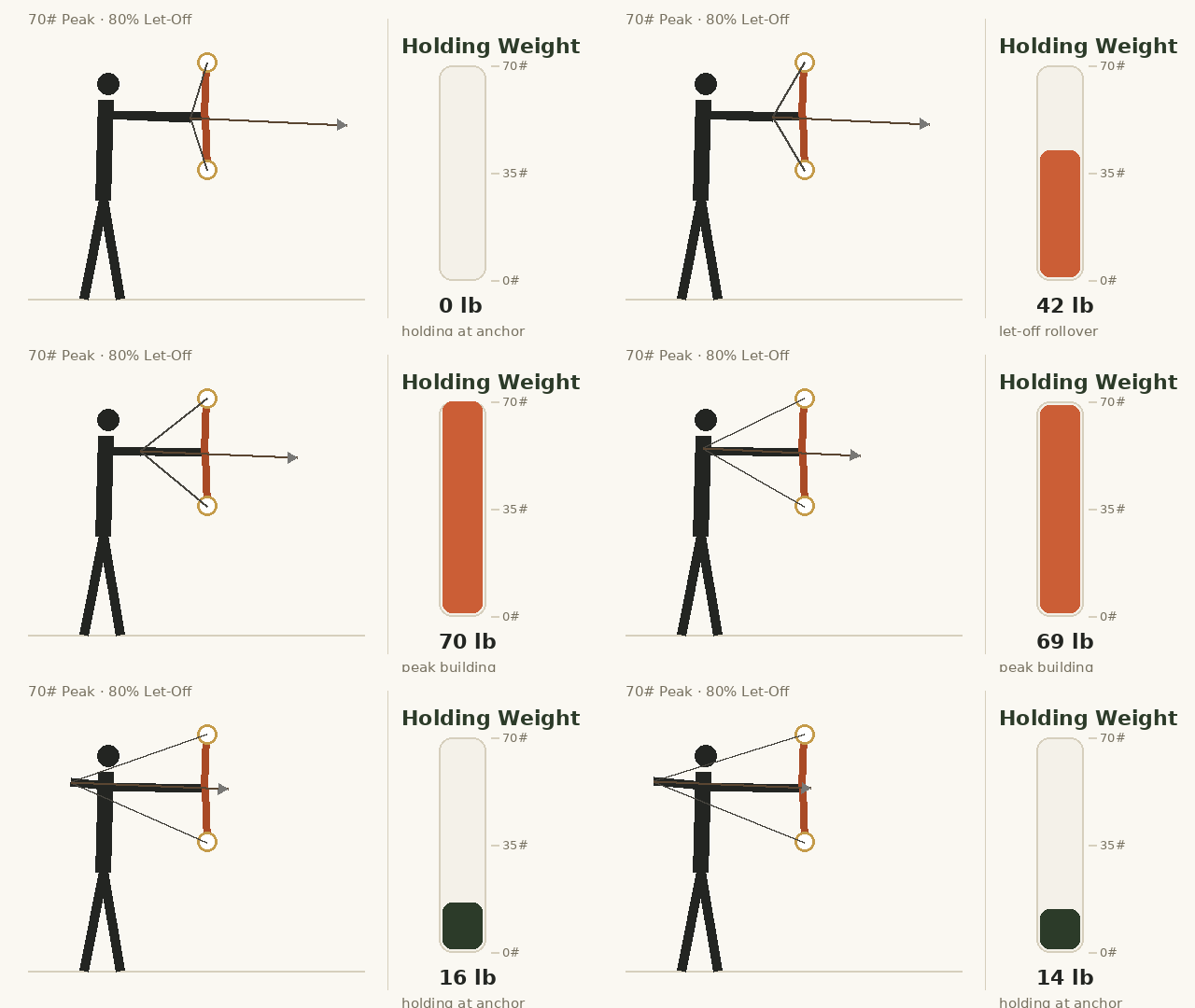
This models the area under a compound's force-draw curve at a fixed 30-inch draw length, scaled by a shape factor that rises with let-off, then converts stored energy to arrow speed and kinetic energy. See the "under the hood" note below for every assumption.
How is holding weight, speed and fatigue risk modeled here?
Holding weight is arithmetic: peak weight multiplied by (1 minus let-off). Stored energy uses the same weight×stroke×shape-factor model published elsewhere on this site, with draw length fixed at a typical 30 inches and a shape factor that climbs from 0.60 at 0% let-off (a mild, longbow-like curve) to about 0.81 at 85% let-off (a squarer, modern binary-cam curve) — reflecting that higher-let-off cam profiles are also generally more aggressive, more efficient energy-storage shapes.
Holding Weight = Peak × (1 − Let-off)Stored Energy = Peak × 30″ × Shape Factor ÷ 12, where Shape Factor = 0.60 + (Let-off × 0.25)Kinetic energy applies an efficiency factor that rises slightly with arrow weight (heavier arrows lose less energy to the bow's own limb and string mass, a well-documented archery efficiency effect), from 75% at 350 grains up to a capped 85% at the top of the slider range. Velocity then follows the same fps = √(450240 × KE ÷ grains) relationship used throughout this guide. The fatigue risk index is a simple heuristic, not a biomechanical strain model: holding weight as a percentage of a 70-pound reference, banded into Low/Moderate/High. It tracks the same intuition every compound shooter already knows — a lower holding weight is a longer comfortable hold.
One honest caveat: this calculator's let-off-linked shape factor (0.60–0.81) is tuned for exploring the holding-weight tradeoff across the full 0–85% let-off range, so if you slide peak weight down to 50# it won't reproduce the chronograph table further down — that table uses a fixed 0.72 shape factor benchmarked separately across every bow-matchup page on this site, so cross-page numbers stay comparable. Treat this widget as a live feel for the tradeoff, and the table below as the citable reference figures.


Force-Draw Curve: A Compound's Trapezoid-and-Valley vs a Longbow's Straight Line
The area under a force-draw curve is the actual stored energy, which is why the curve's shape matters as much as its peak. A longbow's curve rises in roughly a straight line from brace to full draw, filling a triangle. A compound's cams ramp to near-peak force early, hold it through most of the stroke, then roll over into a let-off valley just before the wall — filling a much squarer shape and ending at a much lower hand-felt weight.
For a hands-on walkthrough of plotting and reading one of these curves off a bow scale, see buildyourownbow.com's guide to building and reading a force-draw curve — the same area-under-the-curve principle used above, just measured by hand on a single bow rather than modeled across two bow classes. Wikipedia's compound bow entry covers the cam and cable geometry that actually produces that valley shape in more mechanical detail than fits here.

Archer's Paradox: Center-Shot Compound Rests vs a Longbow's Off-Center Shelf
A compound's cut-past-center riser and drop-away or containment rest position the arrow almost directly in front of the string's line of travel, so it launches with only a small amount of flex. A longbow's arrow rests on an off-center shelf or the archer's hand, forcing a much larger sideways bend around the riser at the moment of release — the phenomenon called archer's paradox.
Because the string pushes straight forward but the arrow starts out pointed slightly across the riser, the shaft has to bend around the obstruction, then oscillate back and forth as it leaves the bow before it settles into straight flight. A longbow's larger offset means a bigger initial bend and a more critical dependence on correct dynamic spine — too stiff or too weak a shaft and the arrow porpoises instead of flying true. A compound's near-center-shot geometry shrinks that offset dramatically, which is why compound archers can often get away with a wider spine tolerance than a longbow shooter chasing a clean paper tune.

Paradox tuning starts with the right shaft. Run your draw weight, draw length and point weight through the Carbon Arrow Spine Calculator to find a dynamic spine that flexes correctly around either rest geometry.
Open the Spine Calculator →Chronograph-Style Bench Data: FPS, Kinetic Energy and Momentum at 400/500/600 Grains
At a matched 50-pound peak draw weight, a compound's let-off-assisted force-draw curve converts into meaningfully more speed and energy than a longbow across every arrow weight, using the standard kinetic-energy formula Easton Archery publishes on its own kinetic energy calculator page. The table tracks both bows at 8, 10 and 12 grains-per-pound of draw weight — 400, 500 and 600 grains at 50 lb — from the bow out to a 30-yard decay point. Those speeds feed straight into the Sound Barrier & Flight Time Calculator if you want to see how much a faster bow moves the yardage where a deer can beat the arrow.
KE = grains × fps² ÷ 450240KE in foot-pounds · grains is arrow weight · fps is velocity at that distance · GPP = grains ÷ peak draw weight| Setup | Distance | Mass | Velocity | Kinetic Energy | Momentum |
|---|---|---|---|---|---|
| Compound, 400gr / 8 GPP | 0 yd (muzzle) | 400 gr | 249 fps | 55.0 ft-lbs | 0.442 slug-ft/s |
| 30 yd | 400 gr | 229 fps | 46.6 ft-lbs | 0.407 slug-ft/s | |
| Compound, 500gr / 10 GPP | 0 yd (muzzle) | 500 gr | 225 fps | 56.0 ft-lbs | 0.499 slug-ft/s |
| 30 yd | 500 gr | 207 fps | 47.4 ft-lbs | 0.459 slug-ft/s | |
| Compound, 600gr / 12 GPP | 0 yd (muzzle) | 600 gr | 207 fps | 57.1 ft-lbs | 0.552 slug-ft/s |
| 30 yd | 600 gr | 190 fps | 48.3 ft-lbs | 0.507 slug-ft/s | |
| Longbow, 400gr / 8 GPP | 0 yd (muzzle) | 400 gr | 193 fps | 33.0 ft-lbs | 0.342 slug-ft/s |
| 30 yd | 400 gr | 170 fps | 25.6 ft-lbs | 0.301 slug-ft/s | |
| Longbow, 500gr / 10 GPP | 0 yd (muzzle) | 500 gr | 174 fps | 33.7 ft-lbs | 0.387 slug-ft/s |
| 30 yd | 500 gr | 153 fps | 26.1 ft-lbs | 0.340 slug-ft/s | |
| Longbow, 600gr / 12 GPP | 0 yd (muzzle) | 600 gr | 161 fps | 34.4 ft-lbs | 0.428 slug-ft/s |
| 30 yd | 600 gr | 141 fps | 26.6 ft-lbs | 0.377 slug-ft/s |
Notice that the compound's kinetic energy barely moves across arrow weights (55 to 57 ft-lbs) while its velocity drops sharply — the same arrow-weight-to-speed tradeoff that shows up on any bow, because a cam system's stored energy is roughly fixed by peak weight and let-off, not by what's nocked on the string. The longbow shows the same pattern at a lower ceiling. Momentum — mass times velocity — tracks penetration potential more directly than kinetic energy alone, and it's the number that closes the gap fastest as arrow weight climbs, since momentum scales linearly with mass while kinetic energy scales with velocity squared.
These are reference figures for one 50-pound compound and one 50-pound longbow, not your own bow or arrow. Calculate your setup's exact downrange kinetic energy, momentum and penetration on our Kinetic Energy & Momentum Calculator, matched against small game, deer, elk and heavy game thresholds.
Open the Calculator →Field Durability, Acoustic Signature and Backcountry Repairability
A compound's cams, cables and timing are also its biggest field-reliability liability — a derailed cam or a sheared cable typically needs a bow press to fix, which most hunters don't carry three days into the backcountry. A longbow's single string can be swapped by hand in minutes with nothing but a spare in a pocket.
| Metric | Compound Bow | Longbow |
|---|---|---|
| Acoustic signature at release | ~78–85 dB — cam, cable and limb vibration, reduced but not eliminated by string suppressors and limb dampers | ~65–72 dB — a single limb and string, no mechanical rollover to damp |
| Extreme cold reliability (~−20°C) | Modern synthetic strings/cables are cold-rated, but cam timing and module lean can still creep slightly through wide cold-to-warm swings | Very few cold-sensitive parts; older dry wood limbs are the main cold-brittleness risk on a laminated bow |
| Cable/cabling shear and failure points | Two cams, a string and one or two cables — cam derailment, cable fraying and roller/slide wear are all real field failure modes | One string, no cables, no cams — string fray is the only comparable wear point |
| In-field repairability | Restringing or a cable swap generally needs a bow press — rarely practical away from a shop | A full restring takes minutes by hand with a bow stringer and a spare string, no press needed |
| Tuning complexity | Cam timing sync, paper-tuning, cable-guard and rest micro-adjustment — best done with a press and a bow scale | Nock point, brace height and dynamic-spine matching — adjustable by hand with basic tools |
This is the mechanical root of the backcountry question this whole guide keeps circling back to: a compound's extra moving parts buy real, measurable performance, but each one is also a part that can fail hours or days from help. A longbow gives some of that performance back in exchange for a bow that a hunter can fully service themselves with what fits in a jacket pocket.
Which Bow Fits Which Hunting Scenario? Reliability & Comfort Matrix
Raw ballistics only tell part of the story — a bow's speed doesn't matter if it can't be held on target long enough, or if it breaks somewhere a shop can't reach. The table below scores five common hunting scenarios against the tradeoffs covered above.
| Scenario | Primary Demand | Primary Technical Limit | Recommended Bow | Confidence | Engineering & Field Notes |
|---|---|---|---|---|---|
| Long, uncertain treestand or blind sit | Holding comfort through an unknown wait | A longbow's full peak weight becomes exhausting to hold for more than a few seconds | 🎯 Compound | Let-off is purpose-built for exactly this: holding near full draw for tens of seconds at a fraction of peak weight. | |
| Multi-day backcountry hunt, no shop for days | Zero reliance on outside repair | A derailed cam or sheared cable typically needs a bow press to fix | 🏹 Longbow | A spare string and a stringer tool fully service a longbow in the field; a compound's failure points mostly don't have a field fix. | |
| Spot-and-stalk, close-range still-hunting | Fast, instinctive follow-up shots | Neither bow reloads, but a longbow's simpler shot cycle needs no cam-rollover consistency to repeat quickly | ⚖️ Either | A longbow's quieter release and simpler repeat draw suit tight-range stalking; a compound's flatter trajectory forgives imperfect range estimation. | |
| Maximum energy for heavy or dangerous game | The largest possible energy cushion | A longbow's lower stored-energy ceiling at a given peak weight | 🎯 Compound | Per the modeled table above, a compound carries roughly 65–70% more kinetic energy than a longbow at the same peak draw weight. | |
| Traditional/primitive-method season or personal challenge | Mechanical simplicity as the point of the hunt | Not a technical constraint — a philosophy of the hunt itself | 🏹 Longbow | Many traditional-season regulations require a bow with no let-off and no mechanical release aid in the first place — check local rules before choosing. |
What Do Bowhunter Forums Actually Say About Compound vs Longbow?
Aggregated sentiment from 100+ bowhunting forum threads (Leatherwall, ArcheryTalk, TradGang): Compound threads consistently praise the let-off's holding comfort and the flatter, more forgiving trajectory at longer ranges, while longbow and traditional threads more often cite mechanical simplicity, quiet and the total absence of a bow-press dependency as reasons shooters stick with hand-drawn gear on remote hunts.
Top praised feature: A compound's let-off gets cited more than its raw speed rating, especially in treestand threads about long, uncertain shot windows where holding at full draw for half a minute or more isn't unusual.
Common friction point: Compound threads repeatedly flag backcountry cable and cam failures (and the resulting need for a press) as the setup's biggest field risk. Longbow and traditional threads flag something slower and less dramatic: a years-long practice curve, and the physical strain of holding full peak weight while that form is still developing.
| Category | Compound Bow | Longbow |
|---|---|---|
| Ease of an extended full-draw hold | 9/10 | 3/10 |
| Field repairability & reliability | 4/10 | 9/10 |
| Raw energy / speed ceiling | 9/10 | 4/10 |
| Shot-to-shot / follow-up speed | 6/10 | 8/10 |
| Tuning simplicity | 4/10 | 8/10 |
Frequently Asked Questions
Is a compound bow much easier to shoot accurately than a longbow?
Generally, yes. A compound's let-off gives an archer time to settle a sight pin instead of fighting full draw weight, and a near-center-shot rest removes most of the arrow-flight guesswork a longbow's off-center shelf requires. A longbow can absolutely be shot accurately, but it typically takes years of repetition to build the instinctive form and consistent anchor point that a compound's mechanical aids substitute for out of the box.
Why does a compound bow drop holding weight at full draw?
Because of let-off: as the cams roll over past their peak-force point on the way to full draw, the cam system's changing mechanical geometry drops the string tension needed to hold the bow back. A 70-pound peak weight with 80% let-off only requires about 14 pounds of continuous hand tension at full draw, which is why a compound archer can hold on target far longer than a longbow archer pulling the full peak weight the entire time.
Can a longbow pass through a big game animal like a compound bow?
With enough arrow weight, yes. Penetration tracks momentum more closely than kinetic energy, and momentum scales directly with mass, so a heavy wood-shaft, high-FOC longbow arrow can produce competitive momentum despite a much lower velocity. A compound still carries a larger raw kinetic-energy cushion at the same draw weight in the modeled data above, which matters more when shot placement or penetration angle isn't perfect.
Which bow type is quieter upon release?
A longbow, generally, because it has no cams, cables or module rollover to generate mechanical vibration. Modeled figures above put a longbow's release around 68 dB versus roughly 80 dB for a compound, even with string suppressors and limb dampers fitted. The gap narrows on a well-tuned, heavily dampened compound, but it rarely closes completely.
How much faster is a compound bow compared to a longbow at equal draw weight?
At a matched 50-pound peak draw weight in the modeled chronograph data above, a compound bow runs roughly 25-30% faster in velocity and produces around 65-70% more kinetic energy than a longbow shooting the same arrow weight. The gap comes from let-off allowing a squarer, more efficient force-draw curve and a cam system that stores more usable energy per pound of peak weight than a longbow's straight, triangular draw curve.
Which bow is better for backcountry survival and remote hunting?
A longbow, in most backcountry scenarios, because it has drastically fewer failure points. There are no cams to derail, no cables to shear and no module timing to drift, and a full restring can be done in the field in minutes with a lightweight spare string and no bow press. A compound's snapped cable or a cam that jumps its track typically ends a multi-day hunt until a shop visit, which is the core tradeoff behind every number in this guide.
Our Final Take: A compound wins on the numbers. Roughly two-thirds more kinetic energy, a holding weight that can drop to a fifth of peak, a flatter trajectory at the same draw weight. A longbow wins on everything those numbers don't capture — a quieter release, drastically fewer mechanical failure points, and a bow that can be fully repaired in the field with a spare string and no press.
👉 Recommendation: If the shot window might run long, the priority is raw energy, and a shop is reachable if something goes wrong, run the holding-strain calculator above with your real draw weight and let-off and let the numbers make the case for a compound. If the hunt is days from the nearest bow press, simplicity and field repairability outweigh raw speed, or the point of the hunt is the traditional method itself, the longbow's tradeoffs are the ones worth living with.




Hey, what's up? Burak here. Archery addict, board game geek, Daft Punk fan.