Composite Bow vs Longbow: Up to 22 fps Faster, but Humidity-Sensitive (Modeled)
A horn-and-sinew composite stores about 35% more energy per pound than a straight wooden longbow, and at 55 pounds that is worth up to 22 fps. Against the reflex-deflex longbows most American hunters actually carry, the lead drops to 3–8 fps. What you really buy with a composite is 15 fewer inches of bow. What you give up is a bow you can leave in a damp truck and forget about.

Core Insight: Pick the composite (a ~54″ horn, sinew and wood bow with rigid siyah tips) when bow length is your problem: pop-up blinds, cramped stands, thick brush. Pick the longbow when you want a forgiving, quiet, weather-proof bow for heavy arrows. Don’t pick either one for speed alone. Against a straight 69″ longbow the composite gains 13–22 fps; against a 64″ reflex-deflex hunting longbow, only 3–8 fps.
- Energy storage: 1.15 ft-lb per pound of draw weight for the composite against 0.85 for the longbow at a 28″ draw. Most of the gap is banked in the first half of the draw.
- Finger pinch: the string closes to about 108° on a 54″ composite versus 134° on a 69″ longbow. Modeled pinch pressure rises 14%, and past a 29″ draw it keeps climbing.
- Speed, honestly: +13 to +22 fps over a straight longbow at 55 lb, but just +3 to +8 fps over a modern R/D longbow. That second gap is about the shot-to-shot spread of a finger release.
- Blind and stand fit: composite 9/10 for pop-up blinds and tree-stands (about 15″ shorter tip-to-tip); longbow 5/10. Flip it for rain: an unsealed horn bow left for days at 75% humidity can settle about 20% under its marked weight. A well-lacquered one loses far less on a single wet hunt.
Composite bow (~54″ AMO, horn/sinew)
Ideal For: Ground blinds, tree-stands, dry-climate hunts, lighter arrows, thumb-ring or short-draw shooters, and anyone who wants the most speed per pound.
Longbow (64–69″ AMO, wood or wood/glass)
Ideal For: Wet timber, finger shooters with long draws, heavy-arrow hunting setups (12+ GPP), still-hunting where string noise matters, and archers who value a calm, forgiving shot.
Which Bow Fits Your Draw Length, Hunting Spot and Arrow Weight?
Composite versus longbow comes down to four inputs: draw length, the place you hunt, the arrow mass you want in grains per pound (GPP), and your draw weight. Set them below and the tool returns a match split, a starting AMO length, a modeled arrow speed and the reasoning behind it.
Drag your draw length and arrow weight, pick where you hunt, and set your draw weight. The bar shows the split. The cards give you a bow length to start shopping from, a speed estimate and the finger-pinch risk on a stock-length horse bow.
Set your inputs above.
Recommended AMO length
Modeled arrow speed
Finger pinch on a stock 52″ horse bow
Bench advice:
How does the Bowyer Match Tool score and estimate speed?
The split is a weighted planning heuristic: 45% environment, 35% arrow mass (heavier arrows shrink the composite’s fps lead and suit the longbow’s better energy conversion) and 20% draw length (scored against the composite’s 29″ siyah stacking point). It is clamped to 6–94% so it never claims certainty.
Speed comes from this page’s bow model: stored energy of 1.15 or 0.85 ft-lb per pound at 28″, scaled with the square of the power stroke, then split between arrow and limbs with a virtual mass of 122 grains (composite), 236 grains (straight longbow) or 195 grains (R/D longbow, 0.95 ft-lb/lb) and a hysteresis factor of 0.74, 0.95 or 0.93. AMO length uses 1.93 × draw for the composite and 2.46 × draw for the longbow. The pinch card uses the string-angle model from the finger-pinch section below. Confirm everything with a paper-tuning pass.

A note on words before the math. “Composite” here means the old recipe: a thin wood or bamboo core, horn on the belly, sinew on the back, hide glue holding it together, and stiff siyah ears at the tips. Plenty of today’s “horse bows” copy that shape in fiberglass. They keep the geometry. They lose the humidity problem, and some of the magic.
“Longbow” covers three builds that behave differently: the self bow (one stave, usually yew or osage), the straight glass-laminated longbow, and the 62–64″ reflex-deflex (R/D) hybrid that fills most American longbow quivers today. My main reference is a 69″ straight longbow, because that is the shape people picture. Where the R/D hybrid changes the answer, and on speed it changes it a lot, I show it separately.
Why Can Horn and Sinew Bend So Much Further Than Wood?
Because horn and sinew are soft springs. Horn’s stiffness is about a sixth of good bow wood’s, yet it holds roughly twice the stress before failing, so it can compress far more before damage. Sinew stretches up to about 4% and springs back. Wood’s belly starts to crush near 0.5% strain.
Every bow limb is a beam. Bend it and the back (the side facing the target) goes into tension while the belly (facing you) goes into compression. The shorter the limb, the tighter it has to bend to reach the same draw, and the higher the strain on both faces.
Wood fails first on the belly. Dense bow woods crush at roughly 50–60 MPa along the grain, and their stiffness sits near 10–12 GPa; sugar maple lists 54 MPa and 12.6 GPa in the Forest Products Laboratory tables of wood strength. Divide one by the other and you get a crush strain of about half a percent. That is the whole reason a self longbow has to be long.
Horn is a different animal. Cattle horn sheath at 8% moisture measured 1.56 GPa stiffness and 104.5 MPa tensile strength in a study of cattle horn sheath at three moisture levels. Tendon, the raw stuff of sinew backing, stays elastic up to about 4% strain and fails somewhere past 8–10%.
So the composite bowyer puts the stretchy material on the back and the squashable-but-tough material on the belly. The limb can bend like a fishing rod. Short bow, no crushed belly.
| Material (limb face) | Stiffness E (GPa) | Working limit | Max energy density σ²/2E (MJ/m³) |
|---|---|---|---|
| Bow wood belly (compression) | ~9.5–12.6 | ~54 MPa crush (~0.5% strain) | ~0.15 |
| Horn belly (8% moisture) | 1.56 | 104.5 MPa | ~3.5 |
| Horn belly (19% moisture) | 0.85 | 39.7 MPa | ~0.9 |
| Sinew back (tension) | ~1.2 | ~4% elastic strain | ~1.0 (at 4%) |
| Unidirectional glass (both faces) | ~38 | ~700 MPa working (approx.) | ~6.4 |
Look at the energy column. Per cubic inch of belly, horn can hold over 20 times what bow wood holds before damage. Glass beats both, which is why a unidirectional glass laminate made for bow limbs closed most of the gap for modern longbows. Horn keeps one edge glass lacks: it is light, so the limb tips move fast.
Limb Stress & Elasticity Simulator: Watch the Belly Work
Pick a bow build, set your draw length and the relative humidity where the bow lives, and the simulator shows how hard the belly and back are working as a share of their limits, how much draw weight the bow keeps once it has soaked up the moisture, and how much energy each cubic centimeter of belly is holding.
Green is comfortable. Orange means the limb is working hard. Red past 100% means the belly is past its limit: expect set, chrysals or a failed glue line. Drag humidity to 90% and compare the horn bow with the self longbow. They fail in different ways.
What does the stress simulator assume, and what does it leave out?
Peak surface strain at a 28″ draw is set at 2.5% for the composite’s horn and sinew, 0.45% for the self longbow’s belly (0.30% on its back, because a D-section puts the neutral axis near the back) and 0.55% for the glass laminations. Strain then scales with the power stroke (draw minus brace height). Stress is stiffness × strain.
Horn stiffness and strength are interpolated through the measured 0%, 8% and 19% moisture points in the cattle horn study above, with horn moisture mapped from humidity as 8 + (RH − 50) × 0.275. Wood moisture follows the Wood Handbook’s equilibrium-moisture table (about 9% at 50% RH, 14% at 75%, 20% at 90%), with stiffness falling about 2% and crushing strength about 6% per point of moisture. The sinew back is scored as strain against its 4% linear limit. Draw weight kept weights the limb as 45% horn, 35% sinew and 20% core.
Left out: lacquer and wax (which slow moisture uptake a lot), hide-glue creep, temperature, limb taper and set already taken. The humidity numbers are equilibrium values after days of exposure, not one damp morning.
Run the default settings and the pattern jumps out. At 28″ and 50% humidity the horn belly works at about 37% of its strength while the sinew back sits at 63% of its elastic range. The self longbow’s belly is already at 71%. The composite limb bends five times harder and is still less stressed where it counts.
Now push humidity to 90%. The self longbow’s belly goes past 100%: it will take set. The horn bow barely changes on the stress gauges but drops to about 68% of its draw weight. Different failure, same lesson. I think that second gauge is the one most horse-bow buyers never check.
How Do Rigid Siyahs Change the Force-Draw Curve?
Siyahs are stiff levers at the limb tips. Early in the draw they sit nearly in line with the string, so the reflexed working limbs load up fast. Late in the draw they rotate toward 90° to the string and the lever gets longer, so draw weight rises more slowly. Past about 29″ they pass 90° and the bow stacks hard.

That shape is the whole trick. The area under a force-draw curve is the energy the bow stores, and a curve that climbs early and flattens late encloses more area for the same peak weight. A longbow’s curve is close to a straight line from brace to anchor. Less area. Less stored energy.
Replica testing backs the direction, not just my model. Bob Kooi’s measurements of replica bows list a Tartar static-recurve at 27.2 kgf storing 2,430 kgf·cm, against 1,530 kgf·cm for a medieval longbow replica drawn to the same 81.3 cm at 36.2 kgf. A lighter bow, more energy, and a faster arrow (51–60 m/s against 43–53 m/s).
My curves below pin both bows at 55 lb at 28″. The composite is already pulling 42 lb at 20″; the longbow, 33 lb. Near anchor the siyahs flatten the composite’s slope to about 1.4 lb per inch, half the longbow’s 2.8. That late softness is what traditional archers describe as a “sweet” horse bow draw.
| Metric (modeled, 55# at 28″) | Composite (54″) | Longbow (69″) |
|---|---|---|
| Stored energy per lb of draw weight | 1.15 ft-lb | 0.85 ft-lb |
| Stored energy at 55 lb | 63.2 ft-lb | 46.7 ft-lb |
| Draw weight at 20″ | 42.4 lb | 33.1 lb |
| Slope near anchor (27–28″) | ~1.4 lb/in | ~2.8 lb/in |
| Stacking onset | 29.0″ (siyahs pass 90°) | 30.0″ |
| Draw weight at 30″ / 32″ | 61.8 / 83.7 lb | 60.6 / 72.2 lb |
“It’s a horse bow, so it can take any draw.”
Every composite is tillered for a draw. Past it, the siyahs lose their lever and weight climbs 5 to 12 lb per inch on my reference bow. Buy the bow for your draw, not the other way round.
To be fair to the composite: that 29″ wall belongs to my 54″ reference, not to the whole family. Korean and Turkish patterns are built short and drawn well past 30″ with a thumb ring, because their bowyers set the siyah angle and length for that draw. The shape of the curve travels with the design. Ask the maker what draw the bow was tillered for, and believe that number over the marked AMO length.
Does a Shorter Composite Bow Pinch Your Fingers More?
Yes. At a 28-inch draw the string closes to about 108° at the fingers on a 54″ composite and stays open near 134° on a 69″ longbow. The modeled pinch pressure is about 14% higher on the composite, and every inch of draw past 28 closes the angle roughly another 2.5°.
I use the same string-angle model as the rest of the site: 104° at 52″ and 132° at 68″ for a 28″ draw, extended linearly, with pinch indexed as 100 × sin 52° ÷ sin(θ/2). Archers have argued about finger pinch on short bows for years. The formula just puts a number on the feeling.
One twist most comparisons miss. The longbow’s string is under more tension at full draw (about 70 lb per string half against 47 lb), because the wider angle turns less of that tension into draw force. Pinch is not about tension. It is about how sharply the string wraps your fingertips.

| AMO length | String angle | String tension (per half) | Pinch pressure (N/cm²) | vs 69″ longbow |
|---|---|---|---|---|
| 50″ (short horse bow) | 101° | 43 lb | 189 | +20% |
| 52″ | 104° | 45 lb | 185 | +17% |
| 54″ (composite ref.) | 108° | 47 lb | 181 | +14% |
| 58″ | 115° | 51 lb | 173 | +9% |
| 64″ | 125° | 60 lb | 164 | +4% |
| 69″ (longbow ref.) | 134° | 70 lb | 158 | — |
| 72″ | 139° | 79 lb | 155 | −2% |
The historical fix was never a longer bow. It was the thumb ring: one thumb, locked by the index finger, with the string riding a smooth ring instead of three fingertips. Pinch disappears. If you shoot a short composite with fingers past a 29″ draw, I would put a ring and a few weeks of relearning ahead of a longer bow.
How Much Faster Is a Composite Bow? Chronograph-Style FPS, Energy and Momentum
About 13 to 22 fps faster at 55 pounds in my model. The composite stores 35% more energy, but horn and sinew lose more of it to internal damping, so it converts only 58–64% into arrow energy against 62–73% for the longbow. The gap is widest with light arrows and narrows as arrows get heavier.
The model splits stored energy between the arrow and the moving limbs using a virtual-mass term: about 122 grains for the composite’s light working limbs and 236 grains for the longbow’s long, heavy-tipped ones. The composite also carries a damping factor, because horn and sinew turn some energy into heat. Kooi’s replica data points the same way on efficiency.
| Arrow load | Composite (54″, 55#) | Longbow (69″, 55#) | FPS lead | ||||
|---|---|---|---|---|---|---|---|
| FPS | KE (ft-lb) | Momentum | FPS | KE (ft-lb) | Momentum | ||
| 8 GPP (440 gr) | 194 | 36.8 | 0.379 | 172 | 28.9 | 0.336 | +22 |
| 10 GPP (550 gr) | 177 | 38.5 | 0.433 | 160 | 31.1 | 0.390 | +17 |
| 12 GPP (660 gr) | 164 | 39.7 | 0.482 | 149 | 32.7 | 0.438 | +15 |
| 14 GPP (770 gr) | 154 | 40.6 | 0.527 | 141 | 34.0 | 0.482 | +13 |
| Energy conversion | 58% → 64% | 62% → 73% | — | ||||
Modeled at a 28″ draw. KE = grains × fps² ÷ 450,240. Momentum (slug·ft/s) = grains × fps ÷ 225,218.
Here is my opinion on what to do with that table. Don’t shoot the composite light just to see a bigger number. A 660-grain arrow from the composite (164 fps, 0.482 momentum) carries the same momentum as a 770-grain arrow from the longbow at 141 fps, and flies flatter doing it. That is the real gift of the extra energy: heavier arrows without the rainbow trajectory.
Deep-tissue penetration follows momentum and arrow build more than raw speed. The momentum vs kinetic energy breakdown covers why, and the composite’s higher KE per pound is worth most when it goes into a heavier, front-loaded shaft.
What If Your Longbow Is a Modern Reflex-Deflex Hybrid?
Then most of the speed story goes away. A 64″ R/D longbow with glass limbs stores more than a straight stick (I use 0.95 ft-lb per pound) and moves lighter limbs. Same 55 lb, same arrows:
| Arrow load | Composite (54″) | R/D longbow (64″) | Composite lead |
|---|---|---|---|
| 8 GPP (440 gr) | 194 fps | 186 fps | +8 |
| 10 GPP (550 gr) | 177 fps | 171 fps | +6 |
| 12 GPP (660 gr) | 164 fps | 160 fps | +4 |
| 14 GPP (770 gr) | 154 fps | 151 fps | +3 |
Three to eight fps. A finger release can scatter that much from one shot to the next. If a salesman tells you a horse bow will outshoot your R/D longbow, ask him for the chronograph string, not the average.
Plug your own arrow weight and chronograph reading into the Kinetic Energy & Momentum Calculator to see where your setup lands against game-size thresholds. For quick single numbers, the arrow kinetic energy calculator works too, and the arrow weight vs speed guide shows how each grain trades against fps.
Open the calculator →Which Bow Kicks More, and Which Is Louder?
Usually the composite, and for a reason worth understanding. Light working limbs stop fast, and whatever energy the arrow did not take has to go somewhere: into the string, the siyahs and your bow hand. Kooi noted something odd in his replica work: the lower-efficiency bows were often the more pleasant ones to shoot. Damping soaks the shock.
A long wooden limb is the definition of damped. In practice a well-tillered horn bow feels crisp rather than harsh, and a string that is too light on a short composite turns crisp into a slap. Heavier arrows cure most of it. So does a properly weighted string.
Noise is the part hunters underrate. Many composites have string bridges near the siyahs, and the string slaps down onto them at the end of the shot. That crack is sharper than a longbow’s thump. On a nervous whitetail at 20 yards, sound beats speed: the sound barrier & flight time calculator shows how little 10 fps buys you against a deer that drops at the noise. Leather or fur silencers on the bridges and a heavier arrow are the usual fixes.

What Is It Actually Like to Own and Hunt With a Horn Bow?
More hands-on than a longbow. A reflexed composite has to be strung with care, checked for limb twist, unstrung after every session and stored somewhere dry and not too hot. It is usually shot off the hand, often with a thumb ring. None of it is hard. All of it is homework a longbow never gives you.


- StringingA heavily reflexed bow unstrung can curl almost into a C. Use a stringer or the maker’s method, then sight down the string: both limb tips should sit in line with it. A tip that has rolled to one side is the first step toward a twisted, ruined limb.
- StorageUnstring it after shooting. Keep it in a case, away from a hot truck cab and away from a bone-dry heated room. Horn-bow traditions built their whole storage habit around steady, moderate dryness, and the care routine for Asiatic composite bows reads like a humidity-management checklist.
- Arrow launchMost horse bows have no shelf. You shoot off the hand, and with a thumb draw a right-hander places the arrow on the right side of the bow. That changes how the arrow flexes, so spine charts written for shelf bows are only a starting point.
- BroadheadsOff-the-hand launch plus a short bow magnifies any spine or fletching mismatch. Tune bare shafts first, then shoot your actual broadheads before season. A two-blade or three-blade fixed head that flies with your field points is the safe pick.
What I Would Build to Hunt Whitetail With Each Bow
Here is where the arguments end and the arrows start. Same archer, 55 lb at 28″, a practical 500–600 grain hunting arrow:
| Build (55# at 28″, modeled) | Composite (54″) | R/D longbow (64″) | Straight longbow (69″) |
|---|---|---|---|
| 500 gr arrow | 184 fps · 37.8 ft-lb · 0.409 | 177 fps · 35.0 ft-lb · 0.394 | 165 fps · 30.2 ft-lb · 0.366 |
| 600 gr arrow | 171 fps · 39.0 ft-lb · 0.456 | 166 fps · 36.7 ft-lb · 0.442 | 155 fps · 31.9 ft-lb · 0.412 |
| What I would shoot | 600 gr, 125–160 gr fixed head | 600 gr, 125–160 gr fixed head | 600–650 gr, 160 gr+ fixed head |
| Watch out for | Bridge slap, off-hand spine | Very little | Arc past 20 yards |
Cells read fps · kinetic energy · momentum (slug·ft/s). All three builds clear what most whitetail guidance asks for; the draw weight & kinetic energy for deer guide explains the thresholds, and your state’s own rule is in the minimum draw weight by state table. Horse bows and longbows are both legal archery equipment where a draw-weight minimum is the only test. Balance the arrow with the FOC & balance point optimizer before you pick the head weight.
Which Bow Fits a Ground Blind, a Tree-Stand, Wet Timber or a Frozen Sit?
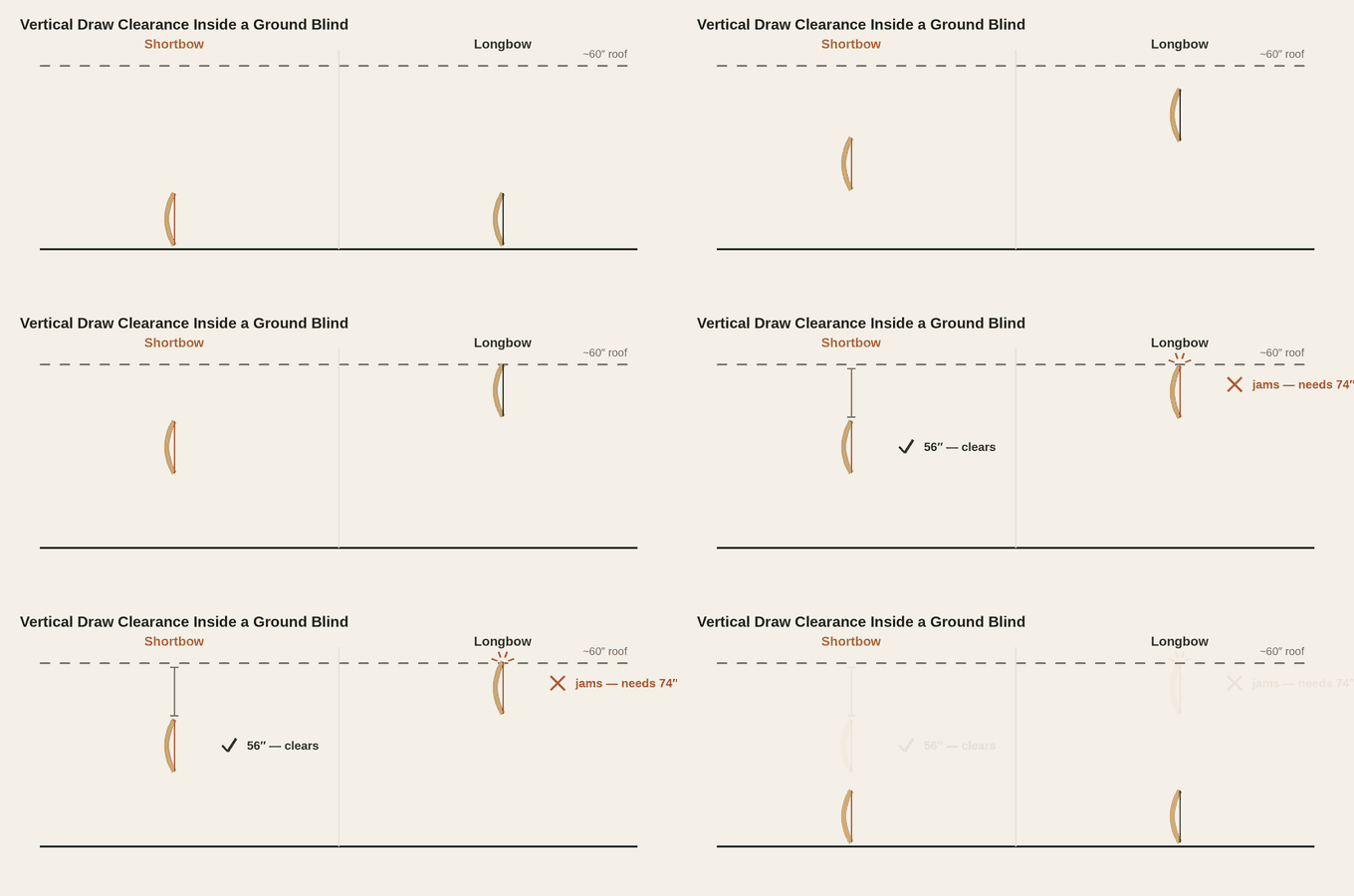
The composite wins anywhere space is tight: pop-up blinds and tree-stands, where 15 fewer inches of bow keeps the lower limb off the floor and rails. The longbow wins anywhere weather is hostile or the woods are quiet: humid timber, rain, sub-zero cold, and close still-hunting where the composite’s string-bridge slap costs you. Glass-laminated longbows are the most weather-proof option of all.
| Scenario | Composite (1–10) | Longbow (1–10) | Pick | Why |
|---|---|---|---|---|
| Pop-up ground blind | 9 | 5 | Composite | A 54″ bow draws upright on a stool; a 69″ limb needs a canted bow or a tall blind, and the tip finds the roof. |
| Tree-stand | 9 | 6 | Composite | Clears the platform and shooting rail on steep down-angles. The longbow works, but you cant it and lose the reference. |
| Spot-and-stalk timber | 8 | 6 | Composite | Short limbs slip through brush while carried. Speed helps on the one fast shot you get. |
| High humidity (>75% RH) | 3 (fiberglass: 8) | 7 self / 9 glass | Glass longbow | Horn and sinew drop to ~80% of draw weight at equilibrium and hide glue creeps. Wood takes set more slowly; glass barely cares. |
| Sub-zero winter | 4 | 8 | Longbow | Stringing a cold, heavily reflexed bow risks limb twist, and hide glue does not like it either. Warm any composite inside your coat before stringing. |
| Still-hunting / spooky deer | 5 | 8 | Longbow | String bridges crack at the end of the shot; a long limb thumps. A few fps will not beat a deer that ducks at the sound. |
| Open country / 3D | 7 | 7 | Either | Composite flattens trajectory; the longbow’s calmer shot and longer sight window forgive misreads. |
- Avoid If: you hunt wet country, leave bows strung in a truck, draw past 29″ with fingers, or cannot give a bow a slow warm-up in the cold. A fiberglass horse bow copies the geometry without the moisture problem.
- Avoid If: most of your hunting happens inside a pop-up blind or a tight tree-stand, you shoot a short draw under 26″, or you want every fps from a light draw weight.
What Do Traditional Archers Say About Horse Bows vs Longbows?
I went through the recurring debates: an ArcheryTalk thread titled longbow vs horsebow, a TradTalk thread weighing a recurve or RD longbow against a Mongolian bow, beginner horse bow questions, and threads on hunting with a short bow. The themes repeat so often that they are worth scoring.
- Top praised (composite): handiness in blinds and brush, and a draw that feels lighter at anchor than the marked weight suggests.
- Top praised (longbow): a quiet, forgiving shot and a bow you can leave in the truck without worrying.
- Common friction point: finger pinch and draw-length limits on short horse bows; hand shock and slower arrows on longbows.
| Trait | Composite (1–10) | Longbow (1–10) | What drives the score |
|---|---|---|---|
| Forgiveness | 6.5 | 8.0 | Longer limbs and more mass resist torque from the bow hand. |
| Draw smoothness | 8.0 | 7.5 | Siyahs soften the last inches; the heavy early draw costs a point. |
| Weather immunity | 3.5 | 8.5 | Horn, sinew and hide glue against wood and glass. |
| Tight clearance | 9.5 | 4.5 | About 15″ less bow to swing. |
| Shot calmness | 6.0 | 7.5 | Light limbs stop fast; long wood damps. |
These scores are my editorial synthesis of the threads linked above and the model on this page, not a formal survey. If your range days tell a different story, the contact page is open.
Where I part ways with the forum crowd: people blame the horse bow for “inconsistency” that is usually a spine problem. A short bow with a 2–3″ wide handle and no shelf asks a lot of the arrow. Run your shafts through the wood arrow spine calculator before you blame the bow.
Frequently Asked Questions
Is a composite bow more powerful than a longbow?
At the same draw weight, yes. My model gives a 54″ horn/sinew composite 1.15 ft-lb of stored energy per pound against 0.85 for a 69″ longbow, which becomes 13 to 22 fps more arrow speed at 55 pounds over a straight longbow. Against a modern 64″ reflex-deflex longbow the lead shrinks to 3 to 8 fps, because the composite converts a smaller share of what it stores.
What do the siyahs on a composite bow actually do?
They act as rigid levers at the limb tips. Early in the draw they let the reflexed limbs load up fast; late in the draw they rotate toward 90° to the string and soften the weight gain to about 1.4 lb per inch near anchor. Past roughly 29″ they go beyond 90° and the bow stacks.
Can you hunt with a horn composite bow in wet weather?
You can, but it is the bow’s weak spot. Horn’s strength falls from 104.5 MPa at 8% moisture to 39.7 MPa at 19%, and my model has an unsealed horn bow settling near 80% of its draw weight after days at 75% humidity. Good lacquer slows that a lot, but it does not stop it. For wet hunts a glass-laminated longbow or a fiberglass horse bow is the safer pick.
Is a composite bow harder to draw than a longbow of the same weight?
It feels heavier early and lighter late. At 20″ of draw the modeled composite is already at 42 lb against 33 lb for the longbow, but near anchor it adds only about 1.4 lb per inch against 2.8. Most archers describe the anchor as easier to hold.
Why does a short composite bow cause more finger pinch?
A shorter bow closes the string angle at your fingers: about 108° on a 54″ composite versus 134° on a 69″ longbow at a 28″ draw. That raises modeled pinch pressure by about 14%. A thumb ring removes the problem, which is how horse archers shot them.
Can you hunt deer or elk with a horse bow?
Yes, where your state’s draw-weight minimum is met and the arrow is tuned. At 55 pounds my model puts a 600-grain arrow from a 54″ composite at 171 fps and 0.456 slug-ft/s of momentum, which is a sound whitetail setup. For elk, most traditional hunters want more draw weight and a heavier arrow, whatever the bow.
Is a composite bow or a longbow more accurate?
For most archers the longbow is more forgiving: longer limbs and more mass resist hand torque, and a wider string angle is gentler on a finger release. A composite shot well with a thumb ring can be just as accurate, but it asks more of your form and your arrow tuning.
What arrow weight works best with a composite bow?
For hunting, 10 to 12 grains per pound is a sound starting range. At 12 GPP the modeled composite still shoots 164 fps with 0.482 slug-ft/s of momentum, matching a 14 GPP longbow arrow on momentum while flying flatter. Go lighter only for target or flight shooting.
Our Final Take: The composite is the better machine. The longbow is the better companion. One stores a third more energy in a bow a foot and a quarter shorter; the other forgives your hand, your draw length and the weather.
👉 Recommendation: If you hunt from blinds or stands in dry country and your draw sits at or under 29″, get a composite built for your draw and spend its speed on a heavier arrow. If you hunt wet timber, still-hunt spooky deer, or want one bow that lives in the truck, a glass-laminated longbow is the call, and a 62–64″ R/D hybrid gets you within a few fps of the composite anyway.
If I could hand one bow to a new traditional hunter in a rainy state, it would be the longbow. The dry-country blind hunter who likes to tinker gets the other one, and a thumb ring with it.
Before you order either, check your real draw length with the draw length calculator and the bow size calculator, then paper-tune the setup. Comparing other traditional shapes? The flatbow vs longbow and yumi vs longbow pages use the same model, and compound bow vs longbow shows what cams change. Tell me what your own composite does on the chronograph through the contact page or the ArcheryEra subreddit.
Hey, what's up? Burak here. Archery addict, board game geek, Daft Punk fan.