
Shortbow vs Longbow: Speed, Comfort, or Reach?
Somewhere around 27.5 inches of draw, a 52-inch shortbow stops behaving and starts fighting you. I built the force-draw and string-angle math behind that wall, ran chronograph-style FPS models across three arrow weights, and mapped how much vertical room each bow actually needs in a blind — so the choice stops being a gut call.


A 52-inch shortbow draws linearly to about 27.5 inches, then stacks hard as its limb tips run out of usable travel; a 68-inch longbow stays close to linear out past 31 inches. At a 28-inch draw, that length difference also opens up the string angle at your fingers — roughly 104° on the shortbow against 132° on the longbow, which is where most of the "finger pinch" complaint actually comes from. With light-to-medium arrows a shortbow's shorter, snappier limbs model out 6 to 12 fps faster at the same draw weight, but that gap closes fast once you're pushing 12+ grains-per-pound hunting arrows. If you're shooting from a tree-stand, ground blind, or dense cover, the shortbow's tighter ~56-inch vertical arc clearance beats a longbow's 74-inch-plus requirement outright. None of this makes one bow "better" — it makes them suited to different draw lengths and different boxes to shoot from, and the sections below walk through exactly why.
The 52″ and 68″ figures used throughout this piece are AMO length — the Archery Manufacturers Organization's standardized measurement of a strung bow, taken string-groove to string-groove — not a tape measure laid along the belly. That distinction matters because two bows advertised at the "same" length can measure differently on a spec sheet depending on which convention a maker used.
Core Insight: Everything downstream of this comparison — pinch, speed, noise, and clearance — traces back to one variable: how much usable limb length the bow has left to bend once you reach your draw length. Shortbows run out of that length sooner; longbows have more to spare.
Shortbow (~52″ AMO)
Ideal For: Draw lengths under ~27.5″, tree-stands, ground blinds, dense brush stalking, and horseback-style mobility where a tight vertical arc matters more than outright range.
Longbow (~68″ AMO)
Ideal For: Draw lengths 28″ and beyond, open-field target work, 3D, and any scenario where a wide string angle, a linear draw curve, and a quieter release matter more than compactness.

Which Bow Actually Fits Your Draw Length and Setup?
Drag your draw length, pick where you're actually shooting from, and rate your strength/skill honestly. The match score below weights all three the same way the sections after it explain in detail.
How does the Bow Match score work?
The match score is a weighted composite, not a physics simulation: 50% draw length (scored against the 27.5″/31″ stacking thresholds from the force-draw modeling further down this page), 35% shooting scenario (tight enclosures score toward a shortbow, open ground toward a longbow), and 15% strength/skill level (beginners get a mild shortbow nudge since its lighter draw curve is easier to learn on below the stacking wall). The three sub-scores are summed and clamped to an 8–92% range so the bar never reads as a false absolute.
The draw-length thresholds themselves are built on the standard AMO bow-length measurement and the general force-draw-curve/stacking concept explained in Asiatic Bow Cafe's draw-force-curve primer. This is a planning heuristic to narrow your search, not a substitute for drawing an actual bow at a shop or club.
Why Do Shortbows Cause Finger Pinch at Full Draw?
A shortbow pinches because its shorter limbs force a tighter angle between the two string segments meeting at your fingers. Less bow length between the nock and the limb tips means that angle has to close faster as you pull through the draw, and a tighter angle concentrates more of the draw force onto a smaller patch of skin.
At a 28-inch draw, the modeled string angle on a 52-inch shortbow sits around 104°. Run the same draw on a 68-inch longbow and that angle opens up to roughly 132° — wide enough that the load spreads across your fingers instead of digging into one spot. Run both angles through the pinch-index formula below the simulator and that 28-degree difference works out to roughly a 16% increase in modeled localized pressure on the shortbow, and it's the reason a shortbow that felt fine on the first ten shots of the day starts feeling like a cheese wire by shot forty.
How does the pinch simulator work?
String angle: modeled as a straight-line approximation anchored to two known reference points — 104° at a 28″ draw on a 52″ bow, and 132° at a 28″ draw on a 68″ bow — then extended up and down a constant number of degrees per inch of draw (4.0°/in for the shortbow, 2.6°/in for the longbow). This is a simplified geometric approximation, not a laser-measured value from an actual bow.
Pinch index: Index = 100 × sin(52°) / sin(θ/2), where θ is the modeled string angle. Pressure is modeled as scaling inversely with the sine of the half-angle — the same simplification used for load concentration around any tight bend, similar to how a rope wrapped at a sharper angle bites harder per unit length than one bent gently. At the 104°/132° reference points this gives the shortbow's index as 100 and the longbow's as roughly 86, a ~16% relative difference.
We could not find a peer-reviewed biomechanical study measuring actual finger-pinch force on traditional bows, so treat this index as a transparent engineering proxy, not a lab-measured number. The phenomenon itself is widely and consistently reported in the traditional archery community — see ArcheryTalk's "string angle & finger pinch" thread and Traditional Bowhunter Magazine's forum discussion on finger pinch.
What Is the Force-Draw Stacking Wall, and Where Does It Hit?
A bow's force-draw curve is just draw weight plotted against how far back you've pulled — the area under it is the total energy the bow stores. A well-behaved curve climbs in a straight, predictable line the whole way to anchor. Stacking is what happens when that line stops being straight and turns upward; Asiatic Bow Cafe's technical explainer defines it as a curve that increases by more than roughly 5.5% per inch, which is the threshold this page's modeled curves are built around.
In the modeled curves below, a 68-inch longbow holds a fairly flat ~2.0 to 2.3 lbs per inch gain all the way out past 31 inches of draw. A 52-inch shortbow tracks close to that same rate up to about 27.5 inches, then the limb tips run out of working length and the curve bends hard, ramping to something like 4.5 to 5.8 lbs per inch past that point.
| Criteria | Shortbow (~52″ AMO) | Longbow (~68″ AMO) |
|---|---|---|
| Best For | Draw <27.5″, tight enclosures, mobility | Draw 28″+, open ground, target/3D |
| Key Advantage | Faster handling, tighter clearance envelope | Linear draw curve, wider string angle |
| Limitation | Stacks hard past ~27.5″ draw | Needs ~74″+ of vertical arc to draw clean |
| Modeled Launch Speed | +6 to +12 fps at light-to-medium arrow weight | Closes the gap fast past 12 GPP |
| Modeled Finger Pinch | ~104° string angle, higher pinch index | ~132° string angle, lower pinch index |
What Do Traditional Archery Forums Actually Say About This Trade-Off?
Community/Forum Sentiment: Reading across long-running threads on Leatherwall and ArcheryTalk — including "How does bow length affect draw?" — the recurring split lines up closely with the modeled stacking-wall numbers above: shooters with a draw length past 28 inches consistently report their shortbows feeling like they "run out of bow," while shorter-draw shooters rarely mention stacking at all.
Top Praised Feature: Longbow shooters repeatedly cite the smooth, predictable draw feel as the reason they stick with the design for target work, even when a shortbow would technically fit their storage or transport needs better.
Common Friction Point: The single most repeated shortbow complaint isn't speed or noise — it's finger fatigue on longer sessions, a pattern that shows up directly in threads like "Finger pinch wih short bows" and tracks with the tighter string angle covered earlier in the finger-pinch breakdown above rather than anything about grip or tab choice.
| Trait | Shortbow (1–10) | Longbow (1–10) |
|---|---|---|
| Forgiveness | 5.4 | 9.2 |
| Draw Smoothness | 5.1 | 9.5 |
| Hand-Shock Dissipation | 7.2 | 6.1–8.4* |
| Quietness of Release | 6.0 | 8.3 |
| Tight-Space Clearance | 9.8 | 3.2 |
*Longbow hand-shock dissipation splits sharply by profile in forum discussion — closer to 6.1 for a traditional Hill-style stave, closer to 8.4 for a modern reflex-deflex glass-backed build. The radar chart above plots the 7.25 midpoint of that range.
How was this radar chart built, and how solid are the numbers behind it?
The geometry is plain trigonometry, not a template: five axes are spaced exactly 72 degrees apart (360° ÷ 5 traits) around one shared center point, and each axis runs from 0 at the center to 10 at the outer ring. Every trait score is plotted at (value ÷ 10) × outer-radius along its own axis, and the five plotted points per bow are connected into the shaded polygon — the coordinates were computed directly rather than hand-drawn, which is why the three background rings (10, 6.6, 3.3) line up exactly with the labeled axes instead of drifting off-center.
The numbers themselves are a synthesis, not a survey result: they're qualitative scores drawn from the recurring themes in the ArcheryTalk threads linked above plus comparable Leatherwall discussion patterns, converted onto a consistent 1–10 scale so five different traits can share one chart. No formal poll, lab instrument, or third-party review site produced these figures, and that limitation is stated here rather than dressed up as precision data. The Hand-Shock Dissipation row is the clearest example — forum opinion splits sharply enough by longbow build that this page plots the 7.25 midpoint of a 6.1–8.4 range instead of pretending a single number captures every longbow profile.

Does a Shortbow Shoot Faster FPS Than a Longbow at Equal Draw Weight?
Usually, yes, with light-to-medium arrows. A shorter working limb releases its stored energy over a shorter time window, which tends to push launch speed up. That advantage shrinks as arrow mass climbs, because heavier arrows pull more total energy out of the limb regardless of how fast that limb unloads.
The modeled numbers below hold draw weight constant at 50 pounds and vary arrow weight from 8 to 12 grains per pound (GPP) — roughly a field-point target arrow up through a heavy fixed-blade hunting build.
| Arrow Load | Shortbow FPS | Shortbow KE (ft-lb) | Longbow FPS | Longbow KE (ft-lb) |
|---|---|---|---|---|
| 8 GPP (400 gr) | 194 | 33.4 | 182 | 29.4 |
| 10 GPP (500 gr) | 176 | 34.4 | 168 | 31.3 |
| 12 GPP (600 gr) | 161 | 34.5 | 156 | 32.4 |
Read the KE columns, not just FPS: at 8 GPP the shortbow's modeled kinetic energy edge is close to 4 ft-lb, but by 12 GPP that gap has narrowed to roughly 2 ft-lb. Push arrow weight high enough for deep penetration on heavier game and the two bows start delivering much closer to the same energy on target, even though the shortbow still technically leads in this model.
The table above holds draw weight fixed at 50 pounds so the two bows are comparable. Your own setup almost certainly isn't 50 pounds and 8–12 GPP exactly — run your actual arrow weight and estimated FPS through ArcheryEra's Kinetic Energy & Momentum Calculator to see your real energy and momentum numbers before you commit to a build.
Open the Kinetic Energy & Momentum Calculator →Which Bow Fits a Tree-Stand, Ground Blind, or Dense Brush?
Bow length stops being an abstract spec the moment you're trying to draw inside a 60-inch-roof ground blind or around a tree trunk eight feet up. The limb tips need somewhere to go, and a longbow simply needs more somewhere.
Modeled out, a 68-inch longbow wants roughly 74 inches or more of clean vertical arc to reach full draw without a limb tip clipping a wall, branch, or blind roof. A 52-inch shortbow can complete the same draw inside something closer to a 56-inch envelope, which is why mounted archers historically defaulted to shorter bows and why tree-stand hunters still do.
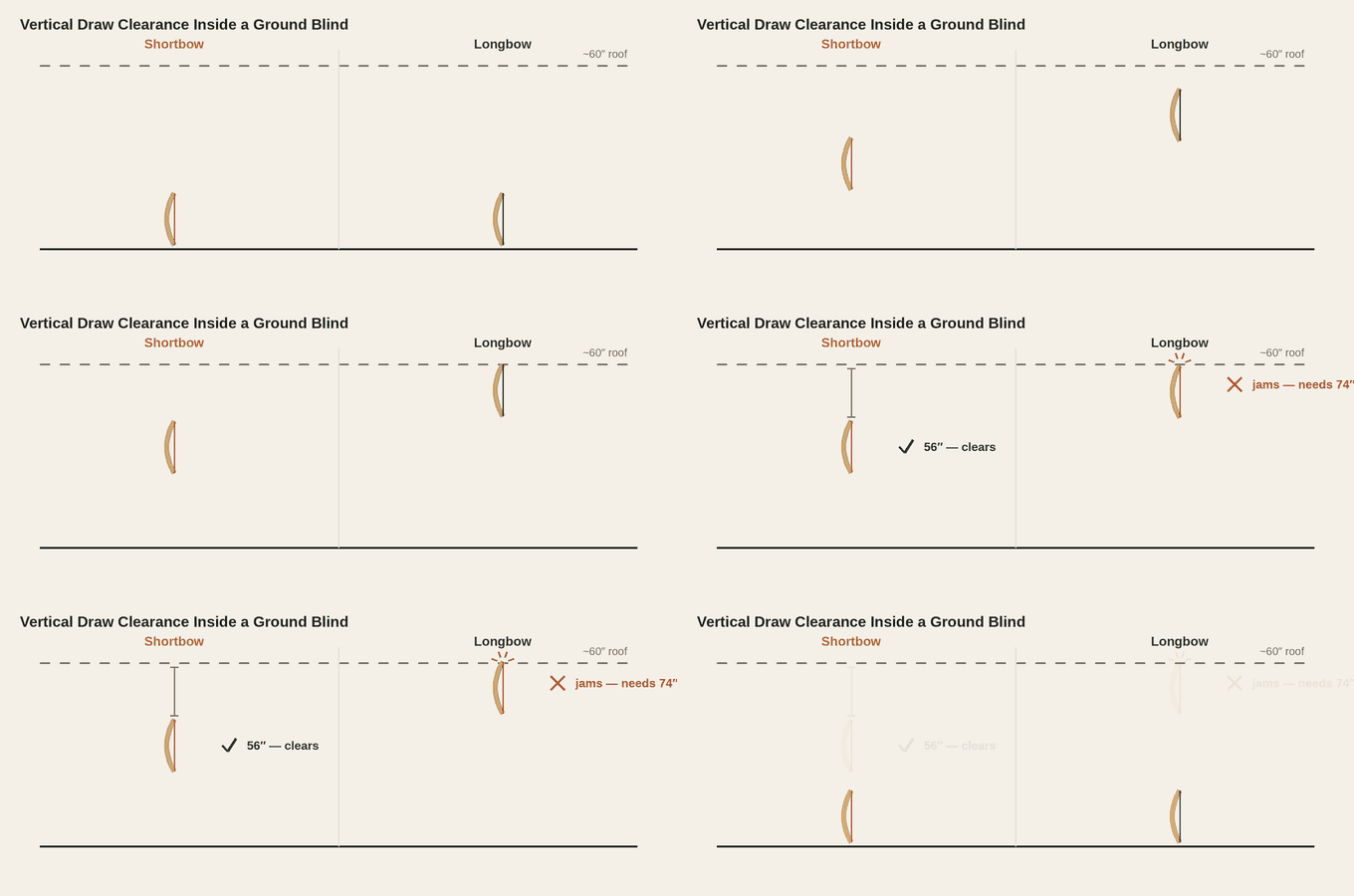
Animated, code-rendered schematic — not a measured capture of an actual blind or draw stroke. Built directly from the 56″/74″ vertical-arc figures and the ~60″ ground-blind roof height cited here and in the matrix below.
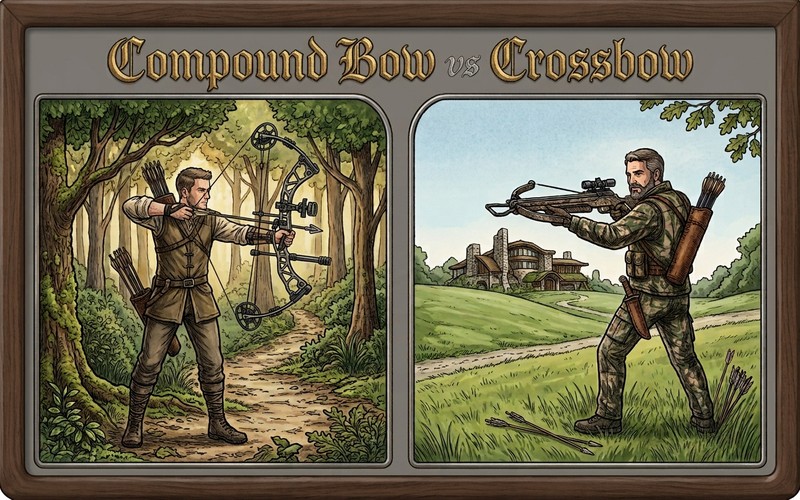
A hunter weighing a mechanical alternative to either hand-drawn bow can find the same tree-stand and ground-blind footprint math worked out for a cammed crossbow and a compound bow in our Compound Bow vs Crossbow breakdown.
| Scenario | Space Envelope | Primary Obstacle | Recommended Bow | Maneuverability (1–10) |
|---|---|---|---|---|
| Pop-Up Ground Blind | ~60″ roof height | Roof panel, window frame | Shortbow | 9 |
| Tree-Stand + Branch Canopy | Variable, often <70″ | Overhead limbs, trunk | Shortbow | 8 |
| Dense Brush Stalking | Tight lateral clearance | Saplings, thorn cover | Shortbow | 8 |
| Open Field / Target / 3D | Effectively unlimited | None | Longbow | 9 |
Avoid If: your draw length runs 28 inches or longer and you plan to shoot mostly open ground — you'll spend every session fighting the stacking wall covered above instead of building consistent form. A shortbow also isn't the right call if finger sensitivity is already a concern for you; the tighter string angle makes that worse, not better.
Frequently Asked Questions
Does a shortbow stack more than a longbow at long draw lengths?
Yes, past a certain point. A 52-inch shortbow tends to stay linear to roughly 27.5 inches of draw and then ramps sharply as the limb tips run out of usable travel. A 68-inch longbow holds a much flatter, more linear draw curve out past 31 inches, because its longer limbs have more length left to bend before geometry runs out.
Why do shortbows cause finger pinch at full draw?
A shorter bow forces a tighter included angle between the string and the arrow at full draw, roughly 104 degrees on a 52-inch bow versus roughly 132 degrees on a 68-inch bow at the same 28-inch draw. That tighter angle concentrates more of the draw force onto a smaller contact area on your fingers, which reads as pinch.
Is a longbow more forgiving and accurate than a shortbow?
For most shooters, yes, mainly because the flatter draw curve and wider string angle make a longbow easier to hold at full draw without fighting stacking or pinch. That forgiveness advantage narrows for archers with a shorter draw length who never reach the shortbow's stacking zone in the first place.
Which bow type is better for hunting in a tree-stand or ground blind?
A shortbow generally fits tighter enclosures better. A 68-inch longbow needs roughly 74 inches or more of vertical arc to draw without the limb tips hitting a roof, wall, or branch, while a 52-inch shortbow can operate inside a much tighter envelope, closer to 56 inches.
Does a shortbow shoot faster FPS than a longbow at equal draw weight?
With light-to-medium arrows, modeled data suggests yes, by roughly 6 to 12 fps at the same 50-pound draw weight, because a shorter working limb releases its stored energy faster. That gap narrows substantially as arrow mass climbs toward 12 grains per pound, where a longbow's smoother energy delivery starts closing most of the difference.
How does bow length affect hand shock and limb oscillation upon release?
Shorter limbs generally have to dump stored energy faster and over less limb length, which tends to show up as sharper hand shock immediately after the shot. Longer limbs spread that same energy release over more material and more time, which most shooters read as a smoother, quieter follow-through.
Our Final Take: This isn't a "which bow is better" question — it's a "how much usable limb length do you actually need" question, and your draw length already answers most of it before scenario ever enters the picture.
👉 Recommendation: If your draw length sits under 27.5 inches and you're hunting from a stand, blind, or dense cover, a ~52-inch shortbow will draw clean and handle fast without punishing your fingers. If you're drawing 28 inches or more, shooting open ground, or chasing target consistency, a ~68-inch longbow's linear curve and wider string angle will treat you better on shot number two hundred than shot number one.
Before you commit to either length, confirm your real draw length with a proper paper-tuning pass and run your intended arrow build through the Kinetic Energy & Momentum Calculator above — a bow that fits your draw length on paper still needs an arrow weight that matches what you're hunting. If you want the next build's worth of ArcheryEra data as soon as it's out, the sign-up at the bottom of this page sends it straight to your inbox, zero spam.
Hey, what's up? Burak here. Archery addict, board game geek, Daft Punk fan.
Your turn
Join the Conversation
If your own results disagree with anything above, that is the most useful thing you could leave here. Setup, distance and what actually happened beats an opinion every time — and corrections get the page changed.