
One Engine. Every Step. Arrow to Impact.
From custom build to ultimate flight, ArcheryEra is the only connected engine that simulates your complete archery & bowhunting ecosystem.
Phase 1 · Build Lab
Build & balance
Grain weight, spine and centre of gravity — settled before you cut a shaft.
Phase 2 · Field Lab
Environment & flight
Steering, wind, terrain and angle — everything between the string and the target.
Phase 3 · Impact Lab
Ballistics & impact
Where the arrow goes, and what it still has left when it gets there.
Precision simulators, chained in three phases. Perfect flight isn’t luck — it’s built. Whether you’re stepping up to the 80-yard line or sitting in a tree stand, every shot runs the same sequence: how the arrow is built, how it flies, and what it delivers on target. Break one link and the shot breaks with it.
This is the site’s most advanced simulation library — full physical models chained across all three phases. Want one fast number without the deep-dive? The simpler standalone calculators live on their own page.
Open Quick Tools →Arrow build & balancing
Phase 1 · three toolsMaster the mechanics before you ever cut a shaft. Total mass and spine come first; where that mass sits comes second, and how fast it all leaves the string comes third.
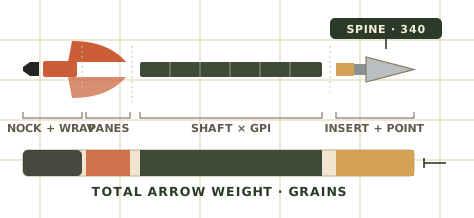
Arrow Build & GPI Weight Calculator
The spine you should actually be shooting, total grain weight, grains per pound, estimated speed and what game that adds up to — from one screen.
Open the calculator →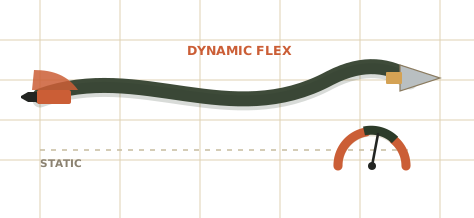
Dynamic Spine & Shaft Flex Calculator
Peak weight, cam aggressiveness, cut length and front-end weight, turned into a live Spine Match Index and an animated shaft-flex simulation — plus the exact inches or grains that fix a miss.
Open the calculator →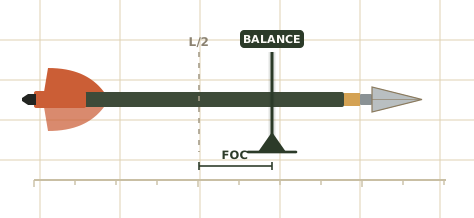
Arrow FOC & Balance Point Optimizer
Move a point weight, a brass insert or a lighted nock and watch the balance line slide along a drawn-to-scale arrow. AMO FOC, finished weight and a component-by-component breakdown of what is pulling where.
Open the optimizer →Environment & flight stability
Phase 2 · three toolsA finished arrow still has to survive the air and the ground it is shot over. These two cover the part of the chain nobody can practise their way out of.
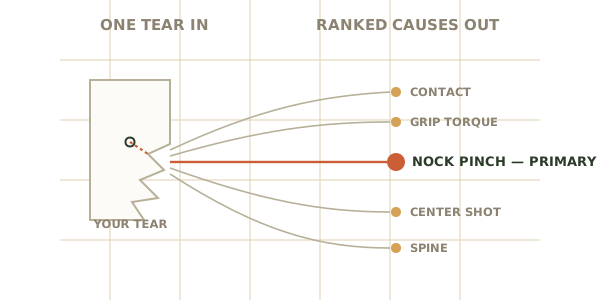
Paper Tune Root-Cause Diagnostic
Your tear, what happened after a few rest moves, and three free mechanical checks, ranked into the real cause — before you touch a rest that was never the problem.
Open the diagnostic →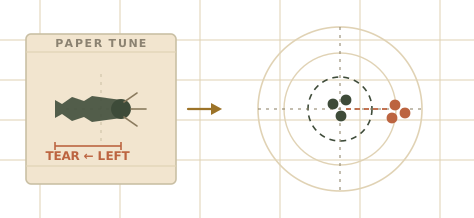
Broadhead Flight & Tuning Stability Checker
How far your heads will land from your field points at any distance, worked out from your paper tear, your fletching and the head you shoot — and which of the three to fix first.
Open the checker →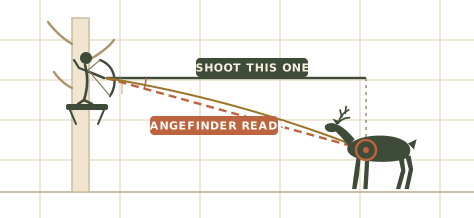
Tree-Stand & Angled Shot Distance Compensator
The yardage to actually shoot from a stand or a hillside, the pin to use, and the part nobody tells stand hunters — where the arrow comes out the far side.
Open the compensator →Ballistics & terminal penetration
Phase 3 · two toolsMap the path, then see what is left at the end of it. Speed, drop and drift decide whether you hit; energy and momentum decide what happens next.
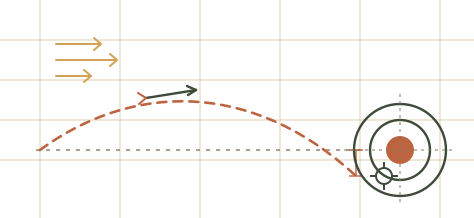
Arrow Trajectory & Sight-Pin Visualizer
Drop, flight time, wind drift, point-on and hold-over, drawn to scale on a target face or a broadside deer instead of buried in a table.
Open the visualizer →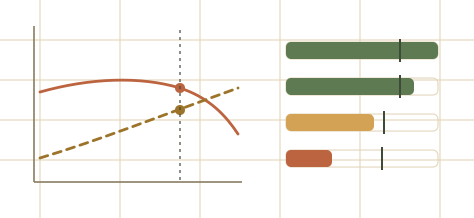
Kinetic Energy, Momentum & Pass-Through Calculator
What the arrow is still carrying when it arrives, and honestly what that is enough for — small game through to elk and heavier.
Open the calculator →All the tools. One connected system.
They share their maths on purpose. Drag and flight time come from the same code in every tool, FOC feeds the broadhead lever arithmetic, draw length and draw weight use the same coefficients in the speed and trajectory tools, and the angle compensator borrows its trajectory from the visualizer — so two of them can never hand you different answers about the same arrow. Every one shows its own working, and says plainly where the model runs thin.