
Legendary Archers of All Time: Who Was Real, and Could Their Shots Happen?
Forty-four archers from history, myth, the Olympics, film and games. I checked each against the oldest record I could find, graded how solid it is, and ran the famous shots through a scatter model built from the current world-record score.

Short answer: the most decorated Olympic archer is still Belgium's Hubert Van Innis, with six golds and three silvers from 1900 and 1920. In today's program, South Korea's Kim Woo-jin leads with five golds after Paris 2024. The best-documented long shot in history isn't Robin Hood's or William Tell's, both of whom may never have existed. It's a Mongol named Yesüngge, whose shot of 335 alds, about 536 m, is carved on a stele from around 1225.
| Archer | Real? | Oldest solid record | The famous shot |
|---|---|---|---|
| Robin Hood | Legend | Ballads after 1450 | Splitting the arrow: first told in a 17th-century poem, and it won't split a solid wooden shaft |
| William Tell | Legend | Swiss texts of the 1470s | The apple: about a 30% shot for today's best archer at 120 paces |
| Nasu no Yoichi | Chronicle | The Heike, 13th–14th c. | A fan on a pitching boat, from a horse in the surf, 1185 |
| Yesüngge | Documented | Stone stele, c. 1225 | 335 alds, about 536 m |
| Mary Rose longbowmen | Documented | Bows raised from a 1545 wreck | Draw weights estimated at 100–185 lb |
| Horace A. Ford | Documented | Score sheets, 1857 | A Double York of 1271 that stood more than 70 years |
| Kim Woo-jin | Documented | Olympic results, 2016–2024 | Five golds, the last in a shoot-off against Brady Ellison |
Which Legendary Archers Were Real People?
Ten names from history and legend, graded by the oldest record behind them. Where a famous shot comes with a distance, I ran it through the shot-odds tool further down.
Robin Hood Legend
There's no proof of one real Robin Hood. The earliest surviving ballad, Robin Hood and the Monk, was written after 1450, and the first clear mention of "rhymes of Robin Hood" is in Piers Plowman from the 1370s. The arrow-splitting trick came much later: the same source traces it to a mid-17th-century poem. MythBusters couldn't split a solid wooden arrow end to end even with direct hits; the follow-up arrow tracks the grain and exits the side. Only a hollow bamboo shaft gave them the movie split.
William Tell Legend
Tell is Switzerland's founding hero, but his existence is disputed. The apple shot appears in the Tellenlied of the 1470s, and Aegidius Tschudi later pinned it to 18 November 1307. Tell shoots a crossbow, and no Swiss version I could find gives a distance. The same story is much older: Saxo tells it of the Danish archer Toko, and the English ballad of William of Cloudeslee puts the apple at 120 paces. That's the distance I use below.
🛠️ Tool
Legend Shot Odds
Would the best archer alive make the legendary shot? Pick one, pick a shooter, and the tool works out the chance of a hit on one arrow from the scatter their real score implies.
How it works: an Olympic face is 122 cm across with ten 6.1 cm rings, and an arrow touching a line scores the higher ring. I solve for the round scatter that produces each score over 72 arrows at 70 m, then scale it with distance. Real scatter grows faster than that with wind and a moving horse, so these odds are on the kind side.
Nasu no Yoichi Chronicle

At the Battle of Yashima on March 22, 1185, the Taira set a fan atop a pole on a boat and dared the Minamoto to hit it. Yoichi rode into the sea on horseback and did it with one arrow. The Tale of the Heike is a literary chronicle, not a muster roll, and I couldn't find a distance in any source I trust; one writer who looked notes only that the day was windy. Set your own guess in the tool. He's also a main character in the manga Drifters.
Minamoto no Tametomo Documented

Tametomo (1139–1170) was a real samurai who fought in the 1156 Hōgen Rebellion. The legends around him are tall even by samurai standards: a left arm about 4 inches longer than his right, for a longer draw, and a Taira ship sunk with one arrow through the hull below the waterline. After the rebellion his captors cut the sinews of his left arm. He died in exile in the Izu Islands.
Tomoe Gozen Chronicle

Tomoe Gozen fought in the same Genpei War, and the Heike describes her as a strong archer and a swordswoman worth a thousand warriors. Like Yoichi, she's known almost entirely from that one literary source, which is why I grade her by the chronicle and not as documented.
Yesüngge and the Mongol Horse Archers Documented
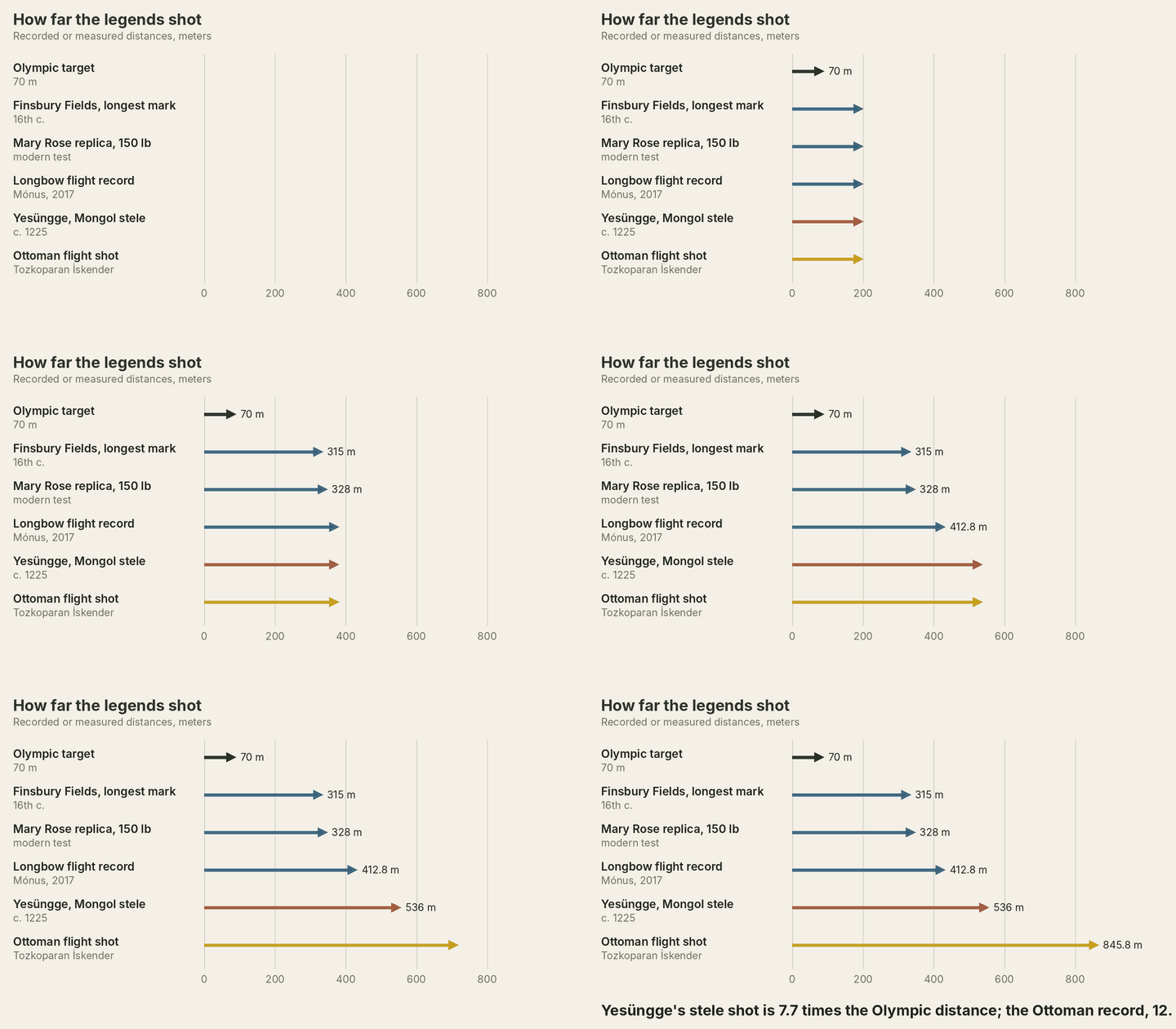
Here's a shot with hard evidence. The Stele of Genghis Khan, dated to about 1224–1225, records that Genghis Khan's nephew Yesüngge shot an arrow 335 alds at a gathering of Mongol nobles. At about 160 cm per ald that's roughly 536 m, a flight shot for distance, not accuracy. His army fought from horseback with composite recurve bows, and used whistling arrows for signals. I compared that bow's physics with an English longbow in Mongolian bow vs. English longbow.
The English Longbowmen Documented
The best evidence for medieval war bows sank with Henry VIII's Mary Rose in 1545. Of the longbows raised from the wreck, the full range of estimated draw weights is 100 to 185 lb, with Robert Hardy putting a typical one at 150–160 lb. A modern 150 lb replica threw a 1.89 oz arrow 359 yards. Most hunters today draw 50 to 70 lb, so those men pulled two to three times what we do, every practice day. The composite bow vs. longbow page runs the numbers on what that draw buys.
Horace A. Ford Documented
Ford is the best-documented great archer of the 1800s. He took up the bow in 1845, won the Grand National Archery Meeting eleven years running from 1849 and a twelfth time in 1867, and shot a Double York Round of 1271 in 1857 that stayed archery's high mark for more than 70 years. He wrote his method down, too, in Archery: Its Theory and Practice (1856).
Fred Bear Documented

Fred Bear (1902–1988) didn't start bowhunting until he was 29, inspired by Art Young, whom he called his hero. He founded Bear Archery in 1933 and took his first bow whitetail in Michigan in 1935, then spent decades filming hunts around the world. The line most often hung on him, "the history of the bow and arrow is the history of mankind," I couldn't trace to a primary source, so treat it as attributed. If you hunt with a bow, the bowhunting checklist is where his legacy lives on this site.
Lieutenant Colonel Jack Churchill Documented

"Mad Jack" Churchill carried a longbow and a broadsword in the Second World War and shot for Great Britain at the 1939 World Archery Championships in Oslo, finishing 26th. He also played a small archer's role in The Thief of Bagdad (1940). The popular story that he killed a German with an arrow is doubtful; he said himself that his bows had been crushed by a lorry earlier in that campaign.
Who Are the Archers of Myth?
Gods aren't disputed historical people; they belong to religious and story traditions. These five carry the bow as part of who they are.
Paris Myth
The Trojan prince who took Helen is the archer of the Trojan War story. Hector fights hand to hand; Paris shoots, and in later tradition his arrow, guided by Apollo, kills Achilles.
Apollo Myth
Apollo is the god of light, music, healing and archery. In the opening of the Iliad his arrows bring plague on the Greek camp. The historical side of Greek archery, from Cretan mercenaries to Scythian archer-police, is on the ancient Greek archers page.
Artemis Myth
Apollo's twin is the goddess of the hunt and the wilderness, almost always shown with a bow. In the Trojan War both twins take Troy's side.
Eros Myth

The god of desire shoots arrows that make people fall in love, which makes him the only archer on this list whose hits are wanted.
Skaði Myth
The Norse giantess-goddess of winter and mountains is associated with skiing and bowhunting, a reminder that the hunting bow was never only a man's tool in the old stories.
Diana, the Roman counterpart of Artemis, carries the same bow and quiver, so I've folded her into Artemis rather than count her twice.
Who Are the Greatest Olympic Archers?
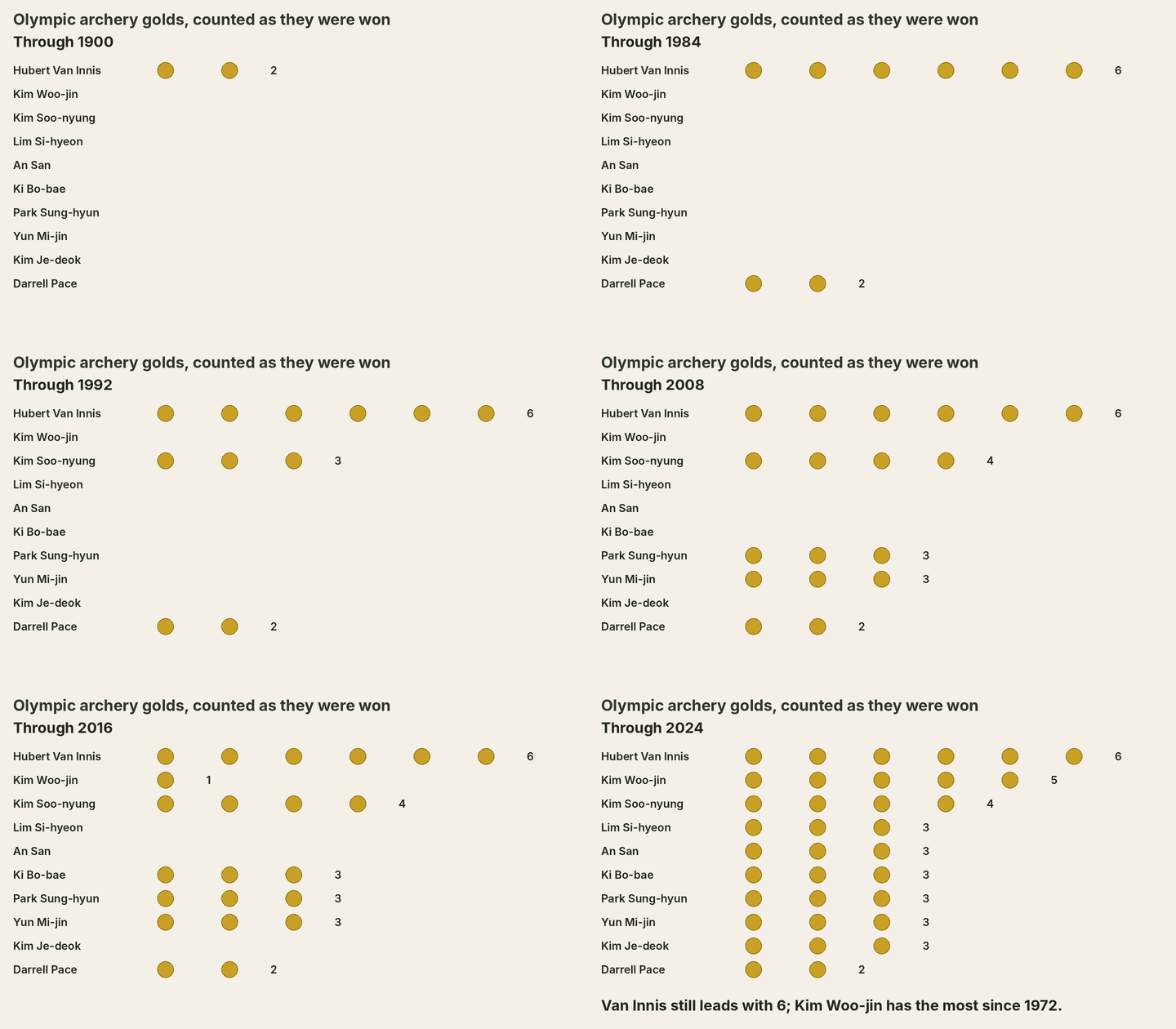
By Olympic golds, the list is short and mostly Korean. Van Innis's six came in a 1900–1920 program of events that no longer exist, like shooting at moving birds; archery left the Games after 1920 and only came back in 1972. Since then, Kim Woo-jin's fifth gold in Paris took him past Kim Soo-nyung's four.
| Archer | Gold | Silver | Bronze | Games |
|---|---|---|---|---|
| Hubert Van Innis (BEL) | 6 | 3 | 0 | 1900, 1920 |
| Kim Woo-jin (KOR) | 5 | 0 | 0 | 2016, 2020, 2024 |
| Kim Soo-nyung (KOR) | 4 | 1 | 1 | 1988, 1992, 2000 |
| Park Sung-hyun (KOR) | 3 | 1 | 0 | 2004, 2008 |
| Ki Bo-bae (KOR) | 3 | 0 | 1 | 2012, 2016 |
| An San, Lim Si-hyeon, Kim Je-deok, Yun Mi-jin (KOR) | 3 each | 0 | 0 | 2000–2024 |
| Darrell Pace (USA) | 2 | 0 | 0 | 1976, 1984 |
Medal counts from the Olympic archery medal tables; team and mixed-team golds included.
Hubert Van Innis
Born in 1866, Van Innis won two golds in Paris in 1900 and four in Antwerp in 1920, twenty years apart, and a World Championship in 1933 at 67.
Kim Woo-jin
Team gold in Rio and Tokyo, then team, mixed team and individual in Paris, where he beat Brady Ellison in a shoot-off for the fifth. He also shot 700 of 720 in the Rio ranking round, a world record at the time.
Kim Soo-nyung
Two golds at 17 in Seoul, team gold in 1992, then a comeback team gold in Sydney in 2000. World Archery's federation named her Female Archer of the 20th Century in 2011.
Lim Si-hyeon and An San
Both won three golds at a single Games: An San in Tokyo, Lim in Paris, where she also shot the women's world record of 694 of 720 in the ranking round.
Park Sung-hyun, Ki Bo-bae and Yun Mi-jin
Park won the individual and team golds in Athens and set a 72-arrow world record of 682 there, plus the first recurve 1440 round over 1,400. Ki Bo-bae won individual and team gold in London and team gold in Rio. Yun Mi-jin won the individual title in Sydney at 17.
Darrell Pace and Brady Ellison
Pace won individual gold in 1976 and 1984 and two world titles; World Archery named him Archer of the Century in 2011. Ellison has no Olympic gold yet, but he holds the men's world record: 702 of 720 at the 2019 Pan American Games. That's the score my shot-odds tool uses for "the best archer alive."
Who Are the Most Famous Archers in Film and TV?
Ten characters who've put more bows in people's hands than any coach. A few of them were trained by real archers.
Katniss Everdeen Fiction
The Hunger Games heroine, played by Jennifer Lawrence. Olympian Khatuna Lorig coached Lawrence for about ten hours, and Lorig says she was soon shooting about 100 arrows a day on an Olympic-style recurve.
Hawkeye Fiction
Clint Barton, created for Marvel by Stan Lee and Don Heck in 1964 and played by Jeremy Renner, has no superpower at all, just aim. The trick arrows are another matter.
Legolas Fiction
Tolkien's elf, played by Orlando Bloom. In the books he trades his Mirkwood bow for a bow of the Galadhrim from Galadriel. On screen his shots ignore physics more often than not.
Lara Croft Fiction
Angelina Jolie's Lara mostly used pistols; the bow arrived with the 2013 game reboot and Alicia Vikander's 2018 film.
Merida Fiction
Pixar's Brave (2012) built its plot around her bow, including a contest she wins for her own hand.
Green Arrow Fiction

Oliver Queen first appeared in DC comics in 1941 and was played by Justin Hartley in Smallville and Stephen Amell in Arrow.
Neytiri Fiction
The Na'vi hunter in Avatar, played by Zoe Saldaña, who teaches Jake Sully to ride and shoot.
Susan Pevensie Fiction
Queen Susan of Narnia, played by Anna Popplewell, whose bow is a gift from Father Christmas in the first book.
Daryl Dixon Fiction
Norman Reedus's survivor in The Walking Dead picks a crossbow over a gun because it's quiet. The same reason hunters reach for one; compound bow vs. crossbow covers the trade.
Ygritte Fiction
Rose Leslie's Free Folk archer in Game of Thrones, who shoots Jon Snow three times and makes a point of telling him she could have killed him.
Who Are the Most Famous Archers in Video Games?
Games are where a lot of people first draw a bow, even a virtual one. Eight that made archery central, and what each got right.

Prophet, Crysis 3 Fiction
A sci-fi shooter that handed its hero a compound bow as the signature weapon in 2013.

Garrett, Thief Fiction
The 1998 stealth classic: water arrows to douse torches, moss arrows to quiet floors, rope arrows to climb. The art here is from the 2014 reboot.

Wander, Shadow of the Colossus Fiction
Sixteen colossi, one sword and one bow, used mostly to get a giant's attention.

Joel and Ellie, The Last of Us Fiction
A bow for silent kills, the same logic as Daryl Dixon's crossbow. Ellie takes it hunting in the winter chapter.

Link, Ocarina of Time Fiction
The 1998 Fairy Bow, with fire, ice and light arrows, aimed from a first-person view. The art here is from a later Zelda game.

Lara Croft, Tomb Raider (2013) Fiction
The reboot made the bow her core tool for survival and hunting.

The Archer, Skyrim Fiction
A full archery skill tree and a slow-motion kill cam for a good arrow.
Hawkeye Gough, Dark Souls Fiction
One of Gwyn's Four Knights and leader of the giant greatarchers, who helps you bring down the dragon Kalameet.
Game images are publisher artwork and screenshots, shown here to identify each game.
🛠️ Tool
Which Legend Shoots Like You?
Tell it what you shoot. It'll find your legend and tell you how your draw weight stacks up against a Mary Rose war bow.
If "legendary" means the record backs it up, my pick is Horace Ford: twelve national titles and a score that held for more than 70 years, with equipment you'd struggle to group with today. For a single shot, Yesüngge's 536 m on a stone that's lasted eight centuries beats any apple or split arrow, because we know it happened.
Frequently Asked Questions
Who is the most decorated Olympic archer?
Hubert Van Innis of Belgium, with six golds and three silvers from the 1900 and 1920 Games. Since archery returned to the Olympics in 1972, South Korea's Kim Woo-jin leads with five golds, the last three won in Paris in 2024.
Was Robin Hood a real person?
There's no proof of one real Robin Hood. The earliest surviving ballad was written after 1450, and the first clear mention of Robin Hood rhymes is in Piers Plowman from the 1370s. He's best treated as a legend that may have borrowed from several outlaws.
Was William Tell real?
His existence is disputed. The apple shot first appears in the Tellenlied of the 1470s, and the same story is told earlier of the Danish archer Toko. In the Swiss tradition Tell shoots a crossbow, not a longbow.
Can you really split an arrow like Robin Hood?
Not a solid wooden arrow end to end. MythBusters tried it with direct hits and found the second arrow follows the grain and exits the side. Only a hollow bamboo shaft gave them the movie split, and the trick itself first shows up in a 17th-century poem.
What is the longest recorded arrow shot in history?
The oldest one with hard evidence is Yesüngge's shot of 335 alds, about 536 m, carved on a Mongol stele from around 1225. Ottoman flight archers later shot farther; the record usually given is 845.8 m by Tozkoparan İskender.
How strong were English longbows?
The longbows raised from the Mary Rose, which sank in 1545, have estimated draw weights of 100 to 185 lb. Robert Hardy put a typical one at 150 to 160 lb, two to three times what most bowhunters draw today.
Could the best archer today hit William Tell's apple?
In my scatter model, a shooter at Brady Ellison's 702 world-record level hits an 8 cm apple at 120 paces about 30% of the time on one arrow. Wind, nerves and a crossbow would change that, which is why I call the odds kind.
Did Jennifer Lawrence learn real archery for The Hunger Games?
Yes. Olympian Khatuna Lorig coached her, and Lorig says Lawrence was soon shooting about 100 arrows a day on an Olympic-style recurve.
How I Checked These
For every name I looked for the oldest surviving record and linked it on the claim: chronicles and stele texts for the medieval figures, Olympic medal tables and World Archery for the athletes. Grades are mine. The shot odds come from a scatter model fitted to ranking-round scores; it's arithmetic on a real score, not a test I shot, and it leaves out wind, nerves and horses. Spot something I got wrong? Tell me.
Hey, what's up? Burak here. Archery addict, board game geek, Daft Punk fan.