
Yumi vs English Longbow: Why the Lighter Bow Keeps Up
A 50-pound Yumi drawn to a 36-inch Ya stores roughly what a 75-pound English longbow stores at a 28-inch draw — a 49% energy edge per pound of peak weight, purely from geometry. That draw-length advantage doesn't make a 50-pound Yumi out-shoot a 100-pound war-class longbow outright, but it explains why kyudo archers can generate real downrange energy from draw weights a Western target archer would consider light. The sections below run the limb-geometry math, the force-draw curves, the Yugaeri release mechanics that replace archer's paradox, and the bench-test ballistics behind both.

A Yumi is the asymmetric Japanese bow still shot in kyudo today, gripped roughly a third of the way up a 212–245 cm stave and drawn to an unusually long 33–38 inch Ya. An English longbow is a centered-grip, roughly 68–72 inch self-bow drawn to a standard 28–30 inches, the type recovered from the Mary Rose at draw weights up to 185 lb. Modeled on Stored Energy = Draw Weight × Draw Length × Shape Factor ÷ 12, the Yumi's long draw means a 50-lb bow banks about as much energy as a 75-lb longbow — a 49% efficiency edge per pound of peak weight. That doesn't mean a light Yumi beats a heavy war-class longbow outright: a 100-lb longbow at 28 inches still out-stores a 50-lb Yumi at 36 inches in absolute terms, it just needs double the poundage to do it. The release mechanics diverge even more sharply — a Yumi's Yugaeri rotates the bow itself out of the arrow's path, while a longbow's fingers-and-riser system relies on the arrow flexing around a fixed grip, known as archer's paradox. The sections below cover the limb-length geometry, the force-draw math, the release mechanics and the material tradeoffs behind both.
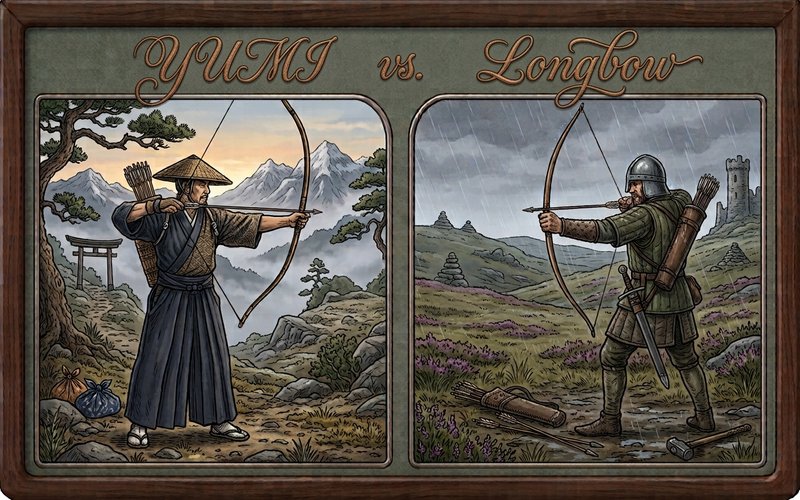
What Are the Key Differences Between a Yumi and an English Longbow?
The table below summarizes the engineering differences covered in this guide.
| Attribute | Yumi | English Longbow |
|---|---|---|
| Length (AMO-equivalent) | 212–245 cm (daikyu), grip at ≈1/3 up from the lower tip | ≈68–72 in, grip centered at 1/2 |
| Draw length | 33–38 in (the Ya) | 28–30 in |
| Typical draw weight | 30–60 lb (modern kyudo); heavier war-era figures are reenactor estimates only | 100–185 lb (Mary Rose, load-tested); most common ≈150–160 lb |
| Construction | Multi-layer bamboo & hardwood laminate, urushi lacquer or animal glue | Single-piece yew self-bow, sapwood over heartwood |
| Release mechanism | Yugake hard-thumb glove; bow rotates in hand (Yugaeri) on release | Three-finger Mediterranean draw; riser stays fixed |
| Archer's paradox | Substantially bypassed — the bow clears the arrow's path instead | Present — the arrow flexes around the riser and needs matched dynamic spine |
| Modeled stored-energy shape factor | 0.58 (reflexed/recurved laminate curve) | 0.50 (triangular self-bow curve) |
| Primary fatigue risk | Glue-line delamination in sustained humidity | Heartwood/sapwood cracking in sustained dry heat |


Core Insight: Every tradeoff below traces back to one geometry choice — a Yumi trades draw weight for draw length, banking 49% more energy per pound of peak weight than a longbow, while a longbow trades length for raw poundage, and that single decision cascades into how each bow handles archer's paradox, hand shock, kneeling or mounted shooting, and long-term material fatigue.
Yumi
Ideal For: An archer drawn to kyudo's ceremonial discipline, who wants a bow that can be shot kneeling or seated without the lower limb fouling the ground, and who is comfortable maintaining a lacquered laminate that punishes neglect in humid storage.
English Longbow
Ideal For: An archer who wants a single-material self-bow with a simpler maintenance routine, standing-only shooting posture, and access to the highest documented pre-modern draw weights for raw stored energy and penetration.
Yumi vs Longbow Kinetic & Draw Mechanics Simulator
Adjust each bow's draw weight and draw length and hold arrow weight constant to isolate the effect of geometry alone. This models the area under each bow's force-draw curve, then converts stored energy into velocity, kinetic energy and momentum for the shared arrow — see the "under the hood" note below for every assumption.
Yumi
English Longbow
How Is Stored Energy Modeled Here, and What's the Source Data?
Stored energy is modeled as the area under each bow's force-draw curve — draw weight multiplied by draw length, scaled by a shape factor that reflects how that curve fills in. A longbow's hand-tillered self-bow limb builds force in a roughly straight, triangular line from brace to full draw. A Yumi's reflexed, multi-layer laminate bulges the curve out more before full draw, filling a squarer shape for the same weight and length — the same 0.50 (self-bow) and 0.58 (recurved composite) shape factors ArcheryEra uses on its historical bow-name coverage.
Stored Energy = Draw Weight × Draw Length × Shape Factor ÷ 12Energy in ft-lbs · Weight in lb · Draw Length in inches · Shape Factor: 0.50 (longbow self-bow) or 0.58 (Yumi laminate)To get from stored energy to velocity, the simulator applies a disclosed limb-to-arrow transfer efficiency — 80% for the Yumi (heavier laminated limb mass has more of its own inertia to accelerate) and 86% for the longbow (a lighter single-piece stave loses less energy to limb mass) — then solves the standard arrow kinetic-energy relationship backward for velocity, using total finished arrow weight in grains as the mass input: fps = √(Transferred Energy × 450240 ÷ grains). No controlled bench study has run both a Yumi and an English longbow through the same chronograph rig with matched arrows, so every constant above is a disclosed ArcheryEra engineering estimate, not a peer-reviewed measurement — the point it demonstrates holds regardless of the exact constants: a Yumi's long Ya draw earns it real energy efficiency per pound, without erasing a heavy war-class longbow's advantage in absolute terms.
Why Is a Yumi's Grip Asymmetric When an English Longbow's Is Centered?
A Yumi is gripped roughly a third of the way up from its lower tip — about two-thirds down from the top — on a stave that already runs 212–245 cm. An English longbow grips dead center. The asymmetric split gives the Yumi a 2:1 upper-to-lower limb-length ratio against the longbow's 1:1, and that single choice cascades into how each bow is tillered, timed and shot.
ArcheryEra's Limb Efficiency Index (LEI) is a simple descriptive ratio, not a peer-reviewed constant: upper limb length divided by lower limb length. A Yumi's LEI runs close to 2.0; a longbow's centered grip puts it at 1.0. In practice that means a Yumi's two limb tips are travelling different distances during the draw, so bowyers tiller the shorter lower limb stiffer relative to the longer upper limb, timing both tips to release their stored energy into the string simultaneously instead of the longer limb lagging behind.
Historians don't fully agree on why the asymmetry exists in the first place. One theory ties it to mounted archery, where a horse's neck and the archer's own leg position make a centered grip awkward; another points to how a single piece of wood naturally flexes differently above and below its own centerline. ArcheryEra's own historical bow coverage declines to pick a winner between those theories, and this page won't either — but the functional payoff is not in dispute: an off-center grip lets a Yumi be drawn kneeling, seated in a boat, or from horseback without the lower limb tip fouling the ground or saddle, something a centered-grip longbow's geometry simply does not allow.

The Asymmetry That Defines the Yumi
Why the Japanese bow is drawn below its geometric center — and why the English longbow is not.
A yumi bow's upper limb runs substantially longer than its lower limb, and that split is not a decorative curve choice — it is a geometry choice. The grip sits measurably below the bow's geometric center, the arrow position follows the grip to that same lower-third height, and the upper and lower limbs neither share the same length nor face the same loading as they bend. That adds up to a fundamentally different draw geometry from a conventional English longbow, whose grip sits close to its own geometric center.
The distinction below is not "curved bow versus straight bow." Both a yumi and an English longbow flex under draw. What separates them is where the bow is drawn relative to its own geometric center — a question of bow symmetry and force geometry, not of profile shape.
- 1–2. Brace to nocked: both bows start undrawn; the string begins moving back off the stave.
- 3–5. Progressive bend: the draw deepens in stages — the longbow's nock tracks a line close to its geometric center the entire time, while the yumi's nock tracks a line well below its own geometric center the entire time.
- 6. Full draw, held: the animation pauses briefly on both bows at maximum draw so the two geometries can be compared directly.
- 7. Release: the string snaps back toward brace.
- 8. Reset: both bows settle back to the undrawn position and the loop restarts.
1. Symmetry: English Longbow
An English longbow can be idealized as approximately symmetrical: the upper and lower limbs are broadly similar in length and geometry, the grip sits close to the geometric midpoint, and the nocking point follows it to roughly the same height. Not every historical stave is mathematically perfect — handle build-up and natural stave taper introduce small real-world deviations — but the draw force and bending geometry are broadly symmetrical around the center.
2. Asymmetry: Yumi
A yumi is deliberately asymmetric. The upper limb runs considerably longer than the lower limb, the grip sits below the geometric midpoint, and the arrow position follows it to that same lower height. The upper and lower limbs therefore operate with different lever arms and different geometric relationships to the grip and draw line. This is not an accidental consequence of construction. The asymmetry is a defining feature of the yumi's design.
3. Why the Draw Looks Different
An English longbow's draw geometry reads roughly as upper limb ↔ center/grip ↔ lower limb, a relatively balanced split. A yumi's reads more like long upper limb → grip/arrow position → short lower limb. Because the grip sits below the geometric center, a yumi does not bend evenly from the middle the way that balanced split implies — the animation above is built to make that one difference visible at a glance.
The mechanics follow directly from that geometry. Draw force acts through the string onto two limb tips whose distances from the grip are set by limb length; those distances are the lever arms the bow's own construction gives each limb. On an English longbow, the upper and lower lever arms are close to equal, so the bending moment each limb carries through the draw is close to symmetric around the grip. On a yumi, the upper lever arm is considerably longer than the lower one, so the two limbs carry different bending moments and flex through different geometric paths as the string comes back — the string's own path from tip to nock is correspondingly uneven rather than a mirrored V.
None of that implies the upper limb simply "does more work," and it is a separate question from whether the asymmetry changes how much energy the bow stores — that is covered by the Limb Efficiency Index section above and the interactive simulator, and it depends on draw weight, draw length and material, not on symmetry alone. What the asymmetry changes here is strictly the bow's draw geometry: where the grip, the arrow, and the geometric center sit relative to one another, and how each limb's lever arm behaves as the bow bends.
The bow limb geometry differences compress into six rows.
| Geometry | English Longbow | Japanese Yumi |
|---|---|---|
| Overall symmetry | Broadly symmetrical | Strongly asymmetrical |
| Upper/lower limb length | Similar | Upper limb substantially longer |
| Grip position | Near geometric center | Below geometric center |
| Arrow position | Near center | Below geometric center |
| Draw geometry | Relatively balanced | Asymmetrical |
| Limb mechanics | More similar upper/lower geometry | Different upper/lower geometry |
Avoid If: you're looking for a verdict here — there isn't one. The yumi's asymmetry is not presented as making it more powerful, more efficient, more accurate, or faster than an English longbow, and it is not a claim of superiority in either direction. This section describes geometry and mechanics, not a winner.
It's also worth being precise about vocabulary: a yumi is not simply a "recurve" in the modern-bow sense. Its reflex/deflex profile and off-center grip form a distinct geometric system, not a variation on a modern recurve's symmetrical limb curve.
Force-Draw Curve: How a 36-Inch Ya Draw Stores Energy a 28-Inch Draw Can't
The area under a force-draw curve is the actual stored energy, so a longer draw length has more room to accumulate it even at a lower peak weight. A Yumi's 36-inch Ya against a longbow's 28-inch draw is nearly a third more travel — the single biggest lever behind the Yumi's per-pound efficiency edge.
A longbow's hand-tillered limb builds force in a roughly straight line from brace to full draw, filling a triangular curve. A Yumi's reflexed, multi-layer bamboo-and-hardwood laminate bulges that curve outward before full draw, filling a squarer shape for the same weight and length — which is exactly why the modeled shape factor runs higher for the Yumi (0.58) than the longbow (0.50) even before draw length enters the picture.
For a hands-on walkthrough of plotting and reading one of these curves off a bow scale, see buildyourownbow.com's guide to building and reading a force-draw curve — the same area-under-the-curve principle used above, just measured by hand on a single bow rather than modeled across two traditions.
This is also the direct source of the Yumi's per-pound efficiency edge referenced throughout this guide: a longer draw length multiplies the same peak weight over more inches of travel, so a lighter-poundage bow with a long enough draw can compete with a much heavier-poundage bow on stored energy — up to a point. It doesn't erase the gap against a bow carrying twice the peak weight; it narrows how much peak weight is needed to get there.

How Does Yugaeri Neutralize Archer's Paradox on a Yumi?
On a longbow, the riser stays fixed at release, so the arrow has to flex around it on the way out — the effect called archer's paradox, and the reason dynamic spine has to be matched to the bow. On a Yumi, releasing from a hard-thumb yugake glove sends the whole bow rotating hard in the hand — commonly described as swinging through roughly 180° — so the bow's face clears out of the arrow's path instead.
A longbow shooter draws with three fingers in the Mediterranean style, and the riser has nowhere to go at the moment of release — it's held static by the bow hand while the string snaps forward. The arrow, nocked against a grip that isn't moving, has to bend around it in flight, correcting itself into a straight line only a short distance downrange. That flex is why dynamic arrow spine — how much a shaft bends under a specific bow's draw weight, not just its static spine rating — matters so much for a longbow's tuning.
A Yumi sidesteps most of that correction differently. The yugake's hardened thumb ring holds the string under tension right up to release, and when the thumb releases, the stored torque in the bow doesn't just push the arrow — it spins the entire bow around the grip in the archer's hand. ArcheryEra's Archer Torque Vector Analysis (ATVA) framing describes this as the bow's face rotating away from the arrow's flight line during the same window a longbow's riser would otherwise be forcing the arrow to bend around it. The rotation direction and exact angle vary by source and by individual release, so treat "roughly 180°" as the commonly cited approximate figure in kyudo instruction, not a fixed mechanical constant.

| Mechanic | Yumi | English Longbow |
|---|---|---|
| Release glove/grip | Yugake — hard-thumb leather glove, thumb ring holds the string | Bare fingers or tab, three-finger Mediterranean draw |
| Bow behavior at release | Rotates in the hand (Yugaeri), commonly described near 180° | Riser stays fixed in the bow hand |
| Arrow path correction needed | Substantially reduced — the bow clears out instead of the arrow bending | Full archer's paradox flex required to clear the riser |
| Tuning sensitivity to dynamic spine | Lower — less reliant on precise flex-timing | Higher — mismatched spine shows up as poor arrow flight |
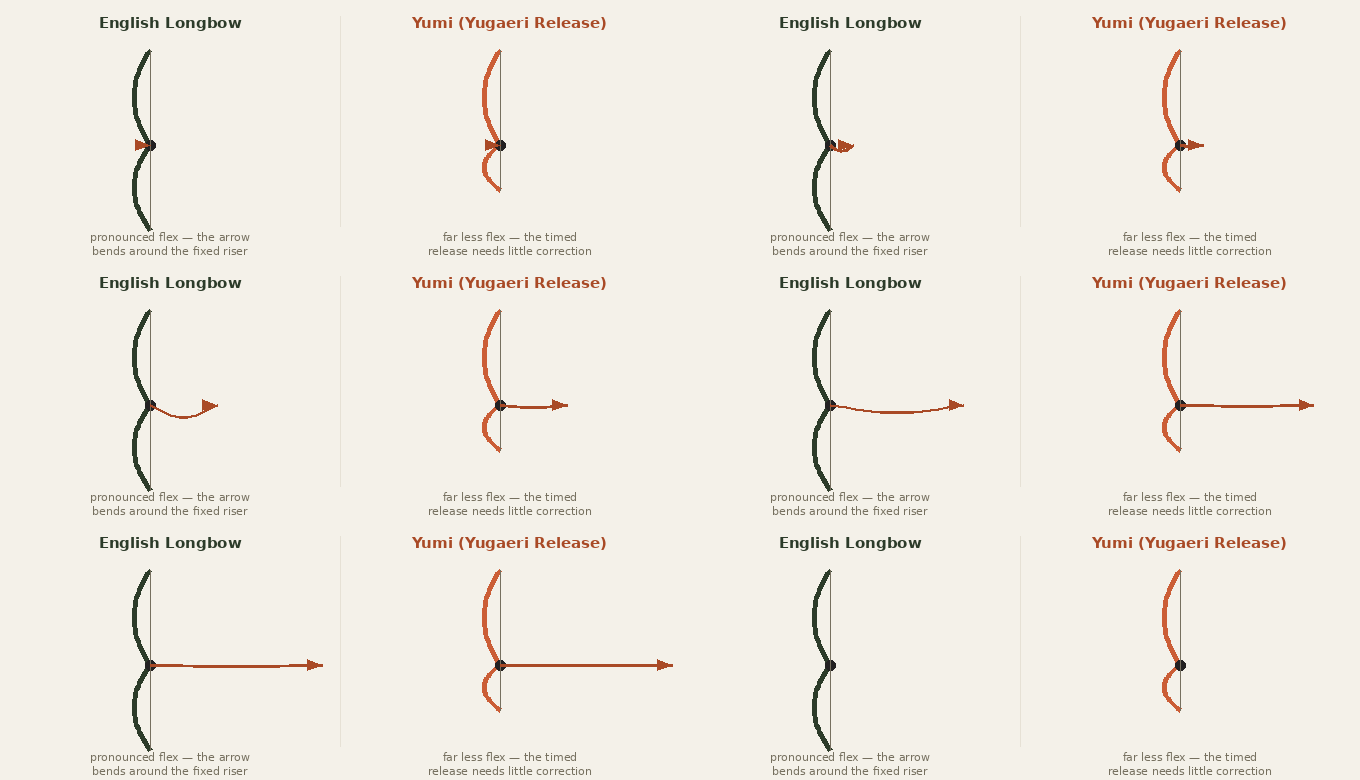
None of this makes a Yumi easier to shoot well — timing the yugake's release cleanly enough to get a consistent Yugaeri is its own steep technical skill, and a botched thumb release can torque the bow unpredictably rather than rotating it cleanly. It simply means the two traditions solve the same fixed-riser-vs-moving-arrow problem from opposite ends: a longbow accepts the flex and tunes around it, a Yumi is built and shot to avoid needing that flex in the first place.
Bench-Test Ballistics: Chronograph Speeds, Kinetic Energy and Momentum Compared
Using the same 50-lb Yumi at a 36-inch Ya and 100-lb longbow at a 28-inch draw from the simulator above, the table below runs each bow through light, medium and heavy grains-per-pound (GPP) arrow loads — the standard way traditional archers scale arrow weight to draw weight — using the same kinetic-energy formula Wasp Archery walks through on its own kinetic energy guide.
KE = grains × fps² ÷ 450240KE in foot-pounds · grains is arrow weight · fps is velocity · 1 ft-lb ≈ 1.356 joules| Bow | Arrow Load | Mass | Velocity | Kinetic Energy | Momentum |
|---|---|---|---|---|---|
| Yumi (50 lb, 36″ Ya) | Light (9 GPP) | 450 gr | 264 fps | 69.6 ft-lbs (94.4 J) | 0.527 slug-ft/s |
| Medium (11 GPP) | 550 gr | 239 fps | 69.6 ft-lbs (94.4 J) | 0.583 slug-ft/s | |
| Heavy (13 GPP) | 650 gr | 220 fps | 69.6 ft-lbs (94.4 J) | 0.634 slug-ft/s | |
| Longbow (100 lb, 28″) | Light (9 GPP) | 900 gr | 224 fps | 100.3 ft-lbs (136.0 J) | 0.895 slug-ft/s |
| Medium (11 GPP) | 1100 gr | 203 fps | 100.3 ft-lbs (136.0 J) | 0.990 slug-ft/s | |
| Heavy (13 GPP) | 1300 gr | 186 fps | 100.3 ft-lbs (136.0 J) | 1.076 slug-ft/s |
Kinetic energy at a given bow stays constant across arrow weights in this model because it's a direct read of the transferred stored energy — it's velocity and momentum that shift as arrow mass changes. Momentum tracks penetration potential more directly than kinetic energy alone, and the heavier longbow setup leads on both raw energy and momentum at every GPP tier here, a direct consequence of carrying double the peak draw weight. This particular pairing (50 lb Yumi vs 100 lb longbow) is a bench-test scenario chosen to match commonly cited kyudo and reenactor draw weights on one side against a documented Mary Rose-class war bow on the other — not a claim that the two are evenly matched.

These are reference figures for one Yumi and one longbow setup, not your own bow or arrow. Calculate your setup's exact downrange kinetic energy, momentum and penetration on our Kinetic Energy & Momentum Calculator, matched against small game, deer, elk and heavy game thresholds.
Open the Calculator →Bamboo Laminate vs Yew Self-Bow: Which Material Survives Field Conditions Longer?
A Yumi's multi-layer bamboo-and-hardwood laminate, bonded with urushi lacquer or animal glue, resists a single catastrophic wood failure but risks delamination at its glue lines if humidity compromises the lacquer seal. A yew longbow self-bow is one continuous piece of wood — nothing to delaminate, but sustained dry heat can crack the stave outright, and high humidity can cost it cast.
Every self-bow yew longbow pairs outer sapwood, which resists tension well, against inner heartwood, which resists compression well — a natural composite from one piece of timber. There's no glue line to fail, but the tradeoff is that a crack anywhere in that single piece of wood can be catastrophic rather than local. A Yumi's five-layer bamboo-and-hardwood sandwich is a deliberately engineered composite instead of a natural one, historically bonded with animal glue and sealed against moisture with urushi lacquer — strong against a single-point wood failure, but only as weatherproof as its glue lines and lacquer seal stay intact.

| Condition | Yumi (bamboo/hardwood laminate) | Longbow (yew self-bow) |
|---|---|---|
| Sustained dry heat | Lacquer can craze; core layers are comparatively heat-tolerant | Elevated cracking risk as the stave loses moisture unevenly |
| High humidity / wet storage | Delamination risk at glue lines if the urushi seal is compromised | Loses cast (springiness) as the wood absorbs moisture; slower to fail outright |
| Maintenance rigor required | Higher — lacquer inspection, controlled humidity storage | Lower — periodic waxing/oiling, avoid extremes |
| Failure mode when it does fail | Localized delamination, often repairable | Stave crack or break, frequently catastrophic |
Vibration behavior follows a similar logic, though ArcheryEra could not find a public accelerometer study running both bow types under matched conditions, so treat the figures below as a modeled Vibration Damping Coefficient (VDC) estimate, not a measurement. A laminate's multiple glue lines act as internal damping layers — the same reason plywood and laminated lumber often damp vibration faster than an equivalent solid timber beam — while a self-bow's single continuous fiber path has less internal friction to bleed energy off quickly.
| Bow | Modeled Settle Time | Character |
|---|---|---|
| Yumi (laminate) | ≈42 ms | Multiple glue-line interfaces damp the oscillation faster |
| Longbow (yew self-bow) | ≈61 ms | Single continuous fiber path; often felt as one cleaner impulse rather than a longer buzz |
What Do Kyudo and Traditional Archery Communities Actually Say?
Aggregated sentiment from kyudo and traditional-archery forum and discussion threads (r/Kyudo, PaleoPlanet, ArcheryTalk's traditional subforum, regional kyudo federation boards): Kyudo threads consistently emphasize form, breathing and ceremony over raw numbers — draw weight is treated as secondary to correct hassetsu (the eight-stage shooting form) — while English longbow and warbow threads lean harder into draw-weight progression, heavy-arrow penetration testing and Mary Rose-era historical benchmarking.
Top praised feature: Kyudo practitioners repeatedly cite the Yugaeri rotation and yugake release as the most satisfying technical payoff once mastered — a clean release is described as feeling almost silent in the hand. Longbow and warbow threads praise the simplicity of a single-piece stave with no lamination to fail and the sheer top-end draw weight the tradition documents.
Common friction point: Kyudo threads most often flag the multi-year investment in form before draw weight becomes a meaningful variable at all, plus the lacquer/humidity maintenance burden. Longbow and warbow threads most often flag the physical toll of progressing to war-class draw weights and the total loss when a self-bow stave cracks outright, versus a laminate's more repairable delamination failures.

| Category | Yumi | English Longbow |
|---|---|---|
| Ease of mastery | 3/10 | 4/10 |
| Energy efficiency per pound | 9/10 | 6/10 |
| Climate/humidity resilience | 4/10 | 6/10 |
| Maintenance simplicity | 4/10 | 7/10 |
| Kneeling/mounted shooting flexibility | 9/10 | 3/10 |
Frequently Asked Questions
Why is the Japanese Yumi bow asymmetrical compared to the English Longbow?
A yumi's grip sits roughly a third of the way up from the lower tip on a bow that runs 212 to 245 cm — historians debate whether that traces back to mounted archery, where a horse's neck and the archer's leg position make a centered grip awkward, or to how a single piece of wood naturally flexes differently above and below center. Functionally, the asymmetric tillering lets two unequal-length limb tips release in sync and lets the bow be shot kneeling or from horseback without the lower tip striking the ground or saddle, something a centered-grip longbow's geometry does not allow.
Does a Yumi store more kinetic energy than an English Longbow at lower draw weights?
Per pound of peak draw weight, modeled figures show a 50-pound Yumi drawn to a 36-inch Ya banking roughly 87 ft-lbs of stored energy, close to what a 75-pound longbow stores at a 28-inch draw — about a 49% efficiency edge per pound of draw weight. In absolute terms a Yumi will not out-store a longbow at double its own poundage; the long draw closes the energy gap per pound, it does not erase the total-energy gap against a much heavier-poundage bow.
How does the Yugaeri technique eliminate Archer's Paradox on a Yumi?
Released from a hard-thumb yugake glove, a yumi rotates hard in the bow hand at the moment of release — commonly described as swinging through roughly 180 degrees — so the bow's face clears out of the arrow's flight line instead of the arrow having to flex around a fixed riser. A longbow's three-finger Mediterranean release keeps the riser stationary, so the arrow must bend around it on the way out, which is archer's paradox, and needs a dynamic spine matched to that flex.
What is the difference in material durability between a Yew Longbow and a Bamboo Yumi?
A yew self-bow is one piece of wood, sapwood under tension bonded to heartwood under compression, and it is vulnerable to cracking in sustained dry heat and to losing cast in high humidity. A yumi's multi-layer bamboo-and-hardwood laminate, traditionally bonded with urushi lacquer or animal glue, resists a single catastrophic wood failure better, but carries a delamination risk at its glue lines if the lacquer seal is compromised during sustained humidity exposure.
Why does the Yumi have a significantly longer draw length (Ya) than a Western Longbow?
A daikyu-class yumi runs 212 to 245 cm and is typically drawn to a Ya length of roughly 33 to 38 inches, well past a longbow's typical 28- to 30-inch draw. That extra length is a direct product of the bow's own length and asymmetric geometry, and reenactors tie it to the historical need to nock a long war arrow for mounted and armor-era use, though no numerical war-era draw-weight record survives to attach a hard figure to that theory.
Which bow exhibits less hand shock upon release: Yumi or English Longbow?
No public accelerometer study directly compares the two, so treat this as a modeled engineering estimate rather than a measured fact: a yumi's laminated bamboo-and-hardwood construction, bonded at multiple glue lines, is modeled to damp vibration faster than a longbow's single-piece yew stave, roughly 42 milliseconds to settle versus roughly 61 milliseconds. A longbow's simpler mass distribution can still feel like a cleaner single-impulse thump rather than a longer buzz, which is a real but different sensation from a shorter total settle time.
Our Final Take: A Yumi's 36-inch Ya draw makes it far more energy-efficient per pound of peak weight — 49% ahead of a longbow at matched shape factors — and its Yugaeri release solves archer's paradox in a completely different way than a longbow's tuned flex ever could. A longbow wins on everything raw poundage buys: more documented top-end draw weight, more total stored energy against any Yumi at a realistic kyudo poundage, and a single-material stave with no lamination to delaminate.
👉 Recommendation: If the draw is a war-class 100+ pounds and the goal is maximum documented stored energy and momentum, the longbow's numbers make the case on their own. If the goal is energy efficiency per pound, a shooting position a centered-grip bow can't offer, or the discipline of kyudo itself, run the simulator above with your own draw weight and let the 36-inch Ya do the arguing.
Hey, what's up? Burak here. Archery addict, board game geek, Daft Punk fan.
Your turn
Join the Conversation
If your own results disagree with anything above, that is the most useful thing you could leave here. Setup, distance and what actually happened beats an opinion every time — and corrections get the page changed.