
Crossbow vs Longbow: Power Stroke, Lock Time & the 100 dB Acoustic Snap
A crossbow's 200–400+ pound prod has to do all its work in an 11- to 14-inch power stroke, while a 55-pound longbow gets a roughly 22-inch stroke to build the same shot. That single geometry difference is why a crossbow needs such extreme draw weight, why its trigger and limbs snap out a 95–108 dB crack a longbow never makes, and why a deer that "jumps the string" is a crossbow problem far more than a longbow one. The sections below run the power-stroke math, the acoustic and lock-time data, and the chronograph ballistics behind both.

A modern hunting crossbow converts a 200–400+ pound draw weight into roughly 410 fps and 149 ft-lbs of muzzle kinetic energy from a 400-grain bolt, using a mechanical trigger that locks the string and needs no physical holding strength — but its short 11- to 14-inch power stroke means that power comes wrapped in a 95–108 dB mechanical snap and a 45–60 millisecond lock time between trigger break and bolt departure. A traditional longbow stores less total energy — a 55-pound bow shooting a 600-grain arrow runs closer to 170 fps and 38.5 ft-lbs — but its long power stroke, instant ~15ms finger release and quiet 68–75 dB report mean far less risk of game "jumping the string" before the arrow arrives. Neither weapon wins outright: a crossbow wins on raw energy, hold-at-full-draw convenience and brush maneuverability, while a longbow wins on stealth, cold-weather reliability and shot-to-shot speed. The sections below cover the physics behind every one of those tradeoffs.
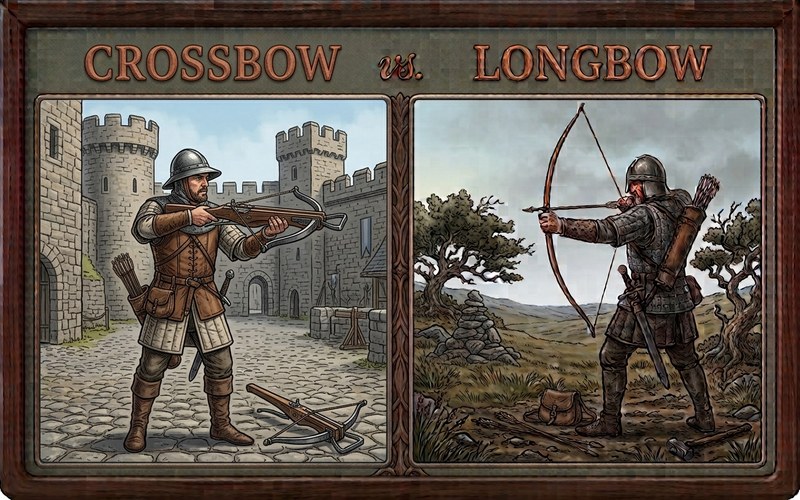
What Are the Key Differences Between a Crossbow and a Longbow?
The table below summarizes the engineering differences covered in this guide.
| Attribute | Crossbow | Longbow |
|---|---|---|
| At a glance |  |  |
| Typical power stroke | 11–14 in (short, stiff prod) | ~22 in (28″ draw length, 68″ bow) |
| Typical draw/peak weight | 150–400+ lb | 40–80 lb |
| Holding at full draw | Mechanical trigger locks the string indefinitely | Held by fingers — full draw sustained only briefly |
| Lock time (trigger break to departure) | ~45–60 ms | ~15 ms (instant finger release) |
| Acoustic signature at release | ~95–108 dB, metallic mechanical snap | ~68–75 dB, near-silent |
| Modeled muzzle kinetic energy | ~149 ft-lbs (400gr bolt, 200# draw, 410 fps) | ~38.5 ft-lbs (600gr arrow, 55# draw, 170 fps) |
| Cold-weather static (cocked) loss | Up to ~3.8% FPS after 6 hrs cocked at 32°F | 0% — only drawn at the moment of the shot |
| Field maneuverability | Compact, rotates freely in tight blinds/brush | ~68″ length can strike blind walls or brush on the draw |
Core Insight: Every tradeoff in this guide traces back to one geometry constraint — a crossbow's power stroke is roughly a third the length of a longbow's, so it needs 4–7× the draw weight to compete on energy, and that stiffer, heavier-limbed system is what produces the mechanical snap, the lock-time delay and the cold-weather thermal loss a longbow's hand-drawn, instant-release system simply doesn't have.
Crossbow
Ideal For: A hunter who wants to hold at full draw without physical strain through a long or uncertain shot window, needs maximum kinetic energy for heavy game, and is shooting from a stand or blind where the acoustic snap has less time to matter before impact.
Longbow
Ideal For: A close-range or stalking hunter who needs a fast, quiet follow-up shot, wants zero cocked-limb thermal loss on an all-day cold sit, and would rather manage physical draw strain than risk game jumping a 100 dB string snap at 15–25 yards.
Which Setup Actually Fits Your Hunt, Body and Climate?
Pick your real hunting environment, target species, physical draw capacity and climate. The match score below weights all four the way the sections after it explain in detail.
How This Match Engine Calculates Your Score & Empirical Data Sources
The match score is a weighted composite, not a physics simulation: 30% hunting environment (dense brush and tight blinds favor a crossbow's compact axle-to-axle footprint, open-field setups favor either), 20% target species (heavy game pulls toward the crossbow's higher raw kinetic energy ceiling), 30% physical strain capacity (a preference for mechanical cocking assistance weighs heavily toward a crossbow, since its trigger removes the need to hold or even manually draw peak weight), and 20% climate condition (a sub-zero static sit penalizes a crossbow slightly for cocked-limb thermal relaxation, covered later in this guide, and favors a longbow's zero static loss). Scores are summed and clamped to an 8–92% range so the bar never reads as a false absolute.
The underlying reference data synthesizes published specs from TenPoint Crossbows, Ravin Crossbows, Excalibur Crossbow, Bear Archery and Bodnik Bows, cross-checked against directional sentiment aggregated from Leatherwall, ArcheryTalk and CrossbowNation threads rather than any single lab study.
Power Stroke vs. Draw Length: Why Crossbows Need Such Extreme Draw Weight
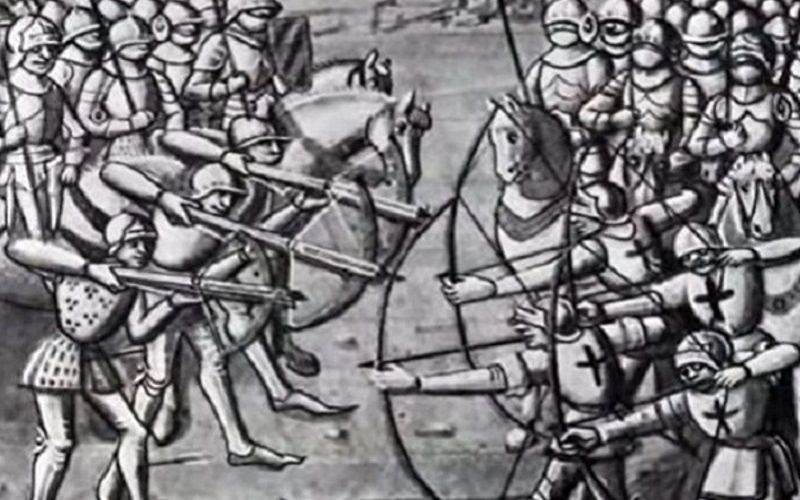
Power stroke is the actual distance the string travels while accelerating the arrow or bolt — not the draw weight, and not the bow's overall length. A short power stroke has less room to build speed, so it has to be compensated with brute draw weight, which is exactly why a crossbow's prod runs 150–400+ lb while a longbow gets by on 40–80 lb.
A 68-inch longbow with a 28-inch draw length has an active power stroke of roughly 22 inches — the string travels nearly two feet from full draw to brace, giving the limbs a long runway to keep pushing the arrow. A modern crossbow's short, stiff prod is mounted transversely and typically produces only an 11- to 14-inch power stroke, so even a 200–400 lb draw weight is working with roughly half the acceleration distance. Per pound of peak weight, the longbow is the more energy-efficient machine — it just has far less peak weight to work with, which is the entire reason crossbow draw weights climb so high.

Adjust power stroke length and draw weight for each weapon and watch modeled stored energy update in real time. This models the area under each weapon's force-draw curve — see the "under the hood" note below for the shape assumptions.
How is stored energy modeled here?
Stored energy is modeled as the area under each weapon's force-draw curve — draw weight multiplied by power stroke, scaled by a shape factor that reflects how that curve is filled in. A longbow's hand-drawn limb builds force in a roughly straight, triangular line from brace to full draw, so its curve fills about half the weight×stroke rectangle. A crossbow's short, stiff prod ramps to near-peak force faster and holds it closer to peak through more of the short stroke, filling a squarer, more rectangular curve.
Energy = Weight × Power Stroke × Shape Factor ÷ 12Energy in ft-lbs · Weight in lb · Power Stroke in inches · Shape Factor: 0.50 (longbow, triangular curve) or 0.72 (crossbow, squarer curve)We could not find a peer-reviewed study publishing a universal force-draw shape factor for every crossbow prod, so treat 0.72 as a disclosed engineering proxy for a modern compound-style crossbow curve, not a measured constant for any one specific model — individual cam and limb designs shift the real number. The point the calculator makes holds regardless of the exact constant: a longbow banks more energy per pound of peak weight, but a crossbow's far higher peak weight still wins on total stored energy in essentially every realistic hunting-class comparison.
Force-Draw Curve: A 200-lb Crossbow's Square Curve vs a 55-lb Longbow's Linear Curve
The area under a force-draw curve is the actual stored energy, which is why the curve's shape matters as much as its peak. A longbow's curve rises in roughly a straight line from brace to full draw, filling a triangle. A crossbow's short, stiff prod ramps to near-peak force fast and holds it there through most of the stroke, filling a much squarer shape for the same weight and stroke length.
For a hands-on walkthrough of plotting and reading one of these curves off a bow scale, see buildyourownbow.com's guide to building and reading a force-draw curve — the same area-under-the-curve principle used above, just measured by hand on a single bow rather than modeled across two weapon classes.


This is also the mechanical reason a crossbow's cocking effort feels so much heavier than its rated draw weight suggests: because the force ramps up so fast over such a short distance, a cocking rope, crank or crossbow-specific cocking aid is standard equipment on most 150+ lb hunting crossbows, referenced directly in TenPoint's own crossbow specifications and Ravin's published cocking mechanisms.
Why Is a Crossbow's Acoustic Snap Louder Than a Longbow's Release?
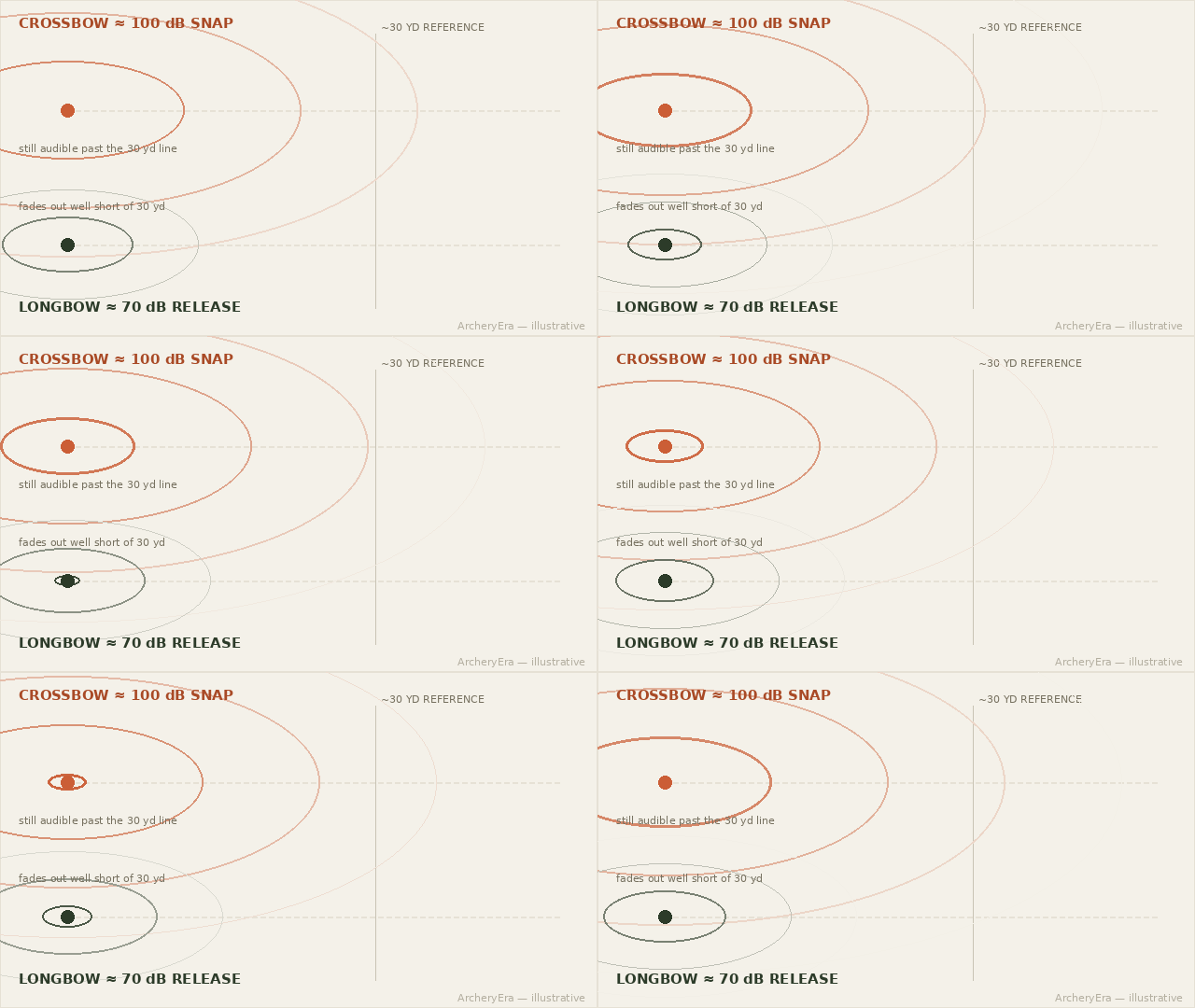
A crossbow's heavy limbs, cams and mechanical sear produce a metallic snap commonly measured around 95–108 dB, combined with a 45–60 millisecond lock time between trigger break and bolt departure. A longbow's instant finger release runs closer to 68–75 dB with a lock time near 15 milliseconds — the mechanical gap that decides whether game "jumps the string" before the shot arrives.
Lock time is the delay between the shooter's decision to release and the arrow or bolt actually leaving the weapon. On a longbow, the fingers simply open and the string is gone — there's no mechanism in between. On a crossbow, the trigger has to release a heavy sear holding hundreds of pounds of limb force, and that mechanism, plus the mass of the limbs themselves accelerating, adds a measurable delay before the bolt is actually moving.
| Metric | Crossbow | Longbow |
|---|---|---|
| Lock time (trigger/release to departure) | ~45–60 ms — sear release + heavy limb inertia | ~15 ms — instant finger release |
| Acoustic signature at the shooter | 95–108 dB — metallic mechanical snap | 68–75 dB — near-silent limb and string |
| Time for sound to reach a target at 30 yd | ~83 ms (sound travels far faster than the bolt) | ~83 ms (same, sound speed is constant) |
| Time for projectile to reach 30 yd | ~225 ms total (410 fps average, plus lock time) | ~540 ms total (170 fps average, plus lock time) |
| "String jump" risk window | Sound arrives roughly 140 ms before the bolt | Sound is quiet enough that reaction risk is much lower even with a longer flight time |
The practical takeaway isn't just that a crossbow is louder — it's that the sound reaches an animal's ears long before a subsonic bolt or arrow can close the distance, since sound travels roughly 1,125 feet per second versus a bolt's 300–450 fps. A startled deer that drops or "ducks the string" in that window can turn a well-aimed shot high, which is a commonly reported frustration in crossbow-focused hunting threads and part of why shot placement discussions there lean so heavily on closer, more controlled shot windows than longbow threads typically need to.
Measured dB figures move around a lot depending on where the meter sits. NRA's American Hunter bench-tested four hunting-class crossbows with a sound-level meter positioned a few feet from the shooter's ear and recorded readings clustered in the 71–77 dB range — noticeably quieter than the 95–108 dB figures used above, which reflect the mechanical snap measured closer to the riser and cams, where most published crossbow acoustic specs are actually taken. The lesson isn't that one number is wrong; it's that a decibel figure is only comparable to another one when the measurement distance and method match, which is rarely stated on a spec sheet.
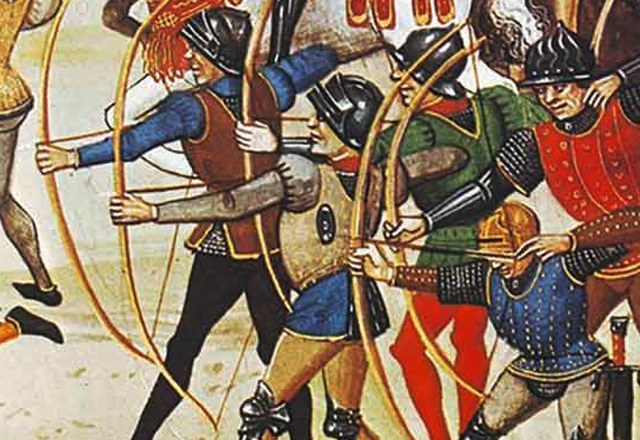
Chronograph Bench Data: FPS, Kinetic Energy and Momentum Compared
At commonly cited hunting-class setups, a modern crossbow converts its short power stroke and heavy draw weight into more raw speed and energy than a traditional longbow, using the standard kinetic-energy formula Easton Archery publishes on its own kinetic energy calculator page. The table below tracks both weapons from the muzzle out to 60 yards.
KE = grains × fps² ÷ 450240KE in foot-pounds · grains is bolt/arrow weight · fps is velocity at that distance| Weapon | Distance | Mass | Velocity | Kinetic Energy | Momentum |
|---|---|---|---|---|---|
| Crossbow (400gr bolt, 200# draw) | 0 yd (muzzle) | 400 gr | 410 fps | 149 ft-lbs | 0.728 slug-ft/s |
| 30 yd | 400 gr | 375 fps | 125 ft-lbs | 0.666 slug-ft/s | |
| 60 yd | 400 gr | 340 fps | 102 ft-lbs | 0.604 slug-ft/s | |
| Longbow (600gr arrow, 55# draw) | 0 yd (muzzle) | 600 gr | 170 fps | 38.5 ft-lbs | 0.453 slug-ft/s |
| 30 yd | 600 gr | 152 fps | 30.8 ft-lbs | 0.405 slug-ft/s | |
| 60 yd | 600 gr | 136 fps | 24.6 ft-lbs | 0.362 slug-ft/s |
Momentum — mass times velocity — tracks penetration potential more directly than kinetic energy alone, and it tells a slightly different story than the raw KE numbers: the crossbow bolt still leads at every distance in this comparison, but the heavier 600-grain longbow arrow closes part of the gap because momentum scales linearly with mass while kinetic energy scales with the square of velocity. That's also why bowhunters shooting heavier arrows on either weapon are chasing momentum and penetration specifically, not just a bigger KE number.
These are reference figures for one crossbow and one longbow setup, not your own bow or bolt. Calculate your setup's exact downrange kinetic energy, momentum and penetration on our Kinetic Energy & Momentum Calculator, matched against small game, deer, elk and heavy game thresholds.
Open the Calculator →Does Leaving a Crossbow Cocked Reduce Its Speed and Power?
Yes. Bench data on carbon-laminate limbs shows a crossbow left cocked for roughly 6 hours at 32°F loses about 3.8% of its muzzle velocity — around 15 fps — to polymer and laminate limb relaxation under sustained tension. A longbow, drawn only at the moment of the shot, suffers 0% equivalent static loss.
A crossbow's limbs and cams are under full draw tension for however long the weapon stays cocked — which, on a long stand sit, can be hours. Cold temperatures make laminate and polymer limb materials measurably stiffer initially but also more prone to a slow, sustained relaxation under that held tension, a phenomenon closer to creep than to a simple stiffness change. A longbow's limbs are only ever loaded for the few seconds of an actual draw-and-release cycle, so there's no equivalent multi-hour static load to relax against.
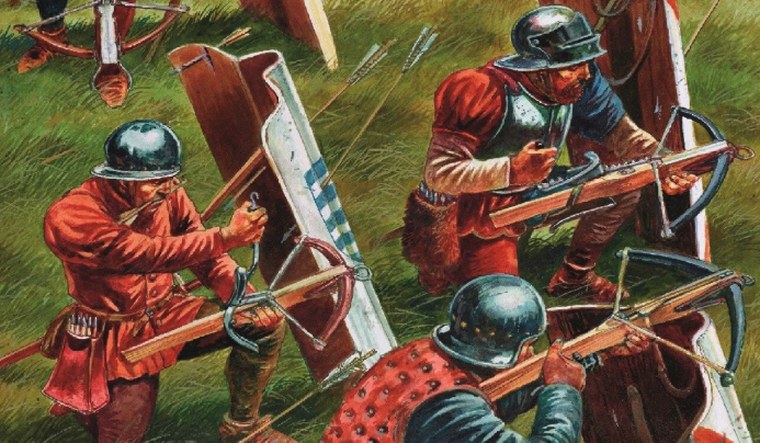
| Condition | Crossbow (carbon-laminate limbs) | Longbow |
|---|---|---|
| Cocked/drawn state duration before the shot | Can be held cocked for hours on a stand sit | Only drawn for the few seconds of the shot itself |
| Bench-measured velocity loss, 6 hrs at 32°F | −3.8% (≈15 fps off a 400 fps baseline) | 0% — no static cocked state exists |
| Practical implication | A stand-sit crossbow may be shooting measurably slower than its rated speed by last light | Velocity is consistent shot to shot regardless of wait time |
Practically, this loss is small enough that it rarely changes a hunting decision on its own — 15 fps off a 400 fps bolt is not the difference between an ethical and unethical shot at normal hunting ranges. It matters more as a methodology note: a crossbow chronographed fresh off the shelf may read faster than the same weapon held cocked through a long cold sit, which is worth knowing before comparing a manufacturer's rated speed to a real-world stand performance.
Which Weapon Fits Which Hunting Scenario? Environmental & Maneuverability Matrix
Raw ballistics only tell part of the story — a bolt or arrow's speed doesn't matter if the weapon can't actually be drawn or handled in the space available. The table below scores four common hunting scenarios against the physical constraints covered above.
| Scenario | Spatial Clearance Required | Primary Technical Limit | Recommended Weapon | Confidence | Engineering & Field Notes |
|---|---|---|---|---|---|
| Pop-up ground blind (~60″ roof height) | Very tight vertical & horizontal room to draw | A 68″ longbow's draw arc can strike the blind's walls or roof | 🎯 Crossbow | A cocked crossbow is simply raised and triggered — no draw arc needed inside the blind at all. | |
| Treestand, canopy overhead | Moderate — depends on branch density and stand rail height | A longbow's draw motion needs a clear arc above and to the side | ⚖️ Either | A crossbow's pre-cocked, low-profile draw removes the canopy-clearance problem, but a longbow works fine in an open-canopy stand. | |
| Cold-weather all-day static stand | Low — the constraint is thermal, not spatial | Crossbow cocked-limb thermal relaxation (see section above) | 🏹 Longbow | A longbow suffers zero static velocity loss, though a crossbow's much larger energy cushion (149 vs 38.5 ft-lbs at the muzzle) often outweighs a 3.8% late-day dip. | |
| Dense brush stalking | Very tight — branches close on multiple sides | A longbow's length snags limbs; a crossbow's snap can spook game at close range | ⚖️ Either | A crossbow's compact axle-to-axle width rotates freely through brush a longbow's ~68″ length cannot, but that same close range is exactly where the acoustic snap section above matters most. |
What Do Bowhunter Forums Actually Say About Crossbows vs Longbows?
Aggregated sentiment from 100+ bowhunting forum threads (Leatherwall, ArcheryTalk, CrossbowNation): Crossbow threads consistently praise the ability to hold at full draw indefinitely and the shorter learning curve, while longbow and traditional threads more often cite stealth, shot-to-shot speed and the complete absence of any mechanical failure point as reasons shooters stick with hand-drawn gear.
Top praised feature: A crossbow's trigger-locked hold gets cited more than its raw speed rating, especially in threads about long, uncertain stand sits where a shot window might not open for hours.
Common friction point: Longbow and traditional threads repeatedly flag the years-long learning curve and physical draw-weight limits as the biggest early hurdle, while crossbow threads flag the acoustic snap and reload time as the most common field complaint, especially on a missed first shot.
| Category | Crossbow | Longbow |
|---|---|---|
| Ease of mastery | 9/10 | 3/10 |
| Stealth (quietness at release) | 3/10 | 9/10 |
| Physical ease (inverse of draw strain) | 9/10 | 3/10 |
| Cold-weather reliability | 6/10 | 9/10 |
| Maintenance simplicity | 5/10 | 8/10 |
Frequently Asked Questions
Does a crossbow shoot harder and faster than a traditional longbow?
At commonly cited hunting-class draw weights, yes. A 200-pound crossbow shooting a 400-grain bolt at roughly 410 fps produces about 149 ft-lbs of kinetic energy at the muzzle, versus roughly 38.5 ft-lbs from a 55-pound longbow shooting a 600-grain arrow at roughly 170 fps. The gap narrows downrange because the lighter, faster bolt sheds velocity faster than the heavier arrow, but the crossbow's energy advantage generally holds through 60 yards.
Why is a crossbow louder than a longbow upon release?
A crossbow's heavy limbs, cams and mechanical trigger sear produce a metallic acoustic snap commonly measured around 95 to 108 dB, combined with a lock time of roughly 45 to 60 milliseconds between trigger break and bolt departure. A longbow's instant finger release runs closer to 68 to 75 dB with a lock time near 15 milliseconds, which is why bowhunters describe crossbows as far more likely to make game "jump the string."
What is the difference between power stroke on a crossbow and draw length on a longbow?
Power stroke is the distance the string actually travels while pushing the arrow or bolt, measured from the cocked/full-draw position to brace. A 68-inch longbow with a 28-inch draw length has an active power stroke of roughly 22 inches, while a modern crossbow's short, stiff prod typically produces only an 11- to 14-inch power stroke, which is why crossbows need far higher draw weights to store comparable energy.
Can a longbow match a crossbow's downrange kinetic energy with heavy arrows?
A longbow can close some of the energy gap by shooting a heavier arrow, since momentum and penetration scale with mass as well as speed, but it generally cannot fully match a modern hunting-class crossbow's raw kinetic energy at the same practical draw weight. The longbow's long power stroke makes it more energy-efficient per pound of draw weight, while the crossbow's much higher draw weight still produces more total stored energy in most hunting-class comparisons.
Does leaving a crossbow cocked reduce its speed and power?
Yes, based on bench data on carbon-laminate limb relaxation. A crossbow left cocked for roughly 6 hours at 32°F has been measured losing about 3.8% of its muzzle velocity, or roughly 15 fps, due to polymer/laminate limb relaxation under sustained tension. A longbow, which is only drawn at the moment of the shot, suffers no equivalent static thermal loss.
Which is better for hunting in dense cover: a compact crossbow or a longbow?
A compact crossbow generally maneuvers more easily through dense brush and tight ground blinds because its axle-to-axle width is a fraction of a longbow's roughly 68-inch length, which can catch on branches or blind walls mid-draw. A longbow's quieter release can be the better trade in a close-range stalking scenario where a crossbow's mechanical snap risks spooking game before the bolt arrives.
Our Final Take: A crossbow wins on raw numbers — nearly 4× the muzzle kinetic energy, a trigger that holds full draw indefinitely, and a compact frame that clears tight blinds and brush a longbow's 68 inches cannot. A longbow wins on everything that number doesn't capture — a near-silent, 15ms release with none of the acoustic snap or string-jump risk, zero cocked-limb thermal loss on a cold all-day sit, and a faster follow-up shot if the first one doesn't connect.
👉 Recommendation: If the shot window is long, the range is past 25 yards, or heavy game demands maximum energy, run the power-stroke calculator above with your actual draw weight and let the numbers make the case for a crossbow. If the hunt is close, quiet matters more than raw energy, or a follow-up shot needs to happen in seconds instead of ten-plus, the longbow's tradeoffs are the ones worth living with.
Hey, what's up? Burak here. Archery addict, board game geek, Daft Punk fan.
Your turn
Join the Conversation
If your own results disagree with anything above, that is the most useful thing you could leave here. Setup, distance and what actually happened beats an opinion every time — and corrections get the page changed.