Barebow vs Olympic Recurve: Same Limbs, 22× Less Stabilization
Same riser, same limbs, two different games. Bolt on a sight, a clicker and a long rod and you have an Olympic recurve: the bow holds still and your form does the work. Take it all off and you have a barebow: you aim with the arrow point, walk your fingers down the string for distance, and you become the sight, the clicker and the stabilizer. Here is what that trade costs in tiller, speed and points, and which one fits the way you shoot.


Core Insight: Olympic recurve is the higher-scoring machine at every distance, and the gap grows with range. Barebow is the simpler, lighter, more intuitive bow, and it is the only one of the two that makes sense for field and 3D. If you want to shoot 70 m, pick Olympic. If you want one bow for the indoor league, the field course and the backyard, pick barebow.
- String-walking and tiller: a 30 mm crawl puts about 6.5% more tension on the lower string segment than the upper one in my geometry model, against 0.6% for an Olympic split-finger hook. Most string-walkers answer with even or slightly negative tiller, not the positive tiller an Olympic bow runs.
- Stabilizers: the long rod and side bars give an Olympic rig about 22 times the barebow’s resistance to twisting left and right in my model (~1,690 vs ~75 kg·cm²). Up and down, the gap is only 1.6×, because the limbs already do most of that work on both bows.
- Scores: in my reference set the barebow trails by ~5.6% at 18 m, ~12.8% at 50 m and ~22.7% at 70 m. Point-on gaps and wind drift do most of the damage at long range.
- The 12.2 cm ring: under World Archery rule 9.3.6 the whole barebow, braced or unbraced, with every weight and damper attached, must pass through a 12.2 cm ring. So weight goes inside or tight against the riser, low, never on a rod.
Barebow (ILF riser, no sight, no rods)
Ideal For: indoor 18 m leagues, field and 3D courses, archers who hate carrying a tackle box, and anyone who enjoys aiming with the arrow instead of a pin.
Olympic recurve (sight, clicker, V-bar)
Ideal For: 70 m target archery, archers chasing the highest possible scores, and anyone who wants the bow to hold still while their form does the work.
Barebow or Olympic? The 1-Minute Comparison
| What you care about | Barebow | Olympic recurve |
|---|---|---|
| Aiming | Arrow point on the target; crawl down the string or move your anchor for distance | Sight pin on the gold; one sight mark per distance |
| Hook & anchor | Usually 3 fingers under the nock, high anchor at the corner of the mouth | Split finger (1 over, 2 under), anchor under the chin with a string touch on the nose |
| Draw check | None allowed; your back and your feel | Clicker tells you when to let go |
| Extra weight | Only what fits through a 12.2 cm ring, mounted on the riser | Long rod, V-bar, side rods, any weight you like |
| Home distance | 18 m indoor, 50 m outdoor, field and 3D courses | 18 m indoor, 70 m outdoor (the Olympic distance) |
| US events | USA Archery barebow division, NFAA barebow recurve (field and indoor), local 3D | USA Archery recurve division, JOAD, Olympic pathway |
| Hunting fit | Good: strip the weights, it is a takedown hunting recurve | Poor: rods, clicker and sight are built for the target line |
| Gear to carry | Bow, tab, arrows. Short case | Bow, sight, clicker, three rods, V-bar, bigger case |
| Biggest frustration | Crawl marks move when arrows, tab or string change | Tuning and setting up a lot of parts |
Which Recurve Discipline Fits the Way You Want to Shoot?
Barebow versus Olympic recurve comes down to four things: the distance you care about, how much gear you will tolerate, how you want to aim, and what you already own. Set them below and the tool returns a match split, a starting ILF setup, a tiller starting point and the reasoning behind it.
Pick your distance, drag the complexity slider, choose an aiming method and tell it what is already in your case. The bar shows the split. The cards give you a setup to start from.
Set your inputs above.
Starting ILF setup
Tiller starting point
Modeled gap to Olympic
Technical rationale:
How does the discipline match tool score?
It is a weighted planning heuristic, not a verdict: 35% distance, 25% complexity tolerance, 25% aiming method and 15% gear you own, clamped to 6–94% so it never pretends to be certain. The score gap card reads from the scoring matrix on this page, and the tiller card uses the split-finger vs 3-under starting points from the crawl section. Confirm any setup with a paper-tuning pass.
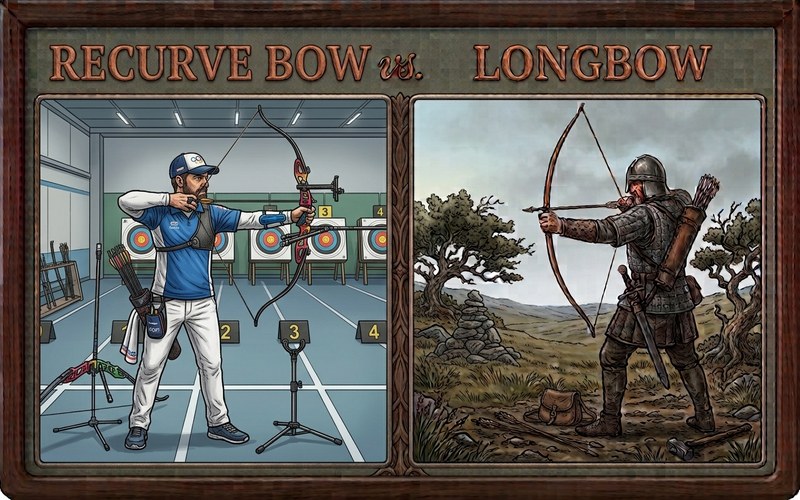
Words first, because the two names get mixed up. An Olympic recurve (World Archery calls the division simply “recurve”) is a takedown bow with a sight, a clicker and stabilizers, shot with a split-finger hook: one finger above the nock, two below. A barebow is the same kind of takedown recurve with all of that stripped off. No sight. No clicker. No rods. The archer aims with the arrow point and usually hooks the string with all three fingers under the nock.
Both sit on the same ILF limb fitting in most cases, and plenty of archers own one riser and swap between the two. That is exactly why the differences are worth measuring. (Still deciding between a recurve and a compound at all? Start with compound bow vs recurve bow.)
Does String-Walking in Barebow Mess Up Your Tiller Balance?
It shifts it, every time you crawl. Moving your fingers down the string lowers the point you pull from, so the lower string segment carries more tension than the upper one and the lower limb works harder. An Olympic archer pulls from the same spot on every shot, so one tiller setting fits every distance. A string-walker has to pick a compromise.
Picture the string at full draw as two straight segments meeting at your fingers. If you pull exactly from the middle, both segments sit at the same angle and carry the same tension. Pull from lower down and the upper segment gets longer and steeper while the lower one gets shorter and flatter.
Your drawing hand pulls straight back. It pushes nothing up or down. So the vertical pull of the two segments has to cancel, and the flatter lower segment can only match the steeper upper one by carrying more tension. That extra tension goes straight into the lower limb.
That is the whole mechanism. No magic.
I modeled it for a 68″ bow (25″ ILF riser, medium limbs) at a 28″ draw, with the limb tips about 635 mm above and below the string’s center and 517 mm in front of your fingers. The Olympic split-finger hook pulls from roughly 5 mm under the nock. A 3-under barebow hook with the index finger touching the nock pulls from about 20 mm under it, and every millimeter of crawl adds to that.
| Hook / crawl | Pull point below nock | Lower vs upper segment tension | Lower limb share of load |
|---|---|---|---|
| Olympic split finger | ~5 mm | +0.6% | 50.2% |
| Barebow, top of string (face-walk) | ~20 mm | +2.5% | 50.6% |
| Barebow, 15 mm crawl | ~35 mm | +4.5% | 51.1% |
| Barebow, 30 mm crawl | ~50 mm | +6.5% | 51.6% |
| Barebow, 45 mm crawl | ~65 mm | +8.6% | 52.1% |
| Barebow, 60 mm crawl | ~80 mm | +10.7% | 52.6% |
Modeled with a two-segment string, frictionless tips and a purely horizontal draw force. Real limbs also bend unevenly under that extra tension, so treat the percentages as the direction and rough size of the effect.
You will see bigger numbers quoted online, some claiming a 30 mm crawl loads the lower limb 14% harder. My geometry does not get there. Even a 60 mm crawl, which is an 18 m crawl for a lot of 40 lb bows, stays near 11% more tension on the lower segment. What the extra load does do is make the bow pitch at release, and that shows up as nock travel on paper and as vertical spread on the target.
Positive, Even or Negative Tiller for String-Walking?
Olympic archers run positive tiller: the top limb sits a few millimeters farther from the string than the bottom one, usually +3 to +5 mm (about 1/8″–3/16″). That offsets a pull point just under the nock and a grip that sits below the bow’s center.
String-walkers pull from much lower, so the lower limb is already doing more. Adding positive tiller strengthens it further. That is backwards. The long-running ArcheryTalk threads on running negative tiller for string walking, on how much negative tiller a stringwalker needs and on negative tiller with a 3-under hook mostly land in the same place: even tiller, or a few millimeters negative, tuned at the crawl you use most.
My stance: start at 0 mm. Tune with bare shafts next to fletched arrows or through paper at your mid crawl (often your 30 m crawl), then try 2 mm negative and keep whichever groups tighter vertically. Don’t chase a perfect tune at 18 m and 50 m at the same time. The crawl changes by 50 mm or more between them, and no single tiller setting is right for both. A deep crawl also changes how the shaft bends off the plunger, so if bare shafts refuse to group at your short crawls, run the arrow through the dynamic spine & shaft flex calculator before you touch the tiller again.
Myth: “Barebow needs more positive tiller because you pull lower.”
Reality: pulling lower already loads the lower limb. More positive tiller makes the imbalance worse. Go even or negative, then let the paper tell you.
String-Walking Crawl & Tiller Shift Calculator
Set your crawl, your marked draw weight, your arrow weight and how far your eye sits above the nock at anchor. The calculator returns the tension split between the limbs, a tiller starting point, the modeled speed loss against an Olympic setup, the distance your crawl should hit and a starting crawl chart for 10–50 m.
Start with the crawl at 0 to see your point-on distance, then slide it down the string. Watch the lower-limb bar climb and the target distance shrink. Underneath, the calculator writes a starting crawl chart from 10 to 50 m for your setup. Copy it, shoot each distance once, and correct the marks on your tab.
Tiller starting point
Modeled launch speed
Point-on vs this crawl
Your starting crawl chart (millimeters below the nock, fingers to tab mark; confirm every line at the range)
| Distance | Crawl (mm) | Launch speed |
|---|
What is inside the crawl calculator?
Tension split: two straight string segments to tips 635 mm above and below center and 517 mm ahead of the fingers; the pull point sits 20 mm below the nock plus your crawl. Lower/upper tension = sinθupper ÷ sinθlower. Tiller: a starting heuristic, +4 mm at the Olympic pull point minus 0.11 mm per extra millimeter of pull-point depth.
Speed: stored energy of 0.95 ft-lb per marked pound, a virtual limb mass of 58 gr and 92% retention, calibrated to 204 fps for a 40 lb Olympic bow with a 320 gr arrow. The barebow loses 0.57″ of power stroke to its higher anchor, and 0.254% of stored energy per millimeter of crawl, calibrated to the 198 and 189 fps reference readings. Point-on: a small drag model (about 12% speed loss by 70 m for an 8 GPP target arrow) flies the arrow from the nock, with the sight line from your eye through the arrow point 780 mm ahead. A crawl raises the nock toward your eye by the crawl distance.

Why Does an Olympic Recurve Hold So Still? Stabilizers and Moment of Inertia
Because a long rod with a weight on the end puts mass far from the grip, and resistance to twisting grows with the square of that distance. My model gives a stabilized Olympic rig about 22 times the yaw inertia of a barebow. The barebow can only add weight inside a 12.2 cm ring, close to the grip, where it barely helps.
Moment of inertia (MoI) is how hard something is to start rotating. For a point mass it is mass × distance² from the axis. Double the distance, four times the effect. That square is the whole story of Olympic stabilization.
I added up the parts of two bows about the grip’s pivot point. Olympic: 25″ riser (1.35 kg), limbs and string (0.55 kg), a 30″ carbon long rod with a 6 oz end weight, a V-bar with 10″ side rods carrying 3 oz each (12 oz of stabilizer weight in total) and an extension sight. Barebow: 25″ barebow riser (1.45 kg), the same limbs, and 800 g of weight in the lower riser, about 14 cm under the pivot.
| Quantity (modeled) | Olympic recurve | Barebow (800 g weights) | Ratio |
|---|---|---|---|
| Total mass | 2.59 kg | 2.80 kg | 0.93× |
| Yaw MoI (left-right twist) | ~1,690 kg·cm² | ~75 kg·cm² | ~22× |
| Pitch MoI (nose up/down) | ~4,060 kg·cm² | ~2,600 kg·cm² | ~1.6× |
| Balance point | ~7.5 cm ahead of the grip | ~4 cm below the grip | — |
| Biggest single contributor | 6 oz front weight (~1,170 in yaw) | limbs (~1,930 in pitch) | — |
Look at the barebow’s own weight: 2.80 kg, heavier than the full Olympic rig. And yet its yaw MoI is tiny, because all that mass sits within a few centimeters of your hand. Weight is not stabilization. Weight far away is.
Pitch is the surprise. Limbs reach about 80 cm above and below the grip, so they give both bows a big pitch MoI before any rod goes on. That is why a barebow does not feel wobbly up and down. It feels twitchy side to side, and every bit of bow-hand torque shows up left and right on the target.

What Happens After the Shot?
The Olympic rig’s balance point sits well forward, so after release it rolls forward and down on the finger sling. That forward roll is the rod doing its job: the bow moves away from your hand instead of kicking into it.
A barebow with its weight low and close jumps forward and stays roughly upright, sometimes rocking the top limb back toward you if the weight is too high in the riser. Most barebow archers tune weight placement until the bow drops straight forward, a little nose-down. If yours flips back, move weight lower or forward.
How Does a Barebow Pass the World Archery 12.2 cm Ring Test?
By keeping every weight inside the riser’s outline or tight against it. Rule 9.3.6 says the bow, braced or unbraced, at any angle and with all weights and dampers attached, must pass through a 12.2 cm ring without flexing or turning the attachments. Stabilizer rods are out. Compact weight stacks bolted low on the riser are in.

The exact wording lives in rule 9.3.6 of the current target archery rulebook, which also bans any draw check (no clicker) and lets the arrow rest’s pressure point sit no more than 2 cm behind the grip pivot. The same barebow section confirms that face-walking and string-walking are permitted.
- Measure the tightest sectionThe ring has to slide along the whole bow, so the problem spot is wherever the riser is deepest front-to-back once weights are on. That is almost always the lower riser, where weight goes. Measure the diagonal, not just depth: a 100 mm deep, 45 mm wide block is about 110 mm corner to corner.
- Use the riser’s own weight system firstPurpose-built barebow risers have pockets or a front plate for weights. Hoyt’s barebow weight system configurable to 20, 30 or 40 oz is sold as compliant with current barebow rules, and Gillo, Spigarelli and others build similar low-mounted stacks.
- Keep dampers flatA rubber damper that sticks out on a stud can fail the ring even when the weights pass. Flat, flush dampers only.
- Test it before the eventCut a 122 mm hole in stiff card or buy a ring gauge and pass the braced bow through it, both ways, at home. Judges will do it at equipment inspection.
How Does Aiming Differ? Sight Line vs Point-On Geometry
An Olympic archer aims by putting a sight pin on the gold; the pin sits on a line from the eye to the target and the sight mark sets the arrow’s angle. A barebow archer aims with the arrow point. The eye-to-point line becomes the sight line, and the crawl sets the angle between the arrow and that line.
Why does the Olympic anchor sit under the chin while barebow anchors high, at the corner of the mouth? Because the barebow archer needs the arrow close to the eye. The closer the nock sits to your eye, the flatter the arrow lies against your sight line and the farther your point-on distance gets. A low anchor would push point-on out past 100 m and make every target a crawl.
That high anchor has a cost, though. It usually means a slightly shorter draw, which I model as 0.57″ less power stroke, and that is most of the speed gap you will see in the next section. There is a whole guide on the other barebow methods, gap shooting and instinctive included, in how to aim a bow without sights.
Does an Olympic Recurve Shoot Faster Than a Barebow at the Same Draw Weight?
Slightly, yes. At a marked 40 lb with a 320-grain arrow my model puts the Olympic bow at 204 fps, a barebow shot off the top of the string at 198 fps and the same barebow at a 35 mm crawl at 189 fps. The high barebow anchor costs a little power stroke; the crawl costs a little more.
The limbs don’t know which discipline you shoot. Same limbs, same draw length, same arrow: same speed. The gap comes from two things the barebow archer does differently. A higher anchor shortens the draw a touch. A deep crawl pulls the string off-center, loads the limbs unevenly and bleeds a little energy into bow pitch and string oscillation.
Bench reports on the crawl penalty vary a lot, and some archers see half of what I model. The anchor part is simpler physics. Stored energy scales roughly with the square of the power stroke, so half an inch out of about 19 is worth about 6 fps at this weight.
| Arrow (40# marked) | Olympic fps / KE | Barebow top fps / KE | Barebow 35 mm crawl fps / KE | fps at 50 m (O / T / C) | fps at 70 m (O / T / C) |
|---|---|---|---|---|---|
| 8 GPP (320 gr) | 204 / 29.6 | 198 / 27.9 | 189 / 25.4 | 186 / 181 / 173 | 180 / 175 / 167 |
| 9 GPP (360 gr) | 194 / 30.1 | 188 / 28.4 | 180 / 25.8 | 179 / 174 / 166 | 173 / 168 / 161 |
| 10 GPP (400 gr) | 185 / 30.5 | 180 / 28.8 | 172 / 26.2 | 173 / 167 / 160 | 168 / 163 / 155 |
Modeled at a 28″ draw. KE in ft-lb = grains × fps² ÷ 450,240. O = Olympic, T = barebow top of string, C = barebow 35 mm crawl. Downrange speeds use a drag model that sheds about 12% of launch speed by 70 m for an 8 GPP target arrow and a little less for heavier ones. By 70 m the Olympic 8 GPP arrow has lost about 22% of its kinetic energy.
What I take from that table: the speed gap is not why barebow scores lower. Six to fifteen fps changes your sight marks, not your groups. The real losses are aim and stability, which the next section puts numbers on.
Put your own chronograph reading and arrow weight into the Kinetic Energy & Momentum Calculator to see what your target arrow carries downrange. The arrow trajectory & sight pin visualizer shows the arc behind your Olympic sight marks, and the arrow weight vs speed guide shows what each extra grain costs in fps.
Open the Kinetic Energy & Momentum Calculator →Clicker vs Barebow Expansion: How Much Does Draw Creep Cost?
Very little indoors and a lot at long range. In my model, letting a 40 lb bow creep forward or pull through by 1/8″ changes arrow speed by about 1.3 fps. At 18 m that moves the arrow under 1 cm. At 50 m it is about 4 cm, and at 70 m nearly 9 cm. The clicker exists to stop exactly that.
An Olympic archer draws into the clicker and keeps expanding through the last millimeter or two until the blade drops off the arrow point. The release happens at the same draw length every time, within about a millimeter. A barebow archer has no clicker (rule 9.3.4 bans any draw check), so draw length comes from back tension and feel alone.
| Draw length error | Speed change | Shift at 18 m | Shift at 30 m | Shift at 50 m | Shift at 70 m |
|---|---|---|---|---|---|
| 1/16″ (1.6 mm) | 0.7 fps | 0.3 cm | 0.8 cm | 2.1 cm | 4.5 cm |
| 1/8″ (3.2 mm) | 1.3 fps | 0.6 cm | 1.5 cm | 4.3 cm | 8.8 cm |
| 1/4″ (6.4 mm) | 2.7 fps | 1.1 cm | 3.0 cm | 8.6 cm | 17.4 cm |
Modeled with this page’s speed and drag model, 40 lb at 28″, 320 gr, sight set for each distance. Shifts are vertical only. Put them next to the ten ring: 4 cm across on the 40 cm indoor face and 12.2 cm across on the 122 cm outdoor face.

That is the quiet reason the score gap grows with distance. Indoors, a quarter inch of creep still lands in the ten. At 70 m the same quarter inch is a nine or an eight, before wind or bow torque even enter the picture.
My advice for barebow archers who shoot 50 m: pick one draw-length reference and train it like a clicker. Some use the tab’s index-finger position against the corner of the mouth; others feel for the string touching the same spot on the chin. The mark does not matter. Doing it the same way every shot does.
Why Are Olympic Recurves More Accurate at 70 Meters Than Barebows?
Three reasons stack up with distance. The sight lets the archer aim off precisely for wind; the long rod resists bow-hand torque; and the clicker fixes draw length, so arrow speed repeats. A barebow at 70 m is past its point-on distance, so the archer aims above the target at nothing, and every error grows with range.
The table below uses my reference averages for a strong national-level archer in each division. They are working figures for comparison, not an official World Archery dataset, and the 30 m row is interpolated. For scale: the barebow world record at 50 m stood at 673 of 720 when Ollie Hicks shot it in 2022, and Brady Ellison’s 702 at 70 m set the recurve mark in 2019.
| Target distance | Olympic recurve avg | Barebow avg | Accuracy gap | Key biomechanical factor | Equipment impact |
|---|---|---|---|---|---|
| 18 m indoor (40 cm face, 40 mm 10-ring) | 288/300 | 272/300 | 5.6% | Deep crawl puts the point on the gold; short flight hides torque | Clicker and rod help, but little distance to amplify errors |
| 30 m outdoor (80 cm face) | 348/360 | 318/360 | 8.6% (interp.) | Mid crawl; tiller compromise is tuned here | Sight holds off for a breeze; barebow guesses |
| 50 m target (122 cm face, barebow’s WA distance) | 335/360 | 292/360 | 12.8% | Barebow near point-on; wind drift starts to dominate | Yaw inertia gap shows as left-right spread |
| 70 m target (122 cm face, Olympic distance) | 660/720 | 510/720 | 22.7% | Barebow past point-on: aim above the target with no reference | Sight + clicker + rod all compound |
Where do those points go? The 70 m row is the clearest case. With a 40 lb bow and a 320 gr arrow, the crawl calculator puts point-on near 52 m. Past that, you have no crawl left. You “gap” above the gold using a spot in the target frame or the sky, and your aim reference moves every time the light changes.
Wind does the rest. A 70 m arrow is in the air roughly 1.3 seconds, and the Olympic archer can hold the pin a measured distance off the gold. The barebow archer is estimating off an arrow point that already covers a big chunk of the target face at that range. In the forum argument about why barebow scores lower even at 18 m, the same factors come up: aiming precision first, then the clicker, then stabilization.
Can You Use the Same ILF Riser and Limbs for Both?
Yes, with limits. ILF limbs fit either kind of riser, and any target riser can be shot barebow by removing the sight, clicker and rods. The catch is balance: a target riser with no weight pockets and no rods tends to flip back at the shot, so dedicated barebow risers carry low, internal weight.
Going the other way works too. A barebow riser takes a sight and stabilizers, but you end up carrying its built-in weight on top of the rods. The thread on barebow vs Olympic recurve risers covers the details archers actually hit: plunger position, weight mounts and the extra mass. My take: one set of ILF limbs is fine for both. One riser for both is a compromise you will feel in the barebow half.
Two things stay discipline-specific. Tiller (see above) and the arrow rest’s pressure point, which barebow rules cap at 2 cm behind the pivot. If you are building from scratch, the recurve arrow spine calculator will get your shafts close for either setup.
Can You Hunt With a Barebow or an Olympic Recurve, and Where Do Americans Compete?
You can hunt with a barebow: take the weights off and it is a takedown hunting recurve, legal wherever your state’s draw-weight rule is met. The Olympic rig is a target tool. For competition in the US, barebow shoots USA Archery target events and NFAA barebow recurve field and indoor rounds; Olympic recurve shoots USA Archery and the Olympic pathway.
A lot of American archers come to barebow from the woods, not the target line, so let’s be practical about hunting.
- Draw weight is the first wallTarget archers shoot 30–45 lb. Plenty of states set no minimum, but some do, and a 40 lb target bow with a 320 gr arrow is light for deer by most guidance. Check the minimum draw weight by state table and the draw weight & kinetic energy for deer guide, then buy hunting-weight ILF limbs for the same riser.
- String-walking does not suit most hunting shotsA crawl chart needs a known distance and time to set your fingers. At a whitetail stepping out at 17 yards, most barebow hunters go to split finger or 3-under at the top of the string, and shoot gap or instinctive. A bow tuned for a deep crawl will want a retune for that.
- Weights and noiseAn 800 g weight stack is dead weight on a long walk, and a target limb’s string slap is louder than most hunting recurves. Pull the weights, add string silencers and check tune again before season.
- Olympic rig in the standSights are legal for archery hunting in most states, but a 30″ long rod, clicker and extension sight are awkward in a stand or blind. I would not take one to the woods.

For competition, NFAA’s barebow recurve style uses the same 12.2 cm ring (checked on the unstrung bow) and allows string-walking and face-walking, so one legal WA barebow works on NFAA field and indoor rounds too. USA Archery target tournaments run barebow and recurve divisions side by side, with the same faces and distances by age class up to the adult 50 m and 70 m. Traditional classes are a different story: World Archery’s own traditional division bans string-walking and the longbow division bans face-walking too, and 3D groups like ASA and IBO write their own traditional-style rules. Read the class rules before you bolt anything on. The tournament class equipment checker sorts this out for a specific bow.
What Do Barebow and Olympic Archers Say About Each Other?
I read through the recurring debates: an ArcheryTalk thread asking how barebow and Olympic recurve compare on accuracy, one on how barebow form differs from Olympic form, one from an archer moving from barebow to Olympic recurve, and the tiller threads linked above. The same themes come back so often that they are worth scoring.
- Top praised (barebow): a light bow that goes anywhere, and the satisfaction of aiming with the arrow.
- Top praised (Olympic): repeatable groups and a bow that stays calm in wind at 70 m.
- Common friction point: crawl marks that drift with every arrow or tab change for barebow; the tuning and gear load for Olympic.
| Trait | Olympic recurve (1–10) | Barebow (1–10) | What drives the score |
|---|---|---|---|
| Precision & repeatability | 9.6 | 7.1 | Clicker, sight and rod against a crawl that moves every distance. |
| Distance adaptability (70 m) | 9.8 | 5.4 | A sight mark for every distance; barebow runs out past point-on. |
| Equipment portability | 4.2 | 9.1 | No rods, no sight, a shorter case. |
| Shooting intuition | 5.1 | 9.5 | Point and shoot versus a clicker-timed process. |
| Tuning ease | 6.0 | 5.0 | Olympic has more knobs; barebow has a tiller that can never be right at every crawl. |
| High-wind stability | 8.5 | 5.5 | Yaw inertia and a pin you can hold off with. |
These scores are my editorial synthesis of the linked threads and the models on this page, not a formal survey. If your range days tell a different story, the contact page is open.
Where I part ways with the forum crowd: people call barebow “the beginner class.” It isn’t. The bow is simpler. The shooting is harder, because the archer is the sight, the clicker and the stabilizer all at once. For a first recurve, the types of archery guide is a better starting point than any class label.
- Avoid If: your goal is 70 m target rounds, you want to shoot the Olympic-style match format, or you get frustrated when your crawl marks move after an arrow or tab change.
- Avoid If: you mostly shoot field and 3D courses, you walk long distances with your bow, or tuning a sight, clicker and three rods sounds like a chore rather than a hobby.
Frequently Asked Questions
What is the main difference between Barebow and Olympic Recurve?
An Olympic recurve carries a sight, a clicker and stabilizers and is shot with a split-finger hook from a fixed under-chin anchor. A barebow is the same kind of takedown recurve with all of that removed: the archer aims with the arrow point, usually hooks all three fingers under the nock, and changes elevation by string-walking or face-walking. Barebow weights must fit inside a 12.2 cm ring.
Does string-walking in Barebow ruin your bow’s tiller balance?
It does not ruin it, but it shifts it with every crawl. Pulling from lower on the string loads the lower limb more; my model gives the lower string segment about 6.5% more tension than the upper one at a 30 mm crawl. Most string-walkers run even or slightly negative tiller and tune at their most-used crawl instead of the positive tiller an Olympic bow uses.
Why are Olympic Recurve bows more accurate at 70 meters than Barebows?
The sight lets the archer hold off precisely for wind, the long rod resists bow-hand torque, and the clicker keeps draw length and arrow speed consistent. A typical 40 lb barebow runs out of point-on distance around 50 m, so at 70 m the archer aims above the target with no reference. In my reference set the gap grows from about 5.6% at 18 m to 22.7% at 70 m.
Can you use the same ILF riser and limbs for both Barebow and Olympic Recurve?
Yes. ILF limbs move freely between the two, and a target riser can be shot barebow by removing the sight, clicker and rods. A target riser without weight pockets tends to flip back at the shot when shot bare, so dedicated barebow risers with low internal weights shoot better. Tiller and plunger position usually need resetting when you switch.
How does weight placement on a Barebow pass the World Archery 12.2 cm ring test?
Rule 9.3.6 requires the whole bow, braced or unbraced, at any angle and with all weights and dampers attached, to pass through a 12.2 cm ring without the attachments moving. Weight therefore goes inside riser pockets or in compact stacks bolted flush to the lower riser, never on a rod. Measure the deepest section diagonally and test with a 122 mm gauge before the event.
Does an Olympic Recurve shoot faster FPS than a Barebow at the same draw weight?
A little. At a marked 40 lb with a 320-grain arrow my model gives 204 fps for the Olympic bow, 198 fps for a barebow shot off the top of the string and 189 fps at a 35 mm crawl. The barebow’s higher anchor shortens the power stroke slightly, and deep crawls bleed a little more energy. The gap changes sight marks more than it changes scores.
Can you hunt with a barebow recurve?
Yes. With the riser weights removed, a barebow is a takedown hunting recurve and is legal wherever your state’s draw-weight rule is met. Target limbs of 30 to 45 lb are light for deer by most guidance, so most hunters fit heavier ILF limbs, shoot from the top of the string with gap or instinctive aim instead of a crawl, and retune before season.
Is barebow easier than Olympic recurve for beginners?
The bow is simpler, but the shooting is not easier. Without a sight, clicker or stabilizers the archer has to control aim, draw length and bow torque alone. Barebow is a good first recurve for indoor, field and 3D archers; anyone set on 70 m target archery should start Olympic to avoid unlearning the high barebow anchor.
Our Final Take: Olympic recurve is the better scoring instrument. Barebow is the better all-round bow. One puts a sight, a clicker and 1,690 kg·cm² of yaw inertia between your mistakes and the target; the other makes you the aiming system and rewards you with a bow you can carry anywhere.
👉 Recommendation: If 70 m is your goal, go Olympic from day one; barebow habits (high anchor, 3-under) have to be unlearned later. If you shoot indoors, field or 3D, start barebow with even tiller and tune at your mid crawl. Keep the ILF limbs either way, because they move between both.
Before you tune either bow, check your draw with the draw length calculator, confirm limb length with the bow size calculator, and set brace height and tiller before a paper-tuning pass. Barebow archers: tune at your most-used crawl and write down the tiller in millimeters, top and bottom. Want new tools like the crawl calculator when they ship? The newsletter sign-up is at the bottom of this page. And tell me which way you went, barebow or Olympic, and what your crawl chart looked like after a range session, on the ArcheryEra subreddit. Real marks from real bows are how this model gets better.
Hey, what's up? Burak here. Archery addict, board game geek, Daft Punk fan.