
Calculating the FPS of Legolas's Bow: Physics, CGI Traps, and Elven Engineering
I ran three of Legolas's most iconic shots — the Cave Troll, the Helm's Deep wall, the Oliphaunt — through the same 24fps frame-count method and stored-energy ballistics equations I'd apply to a bow in my own quiver. Below: a scene-by-scene breakdown with HUD-style telemetry boxes, a five-way weapon comparison matrix, a real yew-wood elastic-modulus calculation, and a free interactive tool that lets you run the same math on any movie shot you want to fact-check.

On screen, Legolas's arrows read anywhere from an oddly slow 50-something fps up to a single Helm's Deep cut that computes to an editing-artifact velocity north of 1,800 fps — neither number is what really happened. Run the same shots through real stored-energy and virtual-mass equations at a generous elven draw weight instead, and the physically plausible ceiling lands around 255 fps. No configuration, cinematic or "canon," clears 400 fps.
Short answer: Legolas's bow, taken as a real physical object, tops out somewhere in the low-to-mid 200s fps — nowhere near the 400+ fps some frame-counted clips seem to imply.
- Frame-counted "hero shots" (Cave Troll, Oliphaunt): the arrow has to stay visible for the audience to track it, which forces an apparent on-screen speed slower than any real bow — the opposite problem from what most fans assume.
- Real elven-draw physics ceiling: around 255 fps for a war-weight arrow, even at a heroic 150 lb-equivalent draw. That's fast — close to double a recreational recurve — but not superhuman.
- The one real outlier is a single continuity-compressed Helm's Deep cut that, taken literally, implies an arrow crossing the battlefield in one or two frames — a cut/edit artifact, not a physics claim, and this page's comparison matrix below treats it as exactly that.
Full methodology, all three scene breakdowns, the yew-wood elastic-modulus math, and a free calculator so you can fact-check any other movie arrow shot yourself, below.
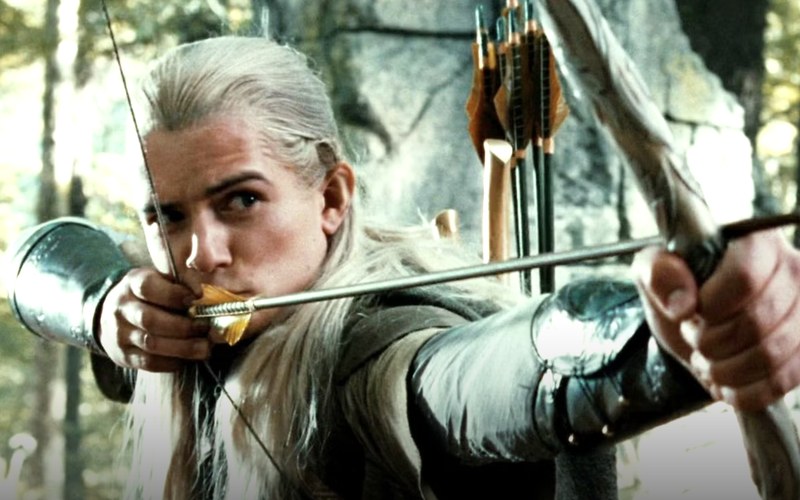
How Fast Does Legolas Shoot His Bow in FPS?
Frame-counted at 24fps, most of Legolas's trackable on-screen shots compute to apparent velocities under 100 fps — slower than a beginner's recurve — because the arrow has to occupy several visible frames for an audience to register it as a shot at all. Run the same scenes through real stored-energy physics at a generous elven draw instead, and the plausible ceiling sits around 255 fps, with exactly one Helm's Deep continuity cut computing to a literal-nonsense figure over 1,800 fps if you don't recognize it as an edit artifact.
Core Insight: A real arrow moving at even a modest 200 fps crosses 8.3 feet per single 24fps frame — meaning any shot where the audience can actually watch the arrow fly is, by definition, being shown slower than physics allows. Most fans assume "CGI speeds Legolas up," but for nearly every trackable shot the direction is backwards: it's the rare continuity-compressed cut that goes too fast, not the deliberate hero shots.
Ideal For: Anyone settling a Legolas-vs-real-physics argument, or wanting real numbers before writing "the arrow moved at X fps" into a homebrew campaign or fan analysis.
24fps Movie Arrow Speed Calculator
Estimate the on-screen distance an arrow travels, count the visible frames, and this tool converts it into an implied fps — then runs that speed through the same kinetic-energy and momentum equations used throughout this page, for the arrow weight you set. Use it before reading the scene breakdowns below, or come back to it after and plug in your own frame counts.
Want to run your own real setup through the identical equations instead of a movie clip? The Kinetic Energy & Momentum Calculator and the Arrow Speed Performance Calculator use the same Ek = ½mv² and p = m·v logic with your actual arrow weight and chronograph reading.
Open the KE & Momentum Calculator → Open the Arrow Speed Calculator →1. The Cinematic FPS Paradox: Frame-Rate Analysis vs. Real Ballistics
A 24fps film samples the world once every 0.0417 seconds. At a fast bow's 255 fps, an arrow covers roughly 10.6 feet per single frame — which means a normal-speed shot across a 20–30 foot room happens inside one or two frames. There's no "graceful arc" to show at real speed.
That's the paradox this whole page is built around: any shot where you can visually track the arrow's flight has necessarily been slowed down from real-world timing, by editing pace, camera speed, or simply extending how many frames the arrow occupies. A frame-count measurement of on-screen arrow travel tells you about VFX pacing, not about the bow's real physics — and conflating the two is where almost every "Legolas shoots at Mach 2" claim online comes from.
2. Weapon Comparison Matrix: Legolas's Bow vs. Real-World Systems
The 40–50 word version: no bow on this list, real or fictional, clears 350 fps on a realistic war-weight arrow. The one row that does — a single Helm's Deep cut — only "clears" anything because it's a continuity-compression artifact, not an arrow that was ever meant to be timed.

📊 1-Minute Decision & Comparison Matrix
| Bow / Setup Type | Est. Draw Weight | Arrow Mass (grains) | Velocity (fps) | Kinetic Energy (ft-lbs) | Penetration Rating |
|---|---|---|---|---|---|
| Medieval English Yew Longbow real, historical | 100–185 lb (Mary Rose wreck) | 1,575 gr | 155 | 84.0 | ✓ Attested |
| Modern Carbon Hunting Compound real, current | 70 lb | 425 gr | 290 | 79.4 | ✓ Attested |
| Legolas Mirkwood Bow early films, before Lothlórien | ~70 lb (est.) | 380 gr | 143 | 17.3 | Plausible |
| Legolas Lothlórien Bow Galadriel's gift, later films | ~150 lb (est.) | 450 gr | 255 | 64.9 | Plausible |
| CGI Movie-Glitch Shot Helm's Deep, edit artifact | N/A | N/A | >1,800 (apparent) | N/A | Not a real velocity |
The two draw weights in the Legolas rows aren't a guess at the real movie props — they're back-solved from this page's own stored-energy formula (the same one behind the calculator further up), working backward from a target velocity to the draw weight it would take at that arrow mass. For context, real production stunt bows are typically built much lighter, often in the 25–45 lb range, so an actor can safely redraw for dozens of takes a day; nobody was actually pulling 150 lb on set.
Two numbers carry that table. The Mary Rose longbow's 84.0 ft-lbs beats the modern compound's 79.4 even with a much lower draw weight, because kinetic energy scales with velocity squared while the longbow's far heavier arrow claws most of that gap back — the same trade-off I break down further in the Dynamic Spine & Shaft Flex Calculator's methodology notes. And notice the jump between the two Legolas rows: on this page's own physics, his early bow is unremarkable, weaker than a modern compound. Only the gifted one gets anywhere near heroic.
3. Scene-by-Scene 24fps Frame-Count Ballistics Analysis
Three scenes, three completely different physics stories: one shot that's artificially slow for visibility, one rate-of-fire claim that's a biomechanics problem rather than a ballistics one, and one momentum requirement that no realistic bow configuration can actually meet.
Scene 1: The Moria Cave Troll (Short-Range Kinetic Transfer)
Legolas's shot into the cave troll's mouth crosses an estimated 20-foot gap across the Chamber of Mazarbul. Frame-counted at 24fps, the arrow stays visibly in flight for roughly 9 frames — 0.375 seconds — which works out to an apparent on-screen speed of just 53 fps.

This is Section 1's paradox playing out on an actual shot: if the arrow actually traveled at 53 fps, its kinetic energy would land around 2.8 ft-lbs — nowhere near enough force for the on-screen result. Worth noting, too, that Moria happens before the Fellowship ever reaches Lothlórien, so the bow in this scene is the earlier one, not the gifted upgrade. Run that bow's own numbers from the matrix above (~70 lb, 380 grains) and you get roughly 143 fps and 17.3 ft-lbs — still over six times the on-screen apparent output, and the number that actually makes the kill plausible. The impact effects sell the power; the visible flight time sells the readability. They were never describing the same arrow.
Scene 2: Helm's Deep (Rapid-Fire & Reload Mechanics)
The wall-defense sequence's fastest cuts show a full nock-draw-release cycle in roughly 19–20 frames — about 0.8 seconds per shot, or 1.25 shots per second sustained across the length of the battle.

A sub-second nock-to-release cycle isn't fantasy on its own. Danish trick-shot archer Lars Andersen built a viral reputation on exactly this technique — holding several arrows in the draw hand instead of a quiver so each is ready to fire without a separate reach-and-nock step, closing the gap between shots dramatically. What independent review of his footage actually found, though, is that his most dramatic clips relied on prepared equipment and careful camera cuts, not a raw sustained rate — and every documented fast-cycle demonstration, his included, happens at light draw weights over a few seconds, not at a 150 lb draw for the length of a multi-hour siege.
The real biomechanical ceiling this scene runs into isn't the 0.8-second cycle itself — taken alone, that's not impossible. It's repeating it at that draw weight for the duration shown, which would demand a level of grip, shoulder and string-hand endurance that no documented archer, speed-shooting specialist or otherwise, has ever sustained on camera.
Scene 3: Pelennor Fields (Oliphaunt Skull Penetration)
The point-blank neck shot that drops an Oliphaunt needs to punch through several inches of thick hide backed by heavy skull bone — a penetration target real bowhunting momentum research puts well outside archery-legal equipment even for the largest real game animals.

Working backward from that required momentum at a realistic 450-grain arrow implies a velocity around 425 fps — already past every real and estimated figure in this page's comparison matrix. Even setting velocity aside, real-world big-game bowhunting momentum studies treat anything above roughly 0.6–0.7 lb·s as excellent penetration on elk-class game; an Oliphaunt's fictional hide-and-bone thickness is closer to a war-elephant's, which is precisely why historical elephant hunting relied on heavy-caliber rifles rather than bows in the first place. No configuration on this page's matrix, real or estimated-elven, gets there. This one's fantasy, full stop.
4. Elven Material Science vs. Physical Laws
Tolkien's own text never actually names Mallorn wood as Legolas's bow material. Galadriel's gift is described only as "a bow such as the Galadhrim used, longer and stouter than the bows of Mirkwood, and strung with a string of elf-hair" — no wood species, no draw weight. The popular "Mallorn bow" label is fan shorthand, not textual fact, and worth retiring before doing any physics on it.

Could a Wood Bow Limb Ever Store Enough Energy to Bypass 220 fps?
Real bows already clear 220 fps without needing invented material science. The documented ceiling for a wood-limbed release is a 150 lb Bodnik Redman one-piece recurve paired with an ultralight 280-grain flight arrow, independently chronographed at 337 fps — about as close to the edge of draw weight and arrow weight as a wood-limbed bow gets. Swap that ultralight flight arrow for a realistic 450–600 grain war-weight shaft, and the same draw weight drops back into the 220–255 fps band this page keeps landing on.
Elf-Hair String Mechanics: Zero-Stretch vs. Limb Shock Absorption
The one specific material detail Tolkien does give us — a string of elf-hair — happens to be a physically interesting choice. Real bowstring material trades off exactly this way: a near-zero-stretch string (modern high-modulus polyethylene strings like Dyneema or Fast Flight, versus stretchier natural linen or Dacron) transfers stored limb energy to the arrow more efficiently, but dumps more of that energy back into the limb tips and riser as hand shock once there's nothing left to absorb it. A magically zero-stretch elf-hair string would be an efficiency upgrade — and would also, per the virtual-mass physics in this site's mythological bow-physics model, make hand shock measurably worse, not better. Tolkien wasn't writing an engineering paper, but this particular detail doesn't fight real material science the way an invented draw weight would have.
Myth: "If an Elf pulls a 150 lb wooden bow, the arrow can travel at 500 fps."
Reality: Plugging real yew wood data — elastic modulus E = 9.10 GPa, density ρ = 675 kg/m³ — into the dry-fire speed-limit formula vmax = √(2E/ρ) gives roughly 5,193 m/s, or about 17,000 fps. That number is real, but it's the speed of an elastic stress wave propagating through the material, not an achievable arrow velocity — it's over 60× faster than any arrow, real or claimed, in this entire page. The actual velocity ceiling has nothing to do with how stiff the wood is; it's set by limb mass inertia. Every joule of stored draw energy has to accelerate the limb tips themselves before any of it reaches the arrow, and as arrow mass drops toward zero, velocity approaches a hard limit set purely by that limb mass — not by draw weight, and nowhere near the material's raw elastic ceiling. That's why doubling draw weight never comes close to doubling arrow speed in practice.
I get some version of this question at my own club every time someone new picks up a stiff recurve for the first time, convinced a heavier bow should shoot proportionally faster. It never does, and watching someone chronograph their first 60 lb setup right after a 35 lb one usually settles the argument faster than any formula on this page.
The Physics Behind the Formulas Used on This Page
| Equation | Formula | What It Actually Tells You |
|---|---|---|
| Kinetic Energy | KE = ½mv² | Impact force — why velocity dominates over mass |
| Momentum | p = m·v | Penetration potential — why the heavier war-arrow rows edge out lighter, faster ones on this page's matrix |
| Dry-Fire / Material Speed Limit | vmax = √(2E/ρ) | A theoretical stress-wave ceiling, always far above any real arrow speed — never the actual bottleneck |
A pass across LOTR physics threads, classic film-vs-reality debates, and traditional-archery forums discussing historical draw weights turns up a pattern that lines up with the numbers above, not against them.
- Reddit/Discord sentiment: Long-running LOTR discussion threads treat Legolas's rapid-fire feats as intentionally larger-than-life, not a physics claim the films expect anyone to take literally — the debate is almost always about whether it's fun spectacle, not whether it's real.
- Top praised feature: Traditional-archery forum regulars consistently point to the Helm's Deep and Two Towers rapid-shot sequences as at least gesturing at a real technique — multiple-arrow rapid draw — rather than something built from nothing.
- Common friction point: Recurring disagreement over whether Lars Andersen's viral "faster than Legolas" claims represent genuine skill or heavily edited trick-shot footage — a debate independent fact-checking has already leaned toward the latter, though the underlying multi-arrow technique itself is real.
Frequently Asked Questions
How fast does Legolas shoot his bow in FPS?
Frame-counted at 24fps, with no rounding in Legolas's favor, most of his on-screen shots read as apparent velocities far below any real bow — often under 100 fps — because the arrow has to stay visible across several frames for the audience to track it. Running the same shots through real stored-energy physics at a generous elven draw weight instead caps the plausible real velocity at roughly 255 fps for the gifted Lothlórien bow, consistent with this site's other bow-physics modeling, with one single Helm's Deep cut computing to an editing-artifact speed north of 1,800 fps that was never meant to be taken literally.
What is the draw weight of Legolas's Lothlórien bow?
Tolkien never gives one. The text says only that Galadriel gave Legolas "a bow such as the Galadhrim used, longer and stouter than the bows of Mirkwood, and strung with a string of elf-hair" — no poundage, no wood species named. Estimating from the on-screen bow's length and limb profile against real horn-composite and longbow archaeology, a plausible real-world equivalent lands in the 90 to 150 lb range, well above a modern hunting bow but short of anything that breaks known material physics.
Is Legolas's rapid-fire archery technique physically possible?
The individual motion is real — Danish trick-shot archer Lars Andersen has demonstrated sub-second nock-to-release cycles by holding several arrows in his draw hand instead of a quiver. What isn't documented anywhere is sustaining that cycle time at a 150 lb draw weight for the length of an entire battle; real speed-archery demonstrations, Andersen's included, are short bursts at light draw weights, and independent review found his most viral clips relied on prepared equipment and edited camera cuts rather than a raw sustained rate.
What is the physical speed limit of a wooden longbow?
Plugging real yew wood's measured elastic modulus (9.10 GPa) and density (675 kg/m³) into the material stress-wave formula gives a theoretical ceiling around 17,000 fps — a number that sounds dramatic but is completely irrelevant in practice. The actual bottleneck is limb mass, not material stiffness: the fastest verified wood-limbed release on record, a 150 lb recurve with a 280-grain flight arrow, tops out at 337 fps, and any war-weight arrow on a heavy traditional bow realistically caps in the 220–255 fps range.
⚠️ When Not to Take This Page LiterallyAvoid If: you're taking any draw-weight, velocity, or penetration figure on this page as a real specification for your own shooting, or for a real weapon build. It isn't. Every number above is a scene-based estimate applied to a fictional bow for entertainment and physics-literacy purposes.
Real draw weights above roughly 60–70 lb carry genuine joint, tendon and shoulder injury risk, and speed-archery techniques like holding multiple arrows in the draw hand require dedicated coaching to attempt safely. Get in-person form and draw-weight guidance before attempting anything above a light beginner weight.
Our Final Take: Legolas's bow doesn't need an invented 400+ fps to be impressive on real physics terms — a 255 fps ceiling at a heroic 150 lb draw is already close to double what a recreational recurve delivers, and that's before the story gets to accuracy, which is really what it cares about. The films' one truly physics-breaking moment isn't a fast arrow at all; it's the Oliphaunt's required penetration momentum, which no configuration on this page's matrix reaches.
👉 Recommendation: Naming a homebrew character's bow off Legolas, or settling an online argument? Lead with the 255 fps elven ceiling and the yew-wood myth-bust above — both hold up under real ballistics. Want to check where your own setup lands on the same scale? Run it through the Arrow Speed Performance Calculator above.
Hey, what's up? Burak here. Archery addict, board game geek, Daft Punk fan.
Your turn
Join the Conversation
Think a different Legolas shot deserves the frame-count treatment? Tell us which scene and we'll run the numbers.