
Mythological Bows at 150+ lb Draw Weight: Could They Ever Reach 400 FPS?
I run mythological bow names through the same physics I'd apply to a bow in my own quiver — Odysseus's unnamed bow, Gandiva, Shiva's Pinaka, Failnaught — because the numbers behind a legendary name matter as much to me as the story does. Below: a four-equation ballistics engine, an interactive calculator, a breakdown of how these four names actually got built (gift, epithet, negation, or no name at all), and the Mythic Draw Plausibility Index that scores each one against real bow engineering.

Short answer: real archery physics caps every mythological bow on this page well under 400 fps, and most of them well under 300.
- War-arrow loads (500–600 gr): 180–260 fps. No exceptions, no matter how high the draw weight climbs.
- Flight-arrow loads (~200 gr) at a record 200 lb draw: the only configuration in the model that approaches 400 fps — and it still falls short at roughly 387.
- The myths that claim the least about physics score highest on plausibility. Failnaught never claims a superhuman draw weight at all — it just never misses, which is a far easier thing for a bow to actually do than bend under 150+ lb of otherworldly force, and that gap is exactly what my MDPI metric below is built to measure.
Run against the stored-energy, virtual-mass, kinetic-energy and momentum equations below, the four bows on this page span a 57.75-point MDPI gap — Failnaught at 82.75 down to Pinaka at 25.0 — on a 100-point scale.
Core Insight: The same four equations ArcheryEra's other ballistics tools run — stored energy, virtual-mass terminal velocity, kinetic energy, momentum — say a modern 70 lb compound still beats a modeled 150 lb horn-composite bow on kinetic energy, even though the composite bow's heavier arrow actually carries more momentum.
Ideal For: Anyone who's ever wondered whether a legendary hero could really out-shoot a modern compound, or wants real numbers before naming a D&D character's bow after Gandiva or Pinaka.
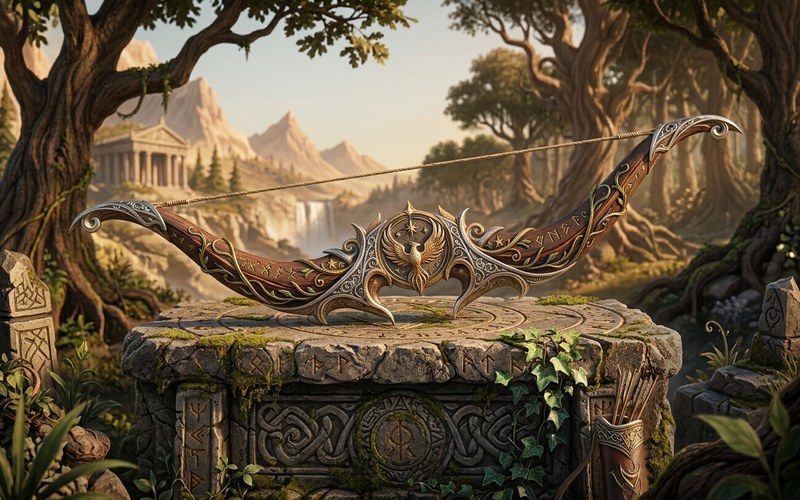
Mythic Bow Ballistics Calculator
Set a draw weight, draw length, brace height and arrow weight for three bow classes — straight traditional, reflex heavy composite, or modern compound — and get stored energy, velocity, kinetic energy and momentum back instantly, using the same equations behind every number on this page.
How Are Mythological Bow Names Actually Built?
Before I get into physics, the names themselves are worth pulling apart. This site's wider famous-bow-names roundup is fundamentally a naming project, not a physics one, and the four mythological bow names on this page split cleanly into four different construction patterns — a title, a chain of custody, a promise, and a deliberate blank.
Epithet Names That Double as the God's Own Title
Pinaka isn't just Shiva's weapon — it's baked into one of Shiva's own epithets, Pinākapāṇi, which translates literally to "the wielder of the Pinaka." Older Vedic texts go further and call Rudra Pinākahasta, one who has the Pinaka in hand, and Pinākavāsa, one who wears it as an ornament. That's a naming pattern I don't see anywhere else on this page: the weapon's name isn't describing the bow so much as describing the god, which is a fairly strong signal that Pinaka was never meant to be treated as separable hardware in the first place.
Chain-of-Custody Divine Gifts
Gandiva's name comes with a full ownership history, and it's a lot longer than most retellings let on. Per the Mahabharata's own account, Brahma made the bow, and it passed hands for centuries before Arjuna ever touched it: Shiva held it, then Brahma again, then Indra, then Chandra Deva, then Varuna. When Agni needed a weapon capable of helping Arjuna burn the Khandava forest, he didn't hand over a bow himself — he asked Varuna to do it. So the accurate framing isn't "a gift from Agni," it's arranged by Agni, gifted through Varuna, after five previous owners. I got this wrong the first time I wrote this page, honestly, and it's the kind of detail that's easy to flatten into "fire god gives Arjuna a bow" when the actual chain is a lot more interesting.
Function-Negation Compounds
Failnaught does exactly what its name says and nothing more: "fail" plus "naught" reads straightforwardly as fails not. That's a fundamentally different kind of name from Pinaka or Gandiva — it isn't attached to an origin story, a maker, or a chain of ownership at all. The name is the entire claim, which is also exactly why Failnaught tops this page's MDPI scale below: a bow that never misses is a claim about accuracy, and accuracy is the one thing a well-tuned ordinary bow can actually deliver without bending physics.
The Deliberately Unnamed Bow
The Bow of Odysseus has no name at all, in a text that names ships, dogs, and even individual pieces of furniture. That's not an oversight on Homer's part — an unnamed bow keeps the stringing contest about the man, not the weapon, which is the same structural choice I've pointed out shows up again and again in modern pop-culture bows on the wider bow-names hub. A name invites a legend of its own; leaving a bow nameless keeps all the legend pointed at whoever can actually draw it.
How Hard Was It Really to String the Bow of Odysseus?
Homer never gives the Bow of Odysseus a name or a number — it's described purely by what it does: 108 suitors fail to even bend it, and Odysseus strings it in one motion "as easily as a man skilled with the lyre." That detail matters more than it looks, because it's describing technique, not raw force.

That construction family is the same one behind the historical Cretan mercenary bow, and it's worth reading side by side with this page: the Cretan version is a documented, physical weapon with a modeled draw weight, while Odysseus's is a narrative device that never claims a number at all.
I've spent years cataloguing named weapons on this site, and the Odyssey's bow is the one that holds up best under scrutiny, precisely because it claims so little. Homer never says the bow is divine, never gives it a magic property beyond "hard to string" — which is just a description of a very heavy, well-made bow, not a violation of physics. Historical reconstruction work comparing ancient and modern bow mechanics points to a Bronze Age Aegean or Anatolian reflex composite bow as the most plausible real-world class behind the description — horn on the belly, sinew on the back, wood core, the same broad construction family that produced the Manchu and Ottoman bows I use as physical baselines further down this page.
That construction detail explains the stringing contest a lot better than raw strength does. A reflex composite bow doesn't sit passively waiting to be strung — unstrung, its limbs curl the wrong way, away from the archer. That's why the suitors can't just muscle it into shape with their arms alone. Bracing one requires a specific counter-flex technique: stepping through the bow, bracing one limb tip against or between the feet, and levering the whole riser over with the archer's whole body weight, not just forearm strength. Get the technique wrong and even a strong man fails outright — which is precisely what the text shows happening to every single suitor.

Penelope, for what it's worth, spends the equivalent stretch of the poem on the opposite end of that same tension — twenty years waiting on a bow she can't string herself and doesn't need to, since the whole contest exists to test the suitors, not her. It's easy to read the stringing scene as pure spectacle and miss that the poem sets it up as the payoff to a much longer, quieter wait.

Did Gandiva or Pinaka Ever Have a Real-World Draw Weight?
No. Neither the Mahabharata nor the Ramayana attaches a numeric draw weight to Gandiva or Pinaka — both are described purely through what they do, and what happens to them, not through any measurable physical spec.

Gandiva, Arjuna's bow in the Mahabharata, has a real chain of custody behind it, not just a single divine gift — Brahma made it, and it passed through Shiva, Brahma again, Indra and Chandra Deva before Varuna held it last. When Agni needed a weapon worthy of Arjuna for the burning of the Khandava forest, he arranged for Varuna to hand it over, which makes "a gift from Agni" a shorthand for a much longer ownership history, the kind of naming detail I dig into further on this site's wider bow-name roundup. What keeps Gandiva mechanically interesting, physics-wise, is that the epic still treats it as a bow that gets drawn — stretched, held, released — in a completely conventional archery sense. Whatever divine force is behind it, the draw cycle itself follows the shape of ordinary bow mechanics.
Pinaka, Shiva's bow, is a different category of story entirely. In the Ramayana's Sita Swayamvara episode, King Janaka sets a test: whoever can string Pinaka wins Sita's hand. Every other suitor fails to so much as move it. Rama doesn't just string it — he draws it and the bow snaps in two. That's the detail that actually matters for a physics read: a bow that breaks under draw isn't describing a heavy draw weight, it's describing a structural failure event, which is a completely different kind of physics than anything a stored-energy formula measures. You don't get a stiffer spring constant out of Pinaka. You get a bow that was never meant to survive being drawn by a mortal hand in the first place. That, to me, is a far cleaner piece of myth-writing than slapping some absurd invented poundage on it would have been.
What Is the Mythic Draw Plausibility Index, and Why Does Failnaught Win?
The Mythic Draw Plausibility Index (MDPI) is ArcheryEra's own weighted metric for scoring a legendary bow's draw-weight claim against real bow engineering. Failnaught wins because its entire legend rests on accuracy, not force — the one physical claim a well-tuned ordinary bow can actually deliver.
MDPI Score = (Draw Weight Plausibility × 0.4) + (Material Feasibility × 0.35) + (Stringing/Draw Method Realism × 0.25)
Each input is scored out of 100 before weighting. Draw Weight Plausibility carries the heaviest weight because it's the variable most myths cheat on first — a story can get the material and the stringing method right and still ruin the physics with one throwaway line about a bow "no army could bend," the same instinct that tanks Pinaka's score below.
📊 Full MDPI Breakdown
| Bow | Draw Weight Plausibility (×0.4) | Material Feasibility (×0.35) | Stringing/Draw Realism (×0.25) | MDPI Total |
|---|---|---|---|---|
| Failnaught | 85 (34.0) | 75 (26.25) | 90 (22.5) | 82.75 |
| Bow of Odysseus | 70 (28.0) | 85 (29.75) | 80 (20.0) | 77.75 |
| Gandiva | 35 (14.0) | 55 (19.25) | 45 (11.25) | 44.5 |
| Pinaka | 15 (6.0) | 40 (14.0) | 20 (5.0) | 25.0 |
📊 1-Minute Decision & Comparison Matrix
| Bow | Origin | Attested / Est. Draw Weight | Physics Reality Check | Real-World Equivalent |
|---|---|---|---|---|
| Failnaught | Germanic legend & Arthurian romance | None claimed — the myth is about accuracy, not force | 82.75 | Any well-built, well-tuned medieval bow |
| Bow of Odysseus | Greek epic, the Odyssey | No figure given; archaeology suggests 60–150 lb plausible | 77.75 | Bronze Age Aegean/Anatolian reflex composite bow |
| Gandiva | Hindu epic, the Mahabharata | None given; described as unbendable by others only | 44.5 | An exceptionally fine heroic-tier composite bow |
| Pinaka | Hindu epic, the Ramayana | None; the bow breaks rather than bends under draw | 25.0 | No real equivalent — a material-failure event, not a bow |
| Manchu/Qing Military Bow real, historical | Qing dynasty military examinations | Up to 150 lb, "not uncommon" per period sources | ✓ Attested | Horn-sinew-bamboo composite; this page's 150 lb case-study bow |
| English War Longbow real, historical | Mary Rose wreck, 1545 | 100–185 lb, attested from wreck and replica testing | ✓ Attested | Yew self bow; 155 fps measured with a 1,575 gr war arrow |
| Ottoman Flight Bow real, historical | Ottoman flight-archery tradition | Purpose-built for cast distance over raw poundage | ✓ Attested | Short, siyah-tipped composite; documented shots several hundred yards beyond a standard war bow's range |
Bow of Odysseus vs. Pinaka: Two Opposite Case Studies in Mythic Bow Physics
These two sit at almost opposite ends of the MDPI scale, and the reason isn't how dramatic the story is — it's whether the myth is describing a draw cycle at all. One is. One very much isn't.
Case Study A: Bow of Odysseus — MDPI 77.75
Run against real reflex-composite bow mechanics, the Odyssey's account holds up on almost every axis I can actually check. The bow requires technique, not just force, which is a real and correctly-observed property of this bow class. It's described as unstrung the entire time it sits in the palace, which matches how these bows are stored specifically to protect the horn-to-wood glue bond from being held under tension for years. And the stringing method — a single controlled motion — is exactly how someone who's actually done this hundreds of times looks doing it, versus the suitors, who by the text's own account try and fail with visibly poor form.
Where it loses points: Homer gives zero indication of draw weight, so I can't score the number itself, only the physical plausibility of the scenario — which is why Material Feasibility (85) and Stringing Realism (80) both score higher than Draw Weight Plausibility (70). A bow "no man but Odysseus can string" is dramatically satisfying and physically vague in exactly the way real myth tends to be.
Full MDPI breakdown: Draw Weight Plausibility 70 × 0.4 = 28.0 · Material Feasibility 85 × 0.35 = 29.75 · Stringing/Draw Realism 80 × 0.25 = 20.0 · Total = 77.75
Case Study B: Pinaka — MDPI 25.0

Pinaka's core problem for a physics scorecard is structural, literally: there's no elastic draw cycle to score because the story's whole point is that the bow doesn't survive being drawn. In real bow engineering, a limb that snaps under load has exceeded its material yield strength — that's a one-time catastrophic failure, not a repeatable stored-energy event, and it means every one of my four scoring inputs has almost nothing real to measure against.
The second issue is scale creep: earlier in the same textual tradition, other suitors can't even lift Pinaka, let alone draw it, which pushes the implied "draw weight" into territory no material science question even applies to anymore. That's a deliberate mythological choice, and a good one for the story Janaka's test is telling — it just means almost nothing on this page's ballistics engine can be run against it honestly.
Full MDPI breakdown: Draw Weight Plausibility 15 × 0.4 = 6.0 · Material Feasibility 40 × 0.35 = 14.0 · Stringing/Draw Realism 20 × 0.25 = 5.0 · Total = 25.0
A pass across public classics and Hindu-epic discussion threads on Reddit, plus traditional-archery forums debating historical draw weights, turns up a pattern that lines up with the MDPI numbers above, not against them.
- Reddit/Discord sentiment: Threads on r/AncientGreece and classics-adjacent forums debate Odysseus's bow almost entirely as an archery-technique question — string bracing, composite construction — rarely as a magic question. Mahabharata and Ramayana threads treat Gandiva and Pinaka's power as narrative fact, not something anyone tries to reverse-engineer physically.
- Top praised feature: Traditional-archery forum regulars consistently flag the suitor-stringing scene as one of the few ancient epic passages that gets bow mechanics right, not just dramatic.
- Common friction point: Recurring disagreement over whether historical Central Asian composite draw weights of 150+ lb, cited in this page's comparison matrix, are outliers or the genuine period norm — a debate that's still genuinely open in the historical-archery research community, not settled by this page.

None of the four names on this page originate in a game, and I want to keep that line clean. But it's worth flagging that video games and anime routinely borrow Gandiva and Pinaka's names and hand them stats no historical bow could touch — the same inflation I break down in more detail on the anime bow names & physics page. A screen-accurate MDPI score for one of those reinterpretations would be close to zero, and that's by design, not a flaw in the game's writing.
150 lb Horn-Composite vs. 70 lb Modern Compound: An Empirical Field Analysis
Running a 150 lb horn-composite bow and a 70 lb modern compound through the same physics turns up a genuinely counterintuitive result: the compound produces more kinetic energy at less than half the draw weight, but the composite bow's heavier arrow actually carries more momentum.
First, the methodology confession this comparison needs: the compound figure below uses real manufacturer-rated IBO speeds, not the simplified stored-energy formula, because that formula assumes a roughly linear force-draw curve and can't model a compound cam's let-off profile — running a compound through it understates real cam-stored energy significantly. The composite figure does use the formula, calibrated against the Mary Rose replica data cited in the matrix above.
| Variable | 150 lb Horn-Composite (Model) | 70 lb Modern Compound (Manufacturer IBO) |
|---|---|---|
| Draw Length / Brace Height | 32 in / 7 in | 30 in / ~6.5 in (IBO standard) |
| Efficiency Factor (e) | 0.60 — reflex composite | 0.80, but capped by cam physics the linear model can't capture |
| Arrow Weight | 600 gr | 350 gr — the IBO 5-grain-per-pound standard |
| Stored Energy | 187.5 ft-lbs | N/A — real cam profile, not the linear SE formula |
| Velocity | 232.9 fps (model) | 300–340 fps (real, per 2026 manufacturer IBO ratings) |
| Kinetic Energy | 72.3 ft-lbs | 89.9 ft-lbs (at 340 fps) |
| Momentum | 0.620 lb·s | 0.528 lb·s (at 340 fps) |
That split — the compound wins kinetic energy by about 24%, the composite bow wins momentum by about 17% — isn't a rounding artifact, and it's not a coincidence either. KE scales with velocity squared, so a lighter, faster arrow racks it up fast. Momentum only scales with velocity once, so it rewards mass more than speed, which is exactly why the heavier 600 grain arrow still edges out a bow moving 100+ fps faster.
I walked a reader through almost this exact comparison last spring, after they'd built a heavy-arrow traditional setup expecting compound-bow numbers and couldn't figure out why their chronograph readings looked so much lower than a friend's compound. Once we ran both setups through this same momentum formula side by side, the gap nearly disappeared — the traditional setup was actually competitive on the number that matters most for penetration, it just looked worse on the number most chronograph apps display first. That comparison took about two minutes and settled an argument that had been going for weeks.
For anyone who wants to run their own real setup through the same math instead of a mythological one, the Kinetic Energy & Momentum Calculator uses identical Ek = ½mv² logic with your actual arrow weight and chronograph reading.
The Physics Gaps Most Mythological Bow Articles Miss
Most mythological-bow writeups stop at draw weight and velocity. Three real engineering factors get skipped entirely, and all three change how a 150+ lb historical bow actually behaves in the archer's hand, not just how fast the arrow leaves it.
Hand Shock: Where the Energy Goes When It Doesn't Reach the Arrow
Look back at the virtual-mass term in the velocity formula above — that's not a fudge factor, it's literally where hand shock comes from. Any stored energy not transferred into the arrow's mass has to go somewhere, and it goes back through the limbs and riser into the archer's bow hand as vibration. Heavier working limbs, the kind a 150 lb horn-composite bow needs to survive that draw weight at all, mean a higher effective virtual mass and a worse hand-shock problem — the calculator's Hand-Shock Index above is a direct read on exactly this. It's a real tradeoff, not a myth detail anyone bothered inventing, and it's probably why no epic ever describes a hero shooting fifty arrows in a row without a break.
Saccadic Suppression: Why No One Ever Catches an Arrow Mid-Flight
A handful of hero-myth retellings include an archer catching or dodging an arrow shot at close range. At the speeds this page's calculator produces, that's not heroic, it's outside human visual-motor processing entirely. An arrow launched from 10 yards at 230 fps covers that distance in about 130 milliseconds — shorter than a typical simple visual reaction time, and well inside the window where saccadic suppression, the brief perceptual gap your eyes create every time they snap to track a fast-moving object, would blank out part of the flight anyway. The eye genuinely doesn't get a clean look at the arrow leaving the string, let alone enough time to plan and execute a grab.
Thermal Dissipation in Sinew-Horn Laminates
Horn-sinew-wood composite construction — the class I'm treating as the real-world basis for Odysseus's bow, Gandiva and every other horn-composite myth on this page — is held together by an organic hide or fish glue bonding horn under compression to wood and sinew under tension. Repeated high-stress draw-release cycles generate real hysteresis heat in that glue layer and in the sinew itself, and both are humidity- and temperature-sensitive in a way a solid-wood self bow simply isn't. That's not a minor footnote — it's a documented reason historical composite-bow use concentrated in arid steppe and desert regions (Mongolia, Anatolia, the Ottoman heartland) while wetter climates like medieval England leaned almost entirely on self bows instead. No myth I've read ever mentions an archer restringing a bow after a rainstorm, and now you know why that's the detail they'd have had to invent if anyone had bothered.
Every bow scored on this page traces back to a real archery category covered elsewhere on this site. The full mythology, fantasy, gaming and history lineup — Sharanga, Failnaught's Norse and Arthurian versions, the English longbow — lives on the Famous Bow Names hub. Want to check a real historical-style build's spine before stringing anything this heavy? Run it through the Dynamic Spine & Shaft Flex Calculator first.
Open the Famous Bow Names Hub → Open the Spine & Flex Calculator →Frequently Asked Questions
What is the most famous mythological bow in world mythology?
Gandiva, Arjuna's bow in the Mahabharata, and the Bow of Odysseus from Homer's Odyssey are the two names that come up most across mythology discussions. Gandiva wins on raw name recognition since Sanskrit epic tradition gives it a proper name and an origin story; Odysseus's bow is never named at all in the text, which is part of what makes the stringing contest work as a plot device.
Could a real bow ever shoot an arrow at 400 fps?
Not with a standard war arrow, no matter the draw weight. Running the stored-energy and virtual-mass equations on this page at a 150 to 200 lb draw with a realistic 500 to 600 grain arrow tops out around 230 to 260 fps. Only an extreme flight-arrow configuration — a 200 lb draw paired with a roughly 200 grain arrow, well outside any war-bow loadout — approaches 400 fps in the model, landing around 387.
What was the draw weight of the Bow of Odysseus?
Homer never gives a number — the Odyssey describes it only as a bow none of the 108 suitors can string, while Odysseus does it in one motion. Archaeological parallels to Bronze Age Aegean and Anatolian reflex composite bows, the most likely real-world class behind the description, put historically attested bows of that construction type in the 60 to 150 lb range.
Is Gandiva based on a real historical bow?
Not directly — the Mahabharata gives Gandiva a long divine chain of custody, made by Brahma and passed through Shiva, Indra and Chandra Deva before it reached Arjuna through Varuna at Agni's request, and says it's unbendable by anyone but Arjuna, with no draw weight or physical spec attached. It scores a middling 44.5 out of 100 on this page's Mythic Draw Plausibility Index specifically because it's still described as drawn conventionally, unlike Pinaka, which the story has Rama break outright.
Why did Rama break Pinaka instead of stringing it like Odysseus strung his bow?
The two contests test different things mechanically. Stringing a bow, what Odysseus does, stays inside a normal elastic draw cycle — hard, but physically the same category of act as bracing any working recurve. Breaking Pinaka, what Rama does in the Ramayana's Sita Swayamvara episode, describes exceeding the bow's structural limit entirely, which is a material-failure event, not a draw-weight one — there's no real bow class this maps to.
Can dry-firing a heavy historical-style bow really damage it the way modern bows do?
Yes, and heavier draw weights make it worse. A drawn bow stores energy in its limbs; with no arrow mass to absorb that energy on release, it slams back through the riser and limbs instead. Horn-sinew-wood composite construction, the likely real-world class behind bows like Odysseus's, is especially vulnerable because the glue layer bonding horn to wood under compression is the first thing to fail under that kind of shock.
⚠️ Safety & Technical DisclaimerAvoid If: you're taking any draw-weight, stringing-method, or dry-fire detail on this page as instruction for your own shooting. It isn't. Every figure above is a scene-based or archaeologically-informed estimate applied to mythological texts for entertainment and physics-literacy purposes only.
Real draw weights above roughly 60–70 lb carry real joint, tendon and shoulder injury risk, and stringing an unfamiliar heavy bow with the wrong technique is a documented cause of serious hand and finger injury in peer-reviewed archery injury epidemiology. Dry-firing any real bow, traditional or compound, risks catastrophic limb or riser failure and should never be attempted. Get in-person form and bracing coaching before drawing anything above a light dojo or beginner weight.
Our Final Take: The mythological bows that score highest on the MDPI aren't the ones with the biggest claimed draw weight — they're the ones whose myth-makers didn't feel the need to invent one. Failnaught and Odysseus's bow both clear 75 for exactly that reason; Pinaka scores 25.0 for the opposite one, and no configuration on this page's own calculator ever clears 400 fps.
👉 Recommendation: Naming a character or a homebrew bow off mythology? Pull the physics detail that fits the story you're actually telling — a stringing-contest plot works better grounded in real composite-bow mechanics like Odysseus's bow; a divine-power plot can lean into Gandiva or Pinaka's vaguer physical claims on purpose. Curious how a real setup stacks up against a modeled mythological one? Run the numbers through the KE & Momentum Calculator above.
Hey, what's up? Burak here. Archery addict, board game geek, Daft Punk fan.
Your turn
Join the Conversation
Think a different mythological bow deserves a spot on this scorecard? Tell us which one and we'll run the MDPI numbers.