
Arrow Fletching Types: 10 Profiles Ranked by Drift and Steering
Ten fletching families, one set of rules. I took published manufacturer specs for each profile, ran every one through the same drag and wind model that powers the ArcheryEra trajectory tool, and put the results side by side: speed kept at 40 yards, crosswind drift, modeled spin and how much steering surface each one actually puts behind a broadhead.

If you buy through our links, we may earn a commission that helps support the work we do. Learn more.
Short answer: the ten arrow fletching types split into three jobs. Steer a fixed-blade broadhead (high-profile shield, hybrid, feathers). Hold speed and fight wind past 40 yards (low parabolic, micro, short stiff vanes, spin vanes). Or kill speed on purpose (flu-flu). Everything else is a trade between those two dials — surface area versus drag.
- Broadhead steerage vs speed retention: in my model a 3× Blazer build keeps 88.0% of a 280 fps launch at 40 yd; three 4″ feathers keep 84.5%; spin vanes keep 91.3% but carry only a fifth of the steering surface.
- Height and weight: modern hunting vanes run 0.41–0.57″ tall and 6–9 gr each; feathers weigh ~2.5–3.5 gr; film spin vanes about 1 gr.
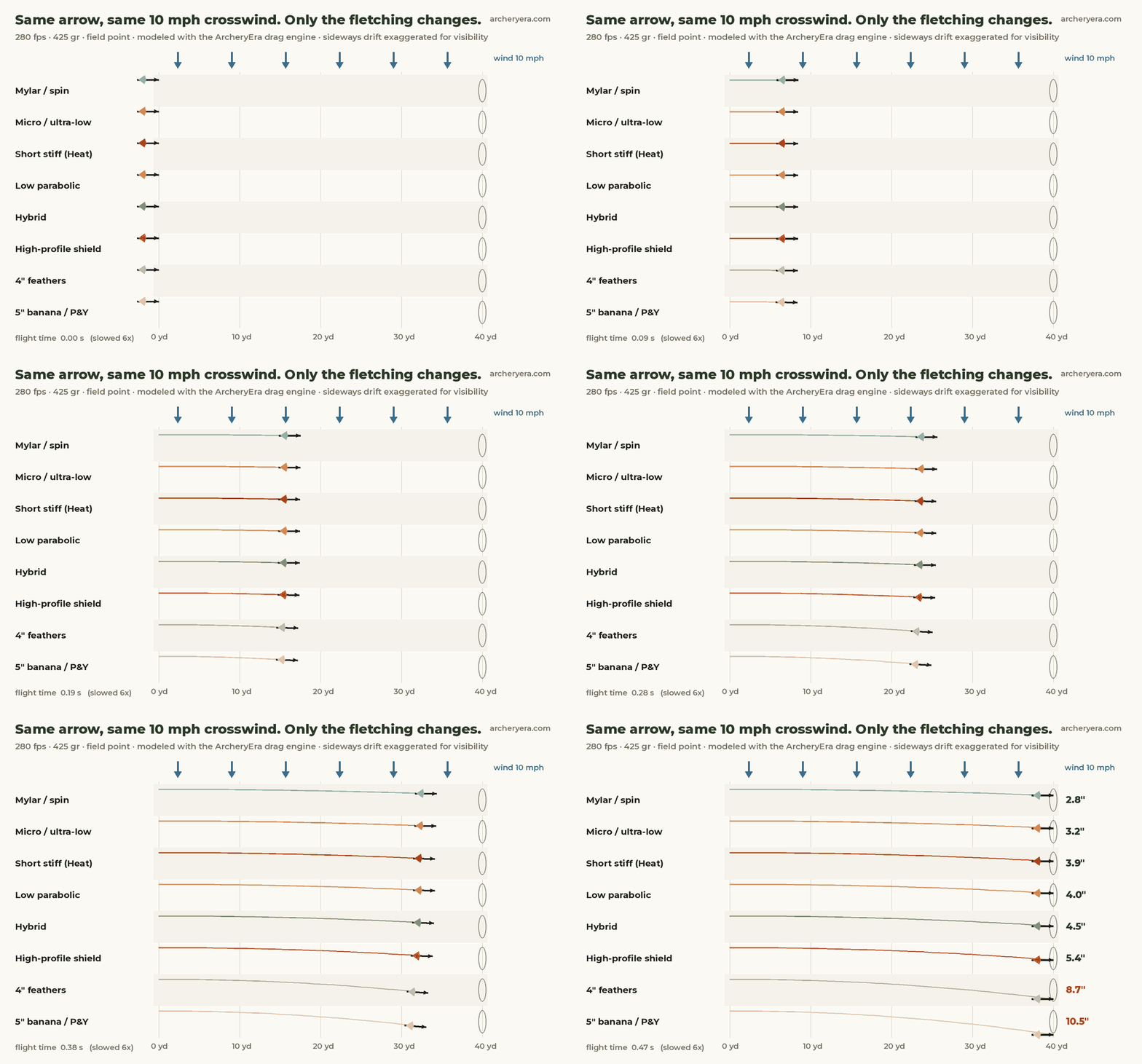
- Weather: feathers soak and flatten in rain unless treated; vanes don’t care. Wind punishes surface area — feathers drift ~8.7″ at 40 yd in a 10 mph crosswind versus ~4.0″ for a low parabolic.
- Rest clearance: shelf and full-capture rests favor feathers or short, low vanes; a properly timed drop-away clears almost anything, which is why tall shield cuts live on them.
Jump to: fletching simulator · pick by setup · the physics · all 10 types & where to buy · comparison matrix · 3 vs 4 fletch · FAQ

The question that started this page came from a TradTalk thread asking how fletching, vanes, feathers, noise and arrow flight all tie together. Good question. Most answers online are a list of names with a sentence each. That doesn’t help you pick.
Already sure about the shaft? If not, start with the arrow types and come back. Every fletching type below gets the same treatment — real dimensions where the maker publishes them, and modeled numbers from one consistent engine where nobody does. Where a number is modeled, I say so.
Which Fletching Type Fits My Setup? Try the Simulator
Setup first, theory later. Pick your fletching, head, speed and the wind you actually hunt in; every number below comes from the same drag model explained in the physics section further down, and each result links to a real example of that profile.
Choosing between 10 different profile geometries requires balancing broadhead surface area against crosswind drift. Simulate downrange velocity decay, wind drift and modeled spin rates with the embedded tool below.
How to use: pick a fletching type and a head, set your launch speed (no chronograph? estimate it with the Arrow Speed & Performance Calculator), arrow weight, distance and crosswind. The charts show speed decay and wind drift out to your distance; the bars rank all ten types at that distance.
Downrange speed (fps)
Wind drift (inches)
All ten types at 40 yards — wind drift, same speed, head and wind:
Modeled estimate using the site-wide exponential drag model (the same one behind the Arrow Trajectory & Sight-Pin Visualizer). Drift assumes a steady full-value crosswind and a well-tuned arrow. Energy at impact uses the same formulas as the KE, momentum & pass-through calculator. A chronograph and a windy afternoon at the range beat every number here.
Under the hood: the math behind the simulator
Speed after d metres. k = fletching drag constant + head drag constant. Fletching k runs from 0.0025 (spin) through 0.0033 (three hunting vanes) to 0.0051 (5″ banana feathers); flu-flu sits at 0.030. Heads add 0 (field), 0.0002 (mechanical) or 0.0006 (fixed blade).
Time of flight in closed form from the same drag model.
Lag-time wind drift: the arrow only drifts for the extra time drag costs it. Sail runs 0.78 (spin) to 1.40 (banana feathers), 3.0 for flu-flu; fixed blades multiply it by 1.25.
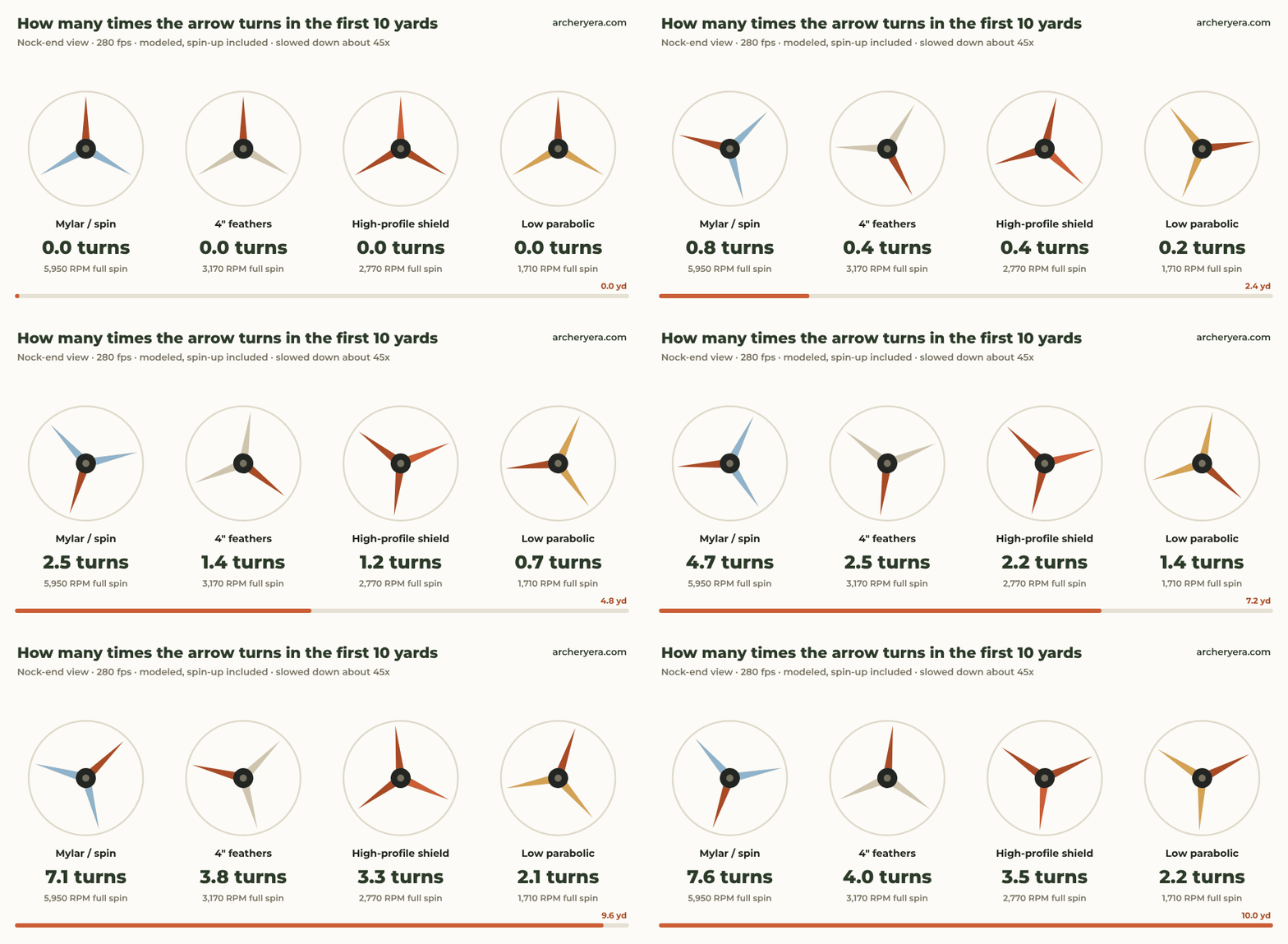
Revolutions after d yards. pitch = yards per turn at full spin (from the RPM equation; speed cancels out). L = 3 yd spin-up distance (modeled band 2.4–4.1 yd): the vanes need airflow to bring the shaft up to full spin. The “3 revolutions in ~X yd” readout solves this for three turns.
Aeff = vanes × length × height × shape fill × √(height ÷ 0.5″). A relative surface index, not a force.
The four anchor profiles (target vanes, hunting vanes, four vanes, feathers) are the same constants the trajectory tool uses; the other six are placed between them by surface area and edge shape. The trajectory model itself is documented on the calculator methodology page.
Avoid relying on it if your broadheads and field points already disagree on paper. A bad tune shows up as drift that no vane swap cures. Fix the tune first with the Broadhead Flight & Tuning Stability Checker, then come back and pick fletching for the wind and distance you actually hunt.
Which Fletching Should I Buy for My Setup?
Match fletching to your head and your rest before anything else. Fixed blades want steering surface, mechanicals and field points want low drag, shelf shooters want feathers, and a full-capture rest caps how tall and how many vanes you can run. The table below is the one-minute version.
| Your setup | Pick | Clamp / layout | Why |
|---|---|---|---|
| Whitetail compound, fixed blade, drop-away | High-profile shield or hybrid | 3°+ helical, 3-fletch | Most steering in a short, clearance-friendly vane; drift at 20–30 yd is small anyway |
| Compound, mechanical heads or field points | Short stiff or low parabolic | Straight or 1–2° offset | Nothing up front is planing, so buy speed and wind resistance instead of surface |
| Western elk / mule deer, 40–70 yd, fixed blade | Hybrid or low parabolic | 3° helical; 4-fletch 75°/105° if the rest allows | Enough steering for the head, less wind penalty than a tall shield at long range |
| Whisker biscuit or other full-capture rest | Low parabolic or short stiff | 3-fletch, light helical | Every vane brushes the bristles; lower and fewer vanes mean less contact and noise |
| Recurve or longbow off the shelf | 4″ feathers or 5″ banana / P&Y | Helical, all feathers from one wing | Feathers fold past the shelf; steering matters more than drift inside 25 yd |
| Olympic or indoor target recurve | Spin vanes or micro vanes | Per the vane maker’s spec | Light tail, fast recovery from a finger release, least drift at 70 m |
| Birds, squirrels, rabbits, aerial targets | Flu-flu | Spiral wrap or 6-fletch, blunt point | Short, safe flight; the arrow dies before it gets far |
| Crossbow | Whatever the bolt maker specifies | Match the rail/cock-vane orientation in the manual | Crossbow vane height and orientation are set by the rail and string path, not by this chart |
Picks, not rules. A bare-shaft and broadhead-vs-field-point check on your own bow overrides every line of this table.
How Does Arrow Fletching Actually Stabilize an Arrow?
Fletching works like the feathers on a dart. When the shaft yaws, the vanes meet air at an angle, make lift and swing the tail back behind the point. Taller or longer vanes make more restoring torque, but the same surface area adds drag, slows the arrow and gives crosswind more to push.
That’s the whole trade. Three forces decide it.
Drag force, from the standard aerodynamic drag equation. ρ = air density (~1.2 kg/m³ near sea level), v = arrow speed, Cd = drag coefficient, A = reference area. Speed is squared, so a 330 fps arrow feels 39% more drag than a 280 fps arrow with identical fletching.
Restoring torque. FL = side lift from the fletching when the shaft yaws, ℓ = distance from the vanes to the arrow’s balance point. More vane area raises FL; higher FOC stretches ℓ.
Modeled spin. θ = helical or offset angle, r = shaft radius, e = a 0.24–0.32 vane-engagement factor (real vanes slip against the air). Same model as my helical vs straight fletching rotation data. That is the full spin rate; the vanes reach it over the first few yards, about 81% by 5 yards and 96% by 10.
Here’s a sanity check I like. A peer-reviewed wind-tunnel study measured whole-arrow drag coefficients of ~1.5 (laminar) to ~2.6 (turbulent), published in Sports Engineering’s arrow aerodynamics research. Plug that into the drag equation for a 0.34″ shaft at 280 fps and a 425 gr arrow decelerates at 13.9–24.2 m/s². The ArcheryEra trajectory engine, built independently from hunting-vane drag constants, predicts 24.0 m/s² for three hunting vanes. Right at the turbulent end. Which is where a hunting arrow lives.
Length gets too much credit. Height and edge shape do more. A 2″ shield and a 2.82″ parabolic land within 5% of each other on steering surface in my index, yet the shield costs more speed and drifts more — because its square-backed top edge sits in fast air. If you want steering with the least wind penalty, go long and moderately tall, not short and tall.
It knows surface area, drag and wind. It does not know:
- Stiffness and temperature. A soft vane that lays over at 330 fps or stiffens at 10°F behaves differently from its spec sheet.
- Contact. One vane kissing the rest or cable guard costs more accuracy than any profile swap on this page.
- Your tune. A nock-high or nock-left arrow drifts on its own, with or without wind. Paper-tune it first.
- Noise. Edge shape and vane material move pitch and volume; the model doesn’t hear anything.
Two quick checks before you trust any chart: dust the vanes and rest with spray foot powder, shoot one arrow, and look for streaks where something touched — the same powder clearance check in Easton’s tuning guide. Then shoot three field points and three broadheads at 20, 30 and 40 yards. If the groups share a center, your fletching is doing its job.
What Are the 10 Types of Arrow Fletching?
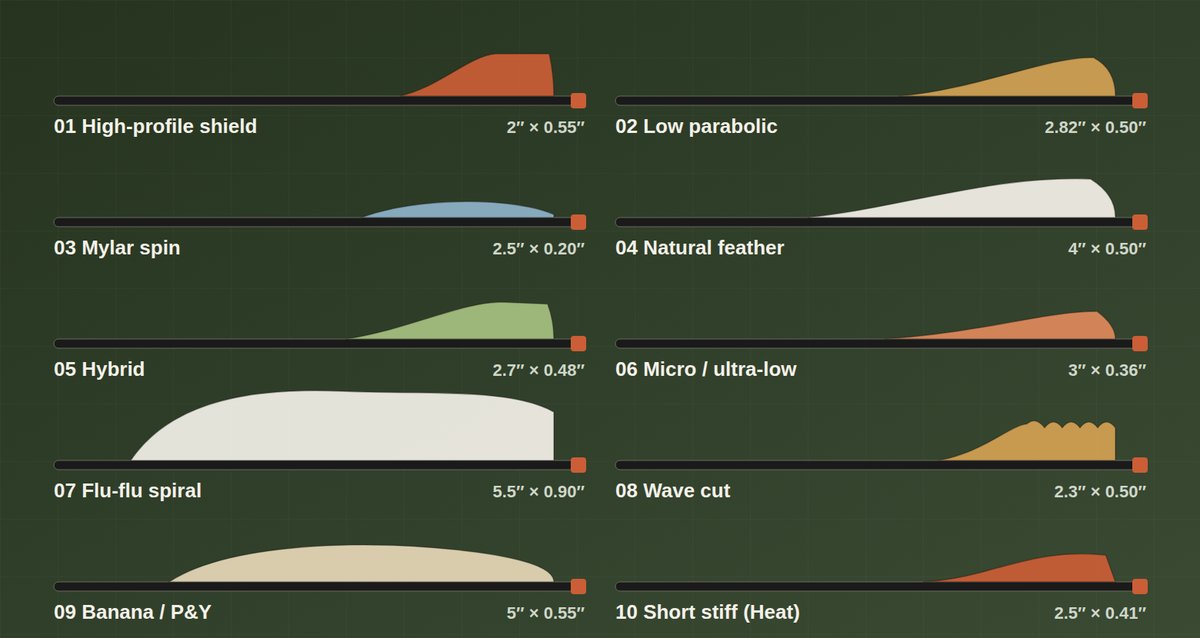
The ten arrow fletching types are high-profile shield, low-profile parabolic, Mylar/spin, natural feather, hybrid, micro/ultra-low profile, flu-flu, wave cut, traditional banana or Pope & Young feathers, and short stiff vanes like the Bohning Heat. They differ in height, length, material and edge shape, which sets steering, drag and wind drift.
Every card uses the same reference setup so the numbers compare cleanly: 280 fps launch, 425 gr arrow, field point, 10 mph full-value crosswind. The steering index is relative — 3× Bohning Blazer = 100.
High-Profile Shield Cut Vanes (Bohning Blazer)
A high-profile shield cut is a short vane with a tall, squared-off back edge. The Bohning Blazer is the reference: 2″ long, about 0.55″ tall, 6 grains. It packs a lot of steering surface into a short footprint, which is why fixed-blade hunters on drop-away rests reach for it first.
Short and tall — almost all of its area sits in the outer half of its height.
The spec itself is a little slippery. Bohning lists the Blazer at 0.53″ on its Bohning Archery hunting vane specs page and 0.57″ on its 3D vane spec sheet. Same vane. I model it at 0.55″ and move on — four hundredths of an inch won’t change a group.
What it does well: the tall back edge bites fast air, so the arrow finishes three stabilizing revolutions in about 6 yards on a 3° helical. What it costs: in my model it gives up about 5 fps to a low parabolic by 40 yards and drifts ~1.5″ more in a 10 mph wind.
See it on Amazon: Bohning Blazer 2″ vanes, 36-pack
Low-Profile Parabolic Vanes (AAE Max Stealth)
A low-profile parabolic vane is longer and lower than a shield, with a smooth rising curve and no hard back corner. AAE lists the Max Stealth at 2.82″ by 0.50″ and 8.8 grains. It trades a little steering for less drag, less noise and less wind drift.
Long, low and swept: area is spread along the shaft instead of stacked up high.
AAE’s own Max Stealth dimensions and tolerances (±0.05″, ±0.5 gr) are tighter than most spec sheets bother to print. Heavier than a Blazer by nearly 3 grains, though. Three of them add about 8 gr to the tail.
This is my default recommendation for 3D and long-range target shooting, and a strong one for mechanical broadheads. Modeled: 251 fps left at 40 yards, ~4.0″ of drift — and a steering index of 95, which is plenty for most fixed blades under 1-1/8″ cut.
See it on Amazon: AAE Max Stealth vanes
Mylar and Spin Vanes (Gas Pro, XS Wings)
Spin vanes are thin curled film, not molded plastic. The curl forces the arrow to rotate hard right off the string. Gas Pro lists its 2.5″ target spin vane at about 1 grain. Olympic recurve and indoor target archers use them for fast recovery and tiny tail weight.
A thin curled strip: lots of spin, very little sail area.
Weight is the headline: roughly 1 gr per vane on Gas Pro’s target spin vane listing, versus 6–9 gr for molded hunting vanes. XS Wings sizes its spin vanes by length (40–100 mm, low and high) rather than publishing a height.
The curl acts like a much steeper helical, so my model puts spin at ~5,950 RPM at launch — highest of any vane here. But the steering index is only 19. Spin corrects a finger-release wobble on a target arrow. It does not out-muscle a fixed-blade broadhead planing at 280 fps.
See it on Amazon: MILAEM 1.75″ curled spin vanes, 50-pack
Natural Feathers (Turkey Parabolic)
Natural fletching is cut from turkey wing feathers, usually in a 4–5″ parabolic or shield shape. A 4″ parabolic weighs under 3 grains. Feathers fold when they hit a shelf or rest, then spring back, and their rough barbule surface stabilizes an arrow faster than smooth plastic.
Longer and lighter: a textured surface that grabs air hard.
Makers like TrueFlight’s die-cut feather shapes and lengths and Gateway sell feathers pre-cut from right-wing or left-wing stock, which sets the natural helical direction. Don’t mix them on one arrow; whether left or right matters at all is covered in left vs right helical.
The model shows the cost of that textured surface: 84.5% speed kept at 40 yards and ~8.7″ of drift at 10 mph — twice a parabolic vane’s. Feathers pay you back up close with a steering index of 134 and shelf clearance nothing plastic matches. My feathers vs vanes crossover data goes deeper.
See it on Amazon: TrueFlight 4″ parabolic feathers
Hybrid Vanes (AAE Hybrid 26, TAC Driver)
A hybrid vane borrows the rising front of a parabolic and the tall back of a shield, usually around 2.7″ long and half an inch high. The AAE Hybrid 26 and TAC Driver are typical. The goal is fixed-blade steering without the full wind penalty of a short, tall shield.
Parabolic front, shield-style back.
Specs line up closely: AAE Hybrid 26 at 2.7″ × 0.5″ and 8.3 gr, and the TAC Driver 2.75 at 6.4 gr. TAC’s stiffer polymer is part of why it holds shape in cold weather.
Modeled: steering index 91, 249 fps at 40 yards, ~4.5″ drift. That’s the middle of the chart on purpose. If you hunt open country with fixed blades, this is the class I’d start with.
See it on Amazon: TAC Vanes Driver 2.75″ · AAE Hybrid 26 vanes
Micro-Profile and Ultra-Low Vanes (Bohning Impulse, Q2i Fusion)
Micro-profile vanes are long and very low, often under 0.4″ tall. Length makes up for the missing height. The Bohning Impulse, a recurve and target favorite, runs 4 grains at 3″. They clear tight target rests and plungers and drift less in wind than any molded vane on this list.
Long and flat: steering comes from length, not height.
Bohning doesn’t publish an Impulse height, so I model the class at 0.36″ — the weights come straight off the Impulse’s 3″ and 4″ specs (4 and 5 gr).
Drift is where they earn their keep: ~3.2″ at 40 yards, lowest of the molded vanes. For open-field target rounds out to 70 m, that matters more than steering. For hunting heads, the index of 62 is thin. I wouldn’t run them behind a 1-1/4″ fixed blade.
See it on Amazon: Bohning Impulse 3″ vanes, 40-pack
Flu-Flu Fletching (Full-Height Spiral Feathers)
Flu-flu fletching uses full-height, uncut feathers, either six straight or one or two long strips wrapped in a spiral. The goal is massive drag. A flu-flu arrow flies close to normal for the first 15–20 yards, then slows sharply and drops, so a missed shot at a bird or squirrel doesn’t travel far.
Full-height feather, spiral-wrapped: drawn at the same scale as the others.
In my model a 500 gr flu-flu launched at 180 fps from a trad bow is down to ~104 fps by 20 yards (58% of launch) and ~60 fps by 40. Compare a regular feather arrow from the same bow: 165 fps at 20. Shot 35° up at a bird, the model lands the flu-flu about 60 yards out and the regular arrow about 173.
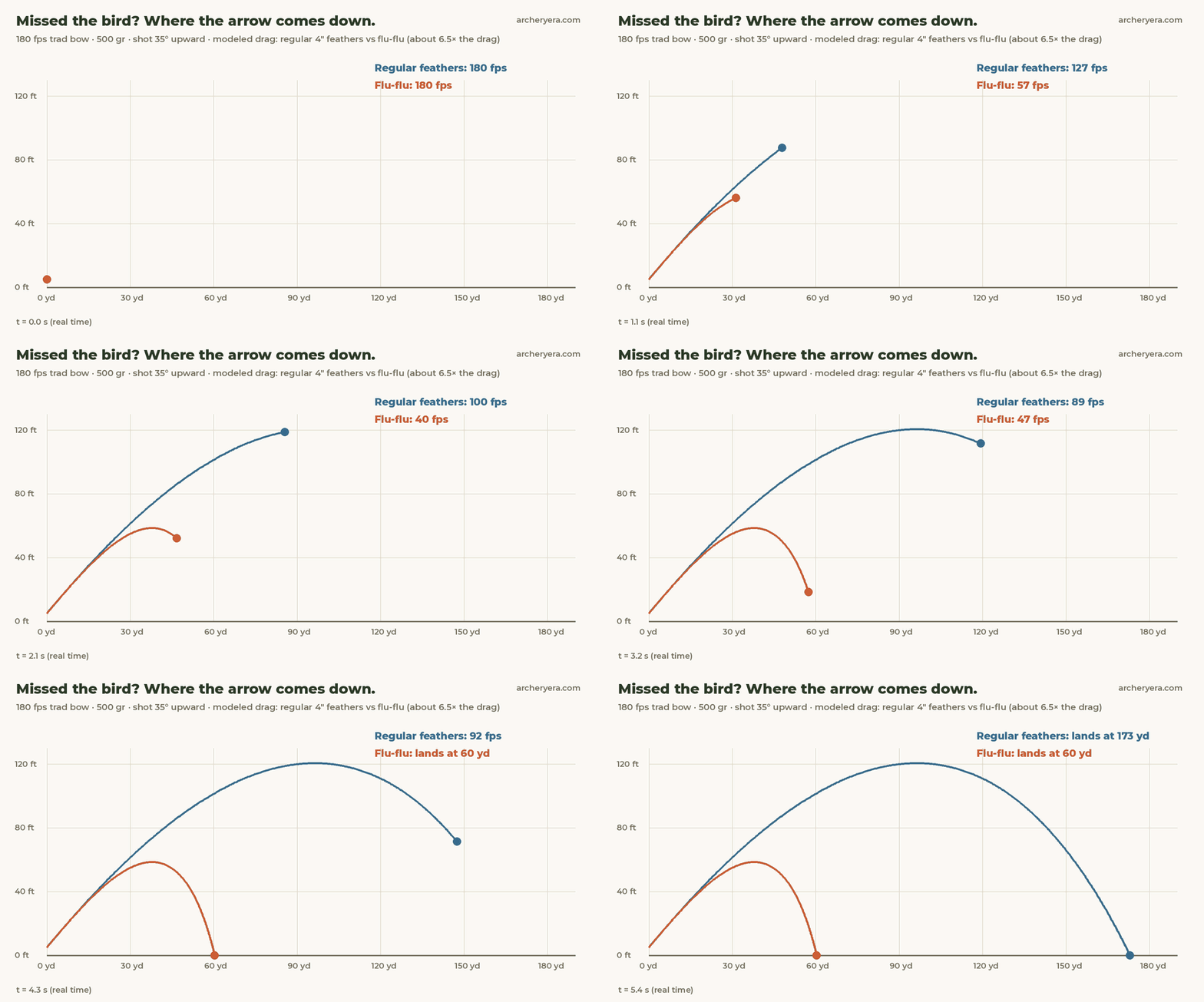
The drag constant I use for flu-flu is about 6.5× a normal feather build. It’s the least certain number on this page — real flu-flu drag depends heavily on how much the feathers are fluffed. Treat it as a shape of the curve, not a promise. Always check what’s behind your aerial target.
See it on Amazon: TrueFlight full-length feathers (for spiral flu-flu) · Carbon Express ready-made flu-flu arrows
Wave Cut and Serrated-Edge Vanes
Wave cut vanes have a scalloped or serrated top edge, sometimes called dragon or shark-fin cuts. The claim is that the notches break up the vortex street off the trailing edge, cutting noise and turbulence. Structurally, most are a mid-height vane with some area removed from the top.
Scalloped top edge: the notches remove area from the part of the vane doing the most work.
Here I’ll be blunt: I haven’t found a published wind-tunnel or chronograph study showing a serrated edge beats a smooth one on flight. The noise claim is more plausible — edge shape does move vortex-shedding frequency, and the 2026 vane-versus-broadhead noise measurements show vane choice alone can swing about 10.5 dB.
So the model treats a wave cut as a hybrid with less area: steering index 75, ~5.0″ drift. Shoot them because you like them. Don’t expect the notches to fix a tune.
See it on Amazon: Bohning X Vane 2.25″ (closest mainstream option; true wave cuts are rare on Amazon)
Traditional Banana and Pope & Young Feathers
Banana and Pope & Young cuts are the classic traditional feather shapes. The banana is a long, low arc; Pope & Young-style cuts, named for bowhunting pioneers Saxton Pope and Art Young, are older traditional die shapes with a long, low back and a gentler front than a modern shield. At 5″ they carry the most steering surface of any normal fletching, and they fold off a wooden shelf without deflecting the arrow.
Long, swept arc — the traditional shelf shooter’s choice.
This is the fletching for heavy wood and carbon arrows off the shelf with 2-blade heads. Steering index 181 — nearly double a Blazer build. The bill comes due in wind: ~10.5″ of modeled drift at 40 yards at 280 fps, and 83% speed kept.
At trad speeds it looks different. From a 180 fps bow the same 5″ banana drifts about 4″ at 20 yards in 10 mph. Most trad shots are inside 25. That’s why the old cut still wins its home ground.
See it on Amazon: TrueFlight 5″ shield-cut feathers, right wing
Short, Stiff Vanes (Bohning Heat)
Short, stiff vanes use a rigid, low profile with an aggressive edge shape to stay flat at high launch speeds. Bohning lists the Heat at 2.5″ long, 0.41″ tall and 6.1 grains. On fast compounds with mechanical heads they resist the flutter that softer, taller vanes can show.
Short, low and stiff.
One correction to a spec you’ll see repeated online: on Bohning’s own Heat listing it’s 2.5″, not 2.25″. The 2.25″ number belongs to Bohning’s X-Vane and X3 line.
Modeled: 251 fps at 40 yards and ~3.9″ drift — basically parabolic numbers at 2.7 gr less weight per vane. Steering index 64. That’s why I’d pair it with mechanicals on a 330+ fps bow and hand fixed blades to a taller vane.
See it on Amazon: Bohning Heat 2.5″ vanes, 36-pack
How Do the 10 Fletching Types Compare Side by Side?
In the ArcheryEra drag model, spin and micro vanes keep the most speed and drift least, feathers steer hardest but lose the most speed, and shield, hybrid and parabolic vanes sit between. Flu-flu is its own category: it is built to shed over half its speed inside 20 yards.
| Fletching type | Profile height | Weight (per vane) | Spin rate (RPM, modeled) | Speed kept at 40 yd | Crosswind drift, 40 yd @ 10 mph | Steering index | Best application |
|---|---|---|---|---|---|---|---|
| High-Profile Shield Cut Vanes | 0.53–0.57″ | 6.0 gr | 2,770 | 88.0% | 5.4″ | 100 | Fixed blades off a drop-away |
| Low-Profile Parabolic Vanes | 0.50″ | 8.8 gr | 1,710 | 89.6% | 4.0″ | 95 | 3D, long-range target, mechanicals |
| Mylar and Spin Vanes | ~0.2″ curl | ~1.0 gr | 5,950 | 91.3% | 2.8″ | 19 | Olympic recurve & indoor target |
| Natural Feathers | ~0.5″ | ~2.5–3.5 gr | 3,170 | 84.5% | 8.7″ | 134 | Shelf-shot recurves & longbows |
| Hybrid Vanes | ~0.48–0.50″ | 6.4–8.3 gr | 2,310 | 89.0% | 4.5″ | 91 | All-round hunting, open country |
| Micro-Profile and Ultra-Low Vanes | ~0.30–0.38″ | 4–5 gr | 1,580 | 90.6% | 3.2″ | 62 | Outdoor target, windy fields |
| Flu-Flu Fletching | ~0.9″ full | ~25–35 gr / set | 3,960 | 33.4% | ~15.4 ft | 1,000+ (air brake) | Birds, small game, aerial targets |
| Wave Cut and Serrated-Edge Vanes | ~0.5″ | ~6–7 gr | 2,310 | 88.3% | 5.0″ | 75 | Noise-conscious hunters (unproven gains) |
| Traditional Banana and Pope & Young Feathers | ~0.55″ | ~3–4 gr | 3,170 | 83.0% | 10.5″ | 181 | Trad hunting with 2-blade heads |
| Short, Stiff Vanes | 0.41″ | 6.1 gr | 1,710 | 89.6% | 3.9″ | 64 | Fast compounds, mechanicals |
Reference arrow: 280 fps launch, 425 gr, field point, 3 vanes (flu-flu modeled as a 6-feather equivalent). Heights and weights are manufacturer figures where published; spin, speed, drift and steering are modeled. Swap to a fixed blade and drift grows by roughly 40–55% in this model — a Blazer build goes from 5.4″ to 8.0″.
Forum sentiment: across the ArcheryTalk and TradTalk fletching threads I track, compound hunters converge on 2″ shield or hybrid vanes for fixed blades, target shooters on low parabolic or spin vanes, and trad shooters on 4–5″ feathers off the shelf. The vanes-for-broadhead-flight debate never really ends — it just resets every season.
Top praised: feathers’ forgiveness when they touch a shelf or rest, and the Blazer’s ability to steer a fixed blade from a short, clearance-friendly footprint.
Common friction point: vanes popping off the shaft and vane contact on full-capture rests — both setup problems more than profile problems. My fletching glue and vane prep guide covers the first one.
3-Fletch or 4-Fletch: How Do 90° and 75°/105° Layouts Change Clearance?
Three vanes at 120° is the default and the lightest. Four vanes at 90° add a third more vane surface but only about 8% more effective steering in a 2025 machine test, and roughly 4.5 fps of loss by 40 yards. A 75°/105° asymmetric four-fletch opens a wider gap at the bottom so both lower vanes straddle the rest launcher or cable path.
The numbers, same reference arrow. The site-wide trajectory engine carries a 3-vane hunting build at k = 0.0033 and a 4-vane build at k = 0.0038. At 40 yards that’s 248 fps vs 244 fps. Small. The tail weight matters more than people think: a fourth 6 gr Blazer on a 425 gr, 28.5″ arrow at 12% FOC drops it to about 11.2% (check yours in the FOC & balance point optimizer) — nearly a full point, from one vane.
| Layout | Steering index | 40-yd speed (280 fps start) | Tail weight (Blazer) | Clearance notes |
|---|---|---|---|---|
| 3-fletch, 120° | 100 | ~248 fps | 18 gr | Cock vane up clears most drop-aways; cock vane out suits many shelf bows |
| 4-fletch, 90° (X) | ~108 | ~244 fps | 24 gr | Symmetrical, so nock orientation matters less; tighter gap for launcher prongs |
| 4-fletch, 75°/105° | ~108 | ~244 fps | 24 gr | Wider bottom slot for the launcher; needs a jig clamp or adapter that indexes these angles |
Speed values use the trajectory engine’s 3-vane and 4-vane drag constants. The steering index counts a fourth vane as about 8% more effective steering, the same calibration the broadhead model uses, set from a 2025 machine test where the fourth vane moved a fixed blade less than an inch at 70 yards. For the measured numbers see 3-vane vs 4-vane fletching.
My take? If you need four vanes on a fast compound with a cable-driven drop-away, 75/105 gives the launcher the widest slot of the 4-fletch layouts. Don’t expect it to steer much better than three. On a whisker biscuit, skip the fourth vane. More vanes means more brushing. Every shot.
Frequently Asked Questions
What are the different types of arrow fletching?
There are ten common arrow fletching types: high-profile shield vanes, low-profile parabolic vanes, Mylar or spin vanes, natural feathers, hybrid vanes, micro or ultra-low vanes, flu-flu fletching, wave-cut vanes, traditional banana or Pope & Young feathers, and short stiff vanes like the Bohning Heat. They differ mainly in height, length, material and edge shape, which sets how hard they steer, how much speed they lose and how far wind pushes them.
Which arrow fletching type is best for fixed-blade broadheads?
For fixed blades you want steering surface. On a compound with a drop-away rest, a 2-inch high-profile shield vane like the Blazer or a 2.7-inch hybrid vane is the usual choice, set with a 3-degree or stronger helical. Off a shelf, 4 to 5-inch feathers steer even harder. Spin and micro vanes carry too little surface for large fixed blades.
How do low-profile parabolic vanes differ from shield-cut vanes?
A shield cut is short and tall with a squared-off back edge; a parabolic is longer and lower with a smooth curve. In the ArcheryEra drag model a Blazer shield build and an AAE Max Stealth parabolic build have almost the same steering surface, but the parabolic keeps about 5 fps more at 40 yards and drifts about 1.5 inches less in a 10 mph crosswind.
When should you use Mylar or spin vanes on an arrow?
Use spin vanes on target arrows, especially Olympic recurve and indoor setups, where a light tail and fast rotation help the arrow recover from a finger release. At about 1 grain each they barely touch FOC. Skip them for hunting with fixed-blade broadheads: the modeled steering surface is roughly a fifth of a Blazer build.
What is a flu-flu fletching used for in bowhunting?
Flu-flu fletching uses full-height, spiral-wrapped or six-fletch feathers to create huge drag, so the arrow flies normally for 15 to 20 yards and then slows sharply. It is used for birds and aerial targets, small game like squirrels and rabbits, and practice where a missed arrow must not travel far. In the model, a 180 fps flu-flu is down to about 104 fps by 20 yards.
How does changing fletching height and length affect downrange arrow drift?
More total fletching area adds drag, and drag is what makes an arrow drift, because wind only pushes it for the extra time drag costs. Height adds more drag and steering per unit than length, since the outer edge sits in faster air. In the model, going from low parabolic vanes to 4-inch feathers roughly doubles 40-yard drift, from about 4.0 to 8.7 inches in a 10 mph crosswind.
How far does a flu-flu arrow travel if you miss?
In the ArcheryEra model, a 500-grain flu-flu shot at 180 fps and 35 degrees upward lands about 60 yards away, while the same arrow with regular 4-inch feathers flies about 173 yards. Real distance depends on how full the feathers are and on launch angle, so always check what is behind an aerial target.
What fletching works best with a whisker biscuit rest?
Low parabolic or short, stiff vanes in a 3-fletch layout with a light helical. Every vane brushes the bristles on every shot, so lower and fewer vanes mean less contact, less noise and less wear. Skip 4-fletch on a biscuit, and check contact with a foot-powder test.
My final take: choose the fletching for the head and the rest first, the wind second, speed last. Then set your jig honestly — a helical clamp for fixed blades, straight or a 1–2° offset for field points and mechanicals — and index the cock vane to your rest’s launcher, not to habit. Glue on a clean, prepped base. Shoot three fletched and one bare shaft before you trust any chart, including mine.
👉 Next: check how your tail weight moves FOC in the Arrow FOC & Balance Point Optimizer, and see the best vanes for hunting for model-by-model picks. New tools land in the newsletter below first.
Hey, what's up? Burak here. Archery addict, board game geek, Daft Punk fan.