
Why Arrow Spine Charts Disagree: Easton vs Gold Tip vs a Formula, Side by Side
Put one 35 lb recurve into five spine calculators and you can get answers from 383 to 600. That’s not a rounding error. It’s the difference between a shaft that bends 0.383 in and one that bends 0.600 in. I lined up Easton’s and Gold Tip’s own charts next to the ArcheryEra spine engine and traced every gap back to an assumption you can check.

Core Insight: Spine charts disagree because each one defines its inputs differently and can only answer with shafts its maker sells. Gold Tip counts the insert as part of point weight. Easton rounds arrow length to the nearest column and adjusts for bow speed. Weight bands start in different places, and Easton’s own hunting and target tools differ by more than a full size. Pick the chart for the shaft you are buying, feed it that brand’s definitions, and let a bareshaft tune settle the rest.
Ideal for: new recurve shooters
Getting 400 from one tool and 600 from another. The cases below show which one to believe.
Ideal for: compound hunters
Choosing between two sizes on a boundary. The assumption table tells you which way to lean.
Ideal for: shop staff
A one-screen way to explain to a customer why the box on the wall and the website disagree.

| Setup | Easton hunting chart | Gold Tip chart | Easton online* | Black Eagle* | ArcheryEra engine |
|---|---|---|---|---|---|
| 35 lb recurve, 30 in arrow, 100 gr point | 460–500 | 500 | 600–675 | 600 | 450 (500 on trad limbs) |
| 35 lb recurve, 32 in arrow, 100 gr point | 390–400 | 400 | 500–575 | 600 | 383 (417 on trad limbs) |
| 70 lb compound, 29 in arrow, 100 gr, IBO 330 | 300–330 | 300 | – | – | 315 smooth / 295 hybrid / 260 speed cam |
| 70 lb compound, 28 in arrow, 100 gr, IBO 330 | 300–340 | 300 | – | – | 335 smooth / 315 hybrid / 285 speed cam |
*As reported in the ArcheryTalk thread quoted below. Every other value was read from the maker’s own published chart or computed with the site engine, September 2026.
What Does Gold Tip’s Chart Say for Your Own Bow?
Before the why, run your own setup. If the two numbers below land within one size, you can skip straight to tuning between sizes. If they don’t, the note under the result names the assumption doing it, and the sections after this explain each one.
This reads Gold Tip’s published chart cell for your setup, applies Gold Tip’s own definition of point weight, and puts the ArcheryEra engine’s answer next to it. If they disagree, the note tells you which assumption is doing it.
Gold Tip values transcribed from Gold Tip’s spine selector chart in September 2026. Point weight is rounded to the nearest chart column (100, 125, 150 gr) and arrow length to the nearest inch.
What Did the Forum Actually Find?
This page started with an ArcheryTalk thread on variation in arrow spine calculator results. The poster ran a 30–35 lb recurve with a 100 gr point through several tools. Gold Tip said 400 at 32 in and 500 at 30 in. Easton’s online selector said 500–575 and 600–675. Black Eagle said 600 for both.
Their conclusion was fair: for a new archer, this is a mess. The replies mostly recommended one calculator over another. I wanted to know why they split, because once you know that, you can predict which way each tool leans.
- Forum sentiment: In that thread, most replies pointed recurve shooters to Victory’s calculator, with 3Rivers’ as the accurate but input-heavy option. Several called Easton’s tool right for a plunger setup and stiff for shooting off the shelf.
- Top praised habit: Buy one size and cut long, then trim a quarter inch at a time during a bareshaft tune.
- Common friction point: The further your arrow length gets from 28 in, the less any chart agrees with any other.
What Do the Charts Say for the Same Bow?
I used the forum poster’s two recurve setups and added two common compound hunting setups. Easton and Gold Tip values come straight from each maker’s current published chart. ArcheryEra values come from the recurve and carbon spine calculators’ shared engine. You can download the comparison as a CSV.
Here’s what surprised me. On the 32 in recurve case, Easton’s 2020 hunting chart and Gold Tip’s chart agree at 390–400. The outlier is Easton’s online target selector, 100 to 175 spine points weaker than Easton’s own hunting chart. Black Eagle is weaker still. So this isn’t brand against brand. It’s two ways of thinking about recurves.
Which Assumptions Move the Answer?
Every tool starts from the same physics: a heavier bow, a longer arrow or a heavier point needs a stiffer shaft. They differ in how they measure those three things and where they draw the lines.
| Assumption | Easton 2020 hunting chart | Gold Tip chart | ArcheryEra engine |
|---|---|---|---|
| What “point weight” means | The point: 100 gr baseline | Point + insert + collar + any added weight | Compound: point + insert + collar, the same as Gold Tip. Recurve: the point, as on Easton’s recurve chart |
| Point weight step | ±3 lb of bow weight per 25 gr | Compound: one 5 lb row per 25 gr. Recurve: 100 and 125 gr read the same row | 3 lb per 25 gr on both engines (Easton’s rule) |
| Arrow length | Nock throat to end of shaft, point and insert not counted; 28.25 in rounds down, 28.5 in rounds up | Nock throat to end of insert | The length you type, no rounding |
| Bow speed / cam | Base 301–340 fps; −5 lb at ≤300, +5 at 341–350, +10 above | Two charts, split at 315 fps | Cam factor on draw weight: 1.00 / 1.09 / 1.20, calibrated to Easton’s 5 lb speed steps |
| Recurves | Same weight rows as compounds, finger release built in | Its own recurve chart, close to the slower compound chart | Separate model calibrated on Easton’s finger-release data |
| Weight bands | 5 lb rows starting 22–26 | 5 lb rows starting 30–34 | Continuous |
| Answers it can give | Easton sizes only (500, 480, 470, 460…) | Gold Tip sizes only (600, 500, 400, 340, 300…) | Any number |
Read from each maker’s published chart and instructions, September 2026.
Point weight is not the same number on every chart
Gold Tip’s selector says point weight is the point plus the insert, collar and any added weight. Easton’s hunting chart is built on 100-grain points and adds or takes off 3 lb of bow weight per 25 gr. Put a 100 gr field point on a 50 gr brass insert and Gold Tip sees 150 gr, two full rows stiffer on its compound chart. Easton’s chart sees 100 gr unless you know to add the insert yourself. Most people don’t.
Arrow length gets measured and rounded differently
Gold Tip measures from the nock throat to the end of the insert. Easton measures from the nock throat to the end of the bare shaft, then applies a rounding rule: 28.25 in drops to the 28 in column, 28.5 in jumps to 29. On both charts one inch of length is worth about one 5 lb row. So a quarter inch of measuring difference right at a rounding edge moves you a full size.
The weight bands start in different places
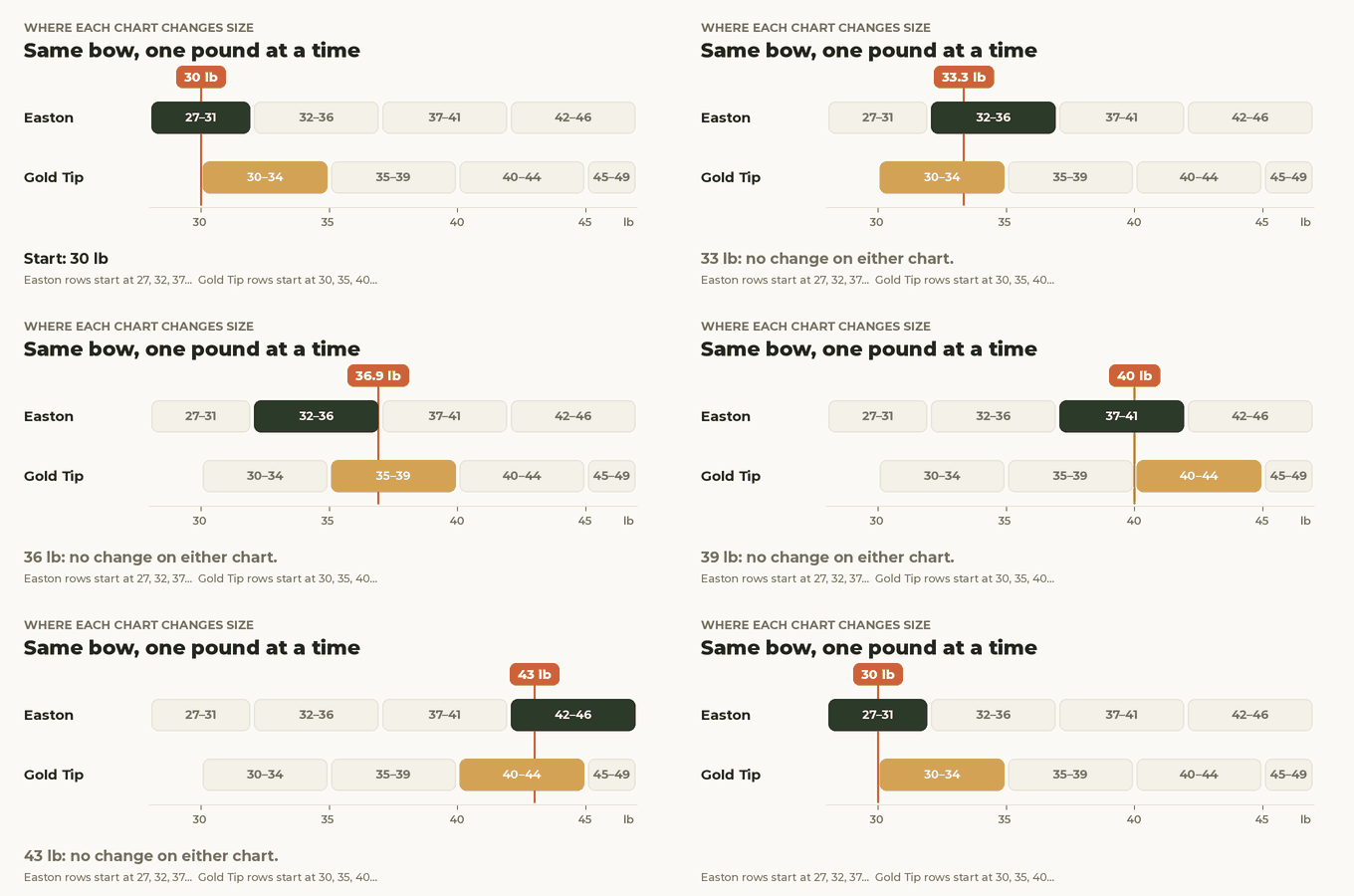
Easton’s rows run 22–26, 27–31, 32–36. Gold Tip’s run 30–34, 35–39. A 35 lb bow sits near the top of an Easton band and at the bottom of a Gold Tip band. Nudge it to 37 lb and Easton jumps a row while Gold Tip does not. Two honest charts can split on a single pound.
Recurves get treated very differently
Easton’s hunting chart reads a recurve on the same weight row as a compound. Gold Tip gives recurves their own chart, which lands close to its slower compound chart. Easton’s target selector is built for finger-release shooters and leans weak. That single choice explains most of the 400-vs-600 spread in the forum thread.
A chart can only answer with shafts the brand sells
Gold Tip’s steps run 500, 400, 340, 300. Easton lists 500, 480, 470, 460 because it sells shafts at each of those. If your ideal is 440, Gold Tip has to round to 400 or 500 and Easton can hand you a 460. That looks like a disagreement. It’s really two catalogs.
Even the spine number has two definitions
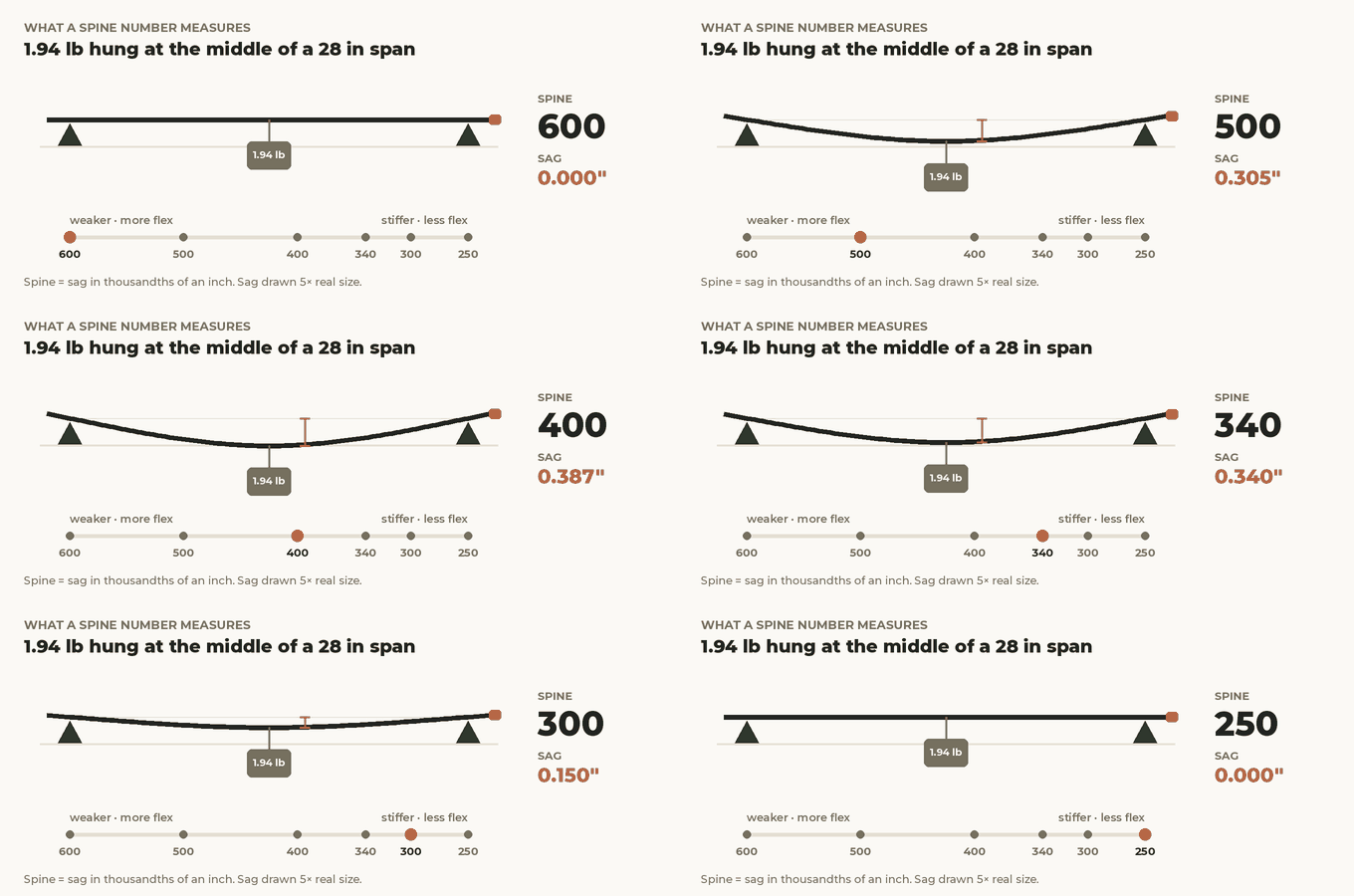
Modern spine numbers are deflection in thousandths of an inch under a 1.94 lb weight on a 28 in span, the method in ASTM F2031. The older AMO test used 2 lb on a 26 in span and reads lower for the same shaft. Most current charts use the 28 in method. An old chart or an old shaft box may not.
What About Compound Bows?
For compounds the two makers agree closely. At 70 lb with a 29 in arrow, Easton says 300–330 and Gold Tip says 300. At 28 in, Easton widens to 300–340 and Gold Tip holds at 300.
My own engine used to be the outlier here: it called 247 for a hybrid cam, a full size or more stiffer than both charts. I went looking for why. The cam factor was part of it, but the bigger problem was the arrow-length term — the old engine charged 12 lb per inch, and both charts step one 5 lb row per inch. In September 2026 I refitted the compound engine against Easton’s 2020 Hunting Shaft Selector and Gold Tip’s charts together, about 4,900 setups from 40 to 84 lb. Now it reads 315 smooth, 295 hybrid and 260 speed cam. The speed-cam number is stiffer on purpose: Easton adds 10 lb for bows over 350 fps, and at 80 lb its chart lands on its 260–240 group too.
For a compound with a release, I’d start on the stiffer side of whatever the charts say, because a broadhead and a heavy front both make an arrow act weaker. For a recurve shot with fingers, especially off the shelf, I’d start one size weaker than Gold Tip or Easton’s hunting chart and cut long. That’s where most traditional shooters on the forums end up after tuning. I’d rather trim a weak arrow than own a dozen stiff ones I can’t fix.
- Avoid trusting any chart past about 31 in of arrow or below 26 in. The rows get sparse and the tools diverge most.
- Avoid mixing definitions. Don’t measure length the Easton way and read the Gold Tip chart.
- Avoid skipping the insert when a chart asks for total front weight.
Stuck Between Two Sizes? Which Change Moves Spine the Most?
This is the question the forum thread never got to. Once you own a dozen shafts, the chart doesn’t matter anymore. What matters is which knob moves the arrow fastest toward matched. I ran the forum poster’s 35 lb recurve (32 in arrow, 100 gr point, centershot) through the recurve spine engine and changed one thing at a time.
| Change (one at a time) | Effective bow weight | Spine the bow now wants | What your current shaft does |
|---|---|---|---|
| Starting setup | 52 lb | 383 | – |
| Point 100 → 125 gr | 55 lb | 366 | Acts weaker |
| Point 100 → 150 gr | 58 lb | 355 | Acts weaker |
| Draw weight +3 lb (38 lb) | 55 lb | 366 | Acts weaker |
| Cut 1 in (31 in) | 47 lb | 417 | Acts stiffer |
| Cut 2 in (30 in) | 42 lb | 450 | Acts stiffer |
| Traditional limbs, off the shelf | 47 lb | 417 | Acts stiffer |
ArcheryEra recurve engine, September 2026. Lower spine number = the bow wants a stiffer shaft.
Read that table sideways and one thing jumps out. One inch of length moves the answer 34 spine points. A 25 gr point swap moves it 17. Inch for grain, the hacksaw is twice the lever. That’s the whole reason “buy long, trim a quarter inch at a time” works, and why I’d never order a recurve arrow cut to my exact draw on day one. If you do cut, square the end properly, because a crooked cut throws the bareshaft read you’re relying on.
Point weight is the fine knob. It’s the one you reach for once length is close, and the one that also moves your FOC. The dynamic spine calculator shows how far a heavier front pushes a given shaft before it tips from stiff to weak.
- Heavier string or more strands: slower string, arrow acts stiffer.
- Higher brace height: arrow acts stiffer. Common trad fix for a slightly weak set.
- Firmer plunger spring: arrow acts stiffer. Only works on a bow with a plunger.
- Fixed-blade broadhead instead of a field point: same weight, same static answer, but any spine error shows up louder at 30 yards.
How do you read a bareshaft to tell which way you’re off?
Shoot two or three fletched arrows and one bare shaft at the same spot from about 15–20 yards. For a right-handed finger shooter, a bare shaft hitting left of the fletched group means the spine is too stiff, and right means too weak. Left-handers flip it.
| Bareshaft lands… | What it means | First fix to try |
|---|---|---|
| Left of fletched | Too stiff | Heavier point, or leave it long |
| Right of fletched | Too weak | Trim ¼ in, or drop 25 gr of point |
| High | Nocking point too low | Move the nock point up 1/16 in |
| Low | Nocking point too high | Move the nock point down 1/16 in |
| With the group | Matched | Stop fiddling. Go shoot. |
Right-handed finger release. Fix height first, then left/right.
Compound shooters with a release get a cleaner read from paper than from bareshafts. My paper tuning walkthrough covers that side.
So Which Spine Chart Should You Trust?
The one made for the shaft in your hand, read with that brand’s own definitions. Then treat the answer as a starting point. For recurves, cut long and bareshaft. For compounds, paper tune and check broadhead flight at 30 yards. A paper tune diagnostic will tell you in a few shots whether you guessed right.
If you shoot old aluminum shafts, the size codes follow a different logic again. I pulled every published Easton XX75 size into one table in the XX75 aluminum spine chart. If you’re adding weight up front, read FOC vs penetration first, because a heavier point changes your spine answer too.
Frequently Asked Questions
Why do arrow spine calculators give different results?
Because each one makes different assumptions and rounds into a different set of shafts. The biggest ones are what counts as point weight, how arrow length is measured, how bow speed or cam type is handled, where the 5 lb weight bands start and end, and which spine sizes the brand actually makes. None of them is wrong. They are starting points built for their own shafts.
Does Gold Tip recommend a stiffer spine than Easton?
Not against Easton’s own hunting chart. For a 35 lb recurve with a 32 in arrow, both land at 390–400. The big gap people notice is against Easton’s online target selector, which a forum user reported at 500–575 for the same bow. Easton’s hunting and target tools disagree with each other by more than a full size.
Does point weight on a spine chart include the insert?
On Gold Tip’s chart, yes. It counts the point, insert, collar and any added weight. Easton’s hunting chart just says 100-grain points. A 100 gr point on a 16 gr insert is 116 gr to Gold Tip, and on a heavier brass insert it can land in a different column entirely.
Should I pick the weaker or stiffer spine when charts disagree?
For a compound with a release, I lean to the stiffer option, because broadheads and heavier fronts both make an arrow act weaker. For a recurve or longbow shot off the shelf, I lean weaker and cut long, then trim a quarter inch at a time during a bareshaft tune. Either way the chart only gets you close. The tune decides.
What does a spine number like 400 mean?
It is the deflection in thousandths of an inch. A 400 spine shaft bends 0.400 in when a 1.94 lb (880 g) weight hangs from the center of a 28 in span, the method in ASTM F2031. Lower numbers are stiffer. The older AMO method used 2 lb over 26 in, so a number from an old chart is not always the same unit.
Which spine calculator is most accurate?
The one built for the shaft you are buying, used with its own definitions. Plug in point weight and length exactly the way that brand measures them. Then confirm with a bareshaft or paper tune, because no chart knows your release, brace height or center shot.
What should I change if my bow falls between two spine sizes?
Change arrow length first. On a 35 lb recurve with a 32 in arrow, cutting one inch moves the spine the bow wants from 383 to 417, while a 25 gr heavier point only moves it from 383 to 366. So length is roughly twice the lever. Buy the stiffer of the two sizes, leave it long, and trim a quarter inch at a time while you bareshaft tune. Point weight is the fine adjustment once length is close.
Hey, what's up? Burak here. Archery addict, board game geek, Daft Punk fan. By day I’m a mechanical engineer (MSc), so beam deflection is the part of spine that makes sense to me first. I ran ArcheryBull from 2018 and wrote the spine engine this page puts on trial, which is why I flagged where it lands off the charts instead of hiding it.