
Easton XX75 Spine Chart: Every Aluminum Arrow Size With Spine, GPI and Diameter
Easton spread its XX75 data across four product pages, and older sizes live in forum posts and shoeboxes. I pulled every published size into one searchable table, checked each spine value against the physics of the tube itself, and built two tools: one that identifies a shaft whose stamp has worn off, and one that tells you which XX75 size fits your bow.

If you buy through our links, we may earn a commission that helps support the work we do. Learn more.
Core Insight: An XX75 size code is the tube’s diameter in 64ths of an inch followed by its wall in thousandths. So a 2213 is 22/64 in across with a 0.013 in wall. Its spine is the deflection at a 28 in span. The 2213 is published at 0.464 in (about a 460 carbon) and 9.8 gpi. For a 45–50 lb bow at a 28 in draw, the shelf and the arrow length decide it: a centershot recurve with a 29 in arrow wants a 2216 or 2117 (0.38–0.41 in), while a stickbow shot off the shelf with a 28 in arrow sits right on the 2213.
Ideal for: trad shooters with old shafts
Identify that box of unlabeled XX75s with a caliper and a grain scale, then check whether it fits your bow.
Ideal for: carbon shooters trying aluminum
Convert any size to a carbon-style spine number and see the weight you will add.
Ideal for: youth and light bows
The 1416–1816 end of the table, 0.76–1.69 in of flex, is where light youth and beginner bows live.

Why Is XX75 Spine Data So Hard to Find?
A TradTalk thread from someone who could not find a spine chart for old Easton XX75s has passed 19,000 views. The poster had 2213s and a 48 lb bow. The replies pointed to a book formula, a different maker’s table and guesswork.
The data does exist. Easton publishes it, but per product line, and discontinued sizes drop off when a line is retired. An ArcheryTalk thread about XX75 GPI charts shows the same hunt for sizes like the 2314. This page puts what is published in one place and marks clearly what is not.
- What people actually ask: “What is in this box?” Not “which shaft is fastest.” Both threads start with a stamp, a bow weight and no chart.
- Why a match usually exists: XX75 sizes step in fine increments, often only 0.02–0.04 in of deflection apart. There is almost always a size within one step of your bow.
- Where it goes wrong: The chart leaves with the box, stamps wear off near the nock, and forum answers mix numbers from different eras of Easton catalogs.
What Is the Spine of Every Easton XX75 Size?
Every value below comes from Easton’s own spec tables for the XX75 Legacy, XX75 Camo Hunter, XX75 Platinum Plus and XX75 Jazz lines. Type a size or the first two digits to filter. You can also download the full table as a CSV with a source link on every row.
| Size | Outside dia. (in) | Wall (in) | GPI | Legacy | Camo Hunter | Platinum Plus | Jazz | Carbon-style spine # | Predicted from code |
|---|---|---|---|---|---|---|---|---|---|
| 2413 | 0.375 | 0.013 | 10.5 | – | 0.372 | – | – | 372 | 0.352 |
| 2317 | 0.359 | 0.017 | 13.3 | – | 0.303 | – | – | 303 | 0.318 |
| 2219 | 0.344 | 0.019 | 13.8 | 0.337 | 0.342 | – | – | 340 | 0.333 |
| 2216 | 0.344 | 0.016 | 12.0 | 0.376 | 0.382 | – | – | 379 | 0.385 |
| 2215 | 0.344 | 0.015 | 10.7 | – | 0.425 | – | – | 425 | 0.407 |
| 2213 | 0.344 | 0.013 | 9.8 | – | 0.464 | 0.464 | – | 464 | 0.461 |
| 2117 | 0.328 | 0.017 | 12.0 | 0.407 | 0.413 | – | – | 410 | 0.423 |
| 2114 | 0.328 | 0.014 | 9.9 / 10.4 | – | 0.513 | 0.513 | – | 513 | 0.500 |
| 2018 | 0.312 | 0.018 | 12.3 | 0.464 | 0.468 | – | – | 466 | 0.471 |
| 2016 | 0.312 | 0.016 | 10.6 | 0.531 | 0.537 | 0.537 | 0.567 | 537 | 0.519 |
| 2013 | 0.313 | 0.013 | 9.0 | – | – | 0.616 | – | 616 | 0.621 |
| 1916 | 0.297 | 0.016 | 10.0 | 0.623 | 0.627 | 0.627 | 0.627 | 627 | 0.611 |
| 1913 | 0.298 | 0.013 | 8.3 | – | – | 0.738 | – | 738 | 0.729 |
| 1816 | 0.281 | 0.016 | 9.3 | – | – | 0.759 | 0.759 | 759 | 0.725 |
| 1716 | 0.266 | 0.016 | 9.0 | – | – | 0.882 | 0.882 | 882 | 0.869 |
| 1616 | 0.250 | 0.016 | 8.4 | – | – | 1.082 | 1.082 | 1082 | 1.055 |
| 1516 | 0.234 | 0.016 | 7.3 | – | – | 1.405 | 1.405 | 1405 | 1.297 |
| 1416 | 0.219 | 0.016 | 7.2 | – | – | 1.685 | 1.685 | 1685 | 1.619 |
| 1214 | 0.197 | 0.014 | 5.9 | – | – | – | 2.501 | 2501 | 2.517 |
Spine columns are Easton’s published static deflection in inches at a 28 in span, per product line. “Carbon-style spine #” is the median across lines × 1000. Diameter is Easton’s published value where listed and the size code otherwise. Predicted column: my beam calculation from diameter and wall alone. The 2114 shows two GPI values because Camo Hunter and Platinum Plus list it differently.
How Do You Read an Easton Aluminum Size Code?
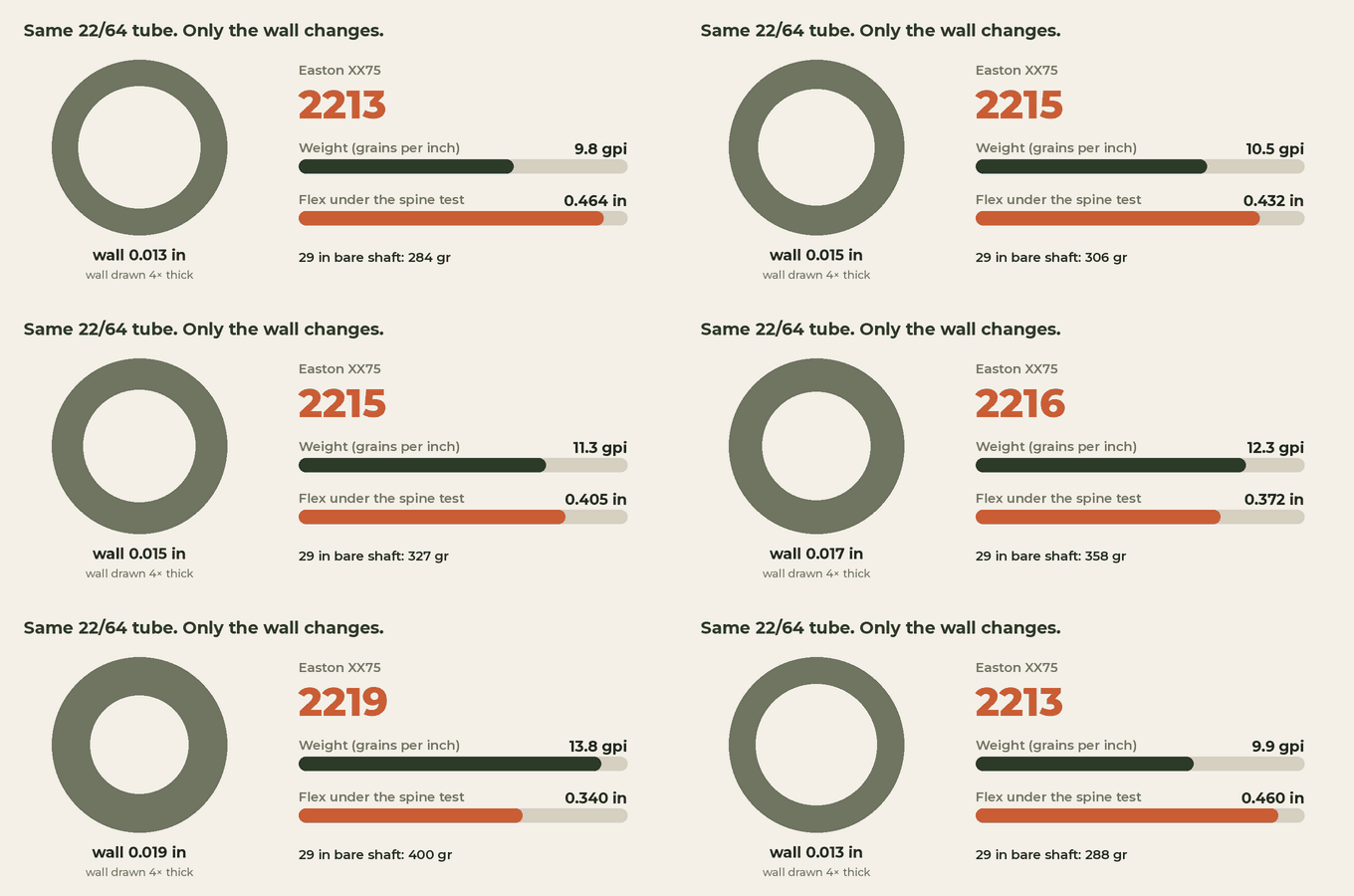
Take the 2213. The 22 is the outside diameter in 64ths of an inch: 22/64 = 0.344 in, which is exactly what Easton lists. The 13 is the wall thickness in thousandths: 0.013 in. A 2219 has the same diameter and a thicker 0.019 in wall, so it is stiffer (0.337–0.342 in) and heavier (13.8 gpi).
That gives you two levers. A bigger diameter stiffens a shaft a lot for little weight. A thicker wall stiffens it less and adds more weight. It is why a 2413 and a 2216 have similar spine (0.372 vs 0.382 in) but the 2413 weighs 1.5 grains per inch less.
The XX75 on the stamp is part of the code too. It names the alloy, 7075 aluminum. Every size in the table shares that one material, which is why a simple tube calculation can check Easton’s numbers, as the next section shows.
Can You Predict Spine From the Size Code Alone?
Mostly, yes, and that makes a good check on the published numbers. I treated each shaft as a hollow 7075 aluminum tube and calculated how far it bends under the 1.94 lb spine-test weight on a 28 in span. The only inputs are diameter and wall, straight from the code.
Across all 19 sizes the prediction lands an average of 2.8% from Easton’s figure, and within 5% for 17 of them. The same tube math predicts grains per inch within a few percent too. The one real outlier is the 1214, whose published diameter (0.197 in) is larger than its code implies. Once I use the published diameter it comes back in line.
So when a size is missing from every current Easton page, the code still gets you close:
| Size | Predicted deflection (in) | Predicted GPI | Forum-reported value |
|---|---|---|---|
| 2312 | 0.431 | 9.3 | – |
| 2314 | 0.376 | 10.8 | 0.391 in, 10.7 gpi |
| 2315 | 0.354 | 11.5 | – |
| 2512 | 0.333 | 10.1 | – |
Forum values come from an old Easton chart quoted on ArcheryTalk and are unverified. Expect about ±4% on the predictions, which is the typical error on sizes Easton does publish.
How Do You Identify an XX75 Shaft With a Worn-Off Stamp?
Stamps wear off near the nock, and a used box can hold two or three sizes. You need a dial caliper that reads to 0.001 in and an arrow grain scale. The caliper gives you the diameter, which is the first two digits. Weight per inch gives you the wall, which is the last two.
Pull the point before you weigh. Wall sizes at one diameter sit only 25–50 grains apart on a 29 in shaft, so a guessed insert weight can push you one size off. One truly bare tube settles it.
Neither tool has to be fancy. Neighboring 64ths sit 0.0156 in apart, so any dial or digital caliper marked in 0.001 in steps splits them easily. A scale that reads to the nearest grain is enough too, because the walls you are separating are 25 grains or more apart.
Measure the tube in the middle, away from the swage or bushing. Length is the aluminum tube only, end to end.
Which XX75 Size Fits My Bow?
Enter your setup. The matcher works out a target spine with the same engine as the recurve spine calculator, then ranks every published XX75 size by how close its deflection sits to that target.
Shaft weight is GPI × arrow length and leaves out the point, insert and nock. A heavier point makes any shaft act weaker. Confirm with a bareshaft tune.
What Draw Weight Does Each XX75 Size Fit?
Most people land here with a stamped size and one question: will it fly out of my bow? So I ran every hunting-weight XX75 size backwards through the same spine engine. Each cell is the marked draw weight where that size sits within ±0.015 in of the engine’s target.
| Size | Spine (in) | GPI | Centershot, 28 in arrow | Centershot, 29 in arrow | Off the shelf, 28 in arrow | Off the shelf, 29 in arrow |
|---|---|---|---|---|---|---|
| 2317 | 0.303 | 13.3 | 68–74 lb | 63–69 lb | 73–79 lb | 68–74 lb |
| 2219 | 0.340 | 13.8 | 58–65 lb | 53–60 lb | 63–70 lb | 58–65 lb |
| 2413 | 0.372 | 10.5 | 52–57 lb | 47–52 lb | 57–62 lb | 52–57 lb |
| 2216 | 0.379 | 12.0 | 51–55 lb | 46–50 lb | 56–60 lb | 51–55 lb |
| 2117 | 0.410 | 12.0 | 46–50 lb | 41–45 lb | 51–55 lb | 46–50 lb |
| 2215 | 0.425 | 10.7 | 44–48 lb | 39–43 lb | 49–53 lb | 44–48 lb |
| 2213 | 0.464 | 9.8 | 40–42 lb | 35–37 lb | 45–47 lb | 40–42 lb |
| 2018 | 0.466 | 12.3 | 39–41 lb | 34–36 lb | 44–46 lb | 39–41 lb |
| 2114 | 0.513 | 10.2 | 35–37 lb | 30–32 lb | 40–42 lb | 35–37 lb |
| 2016 | 0.537 | 10.6 | 32–34 lb | 27–29 lb | 37–39 lb | 32–34 lb |
| 2013 | 0.616 | 9.0 | 24–26 lb | 20–21 lb | 29–31 lb | 24–26 lb |
| 1916 | 0.627 | 10.0 | 23–25 lb | 20 lb | 28–30 lb | 23–25 lb |
Marked draw weight at a 28 in draw with a 125 gr point. A 100 gr point moves each window about 3 lb heavier, a 145 gr point about 2 lb lighter. Each inch of draw past 28 in acts like about 2 lb more bow. Sizes weaker than the 1916 sit under 20 lb and belong on youth bows; the matcher above handles those.
Two things jump out. The 2213 and 2018 are near twins on spine (0.464 vs 0.466 in), yet the 2018 carries 2.5 more grains per inch, about 72 grains more on a 29 in shaft. Pick by the arrow weight you want, not the spine.
And the 2117 is the only size whose window covers 46–50 lb both on a centershot bow with a 28 in arrow and off the shelf with a 29 in arrow. If you do not know yet which bow a box of shafts will end up on, that is the one to grab.
What About the 48 lb Bow and the 2213s From the Forum?
The TradTalk poster had 2213s and a 48 lb bow at a 28 in draw. The kind of bow matters more here than the pounds, so here are all four readings with a 125 gr point:
| 48 lb bow, 28 in draw | Engine target | 2213 (0.464 in) reads | Closest sizes |
|---|---|---|---|
| Centershot recurve, 29 in arrow | 0.377 in | 0.087 weak, 2–3 steps | 2216, 2413 |
| Centershot recurve, 28 in arrow | 0.410 in | 0.054 weak, 1–2 steps | 2117, 2215 |
| Off the shelf, 29 in arrow | 0.410 in | 0.054 weak, 1–2 steps | 2117, 2215 |
| Off the shelf, 28 in arrow | 0.443 in | 0.021 weak, one small step | 2215, 2213, 2018 |
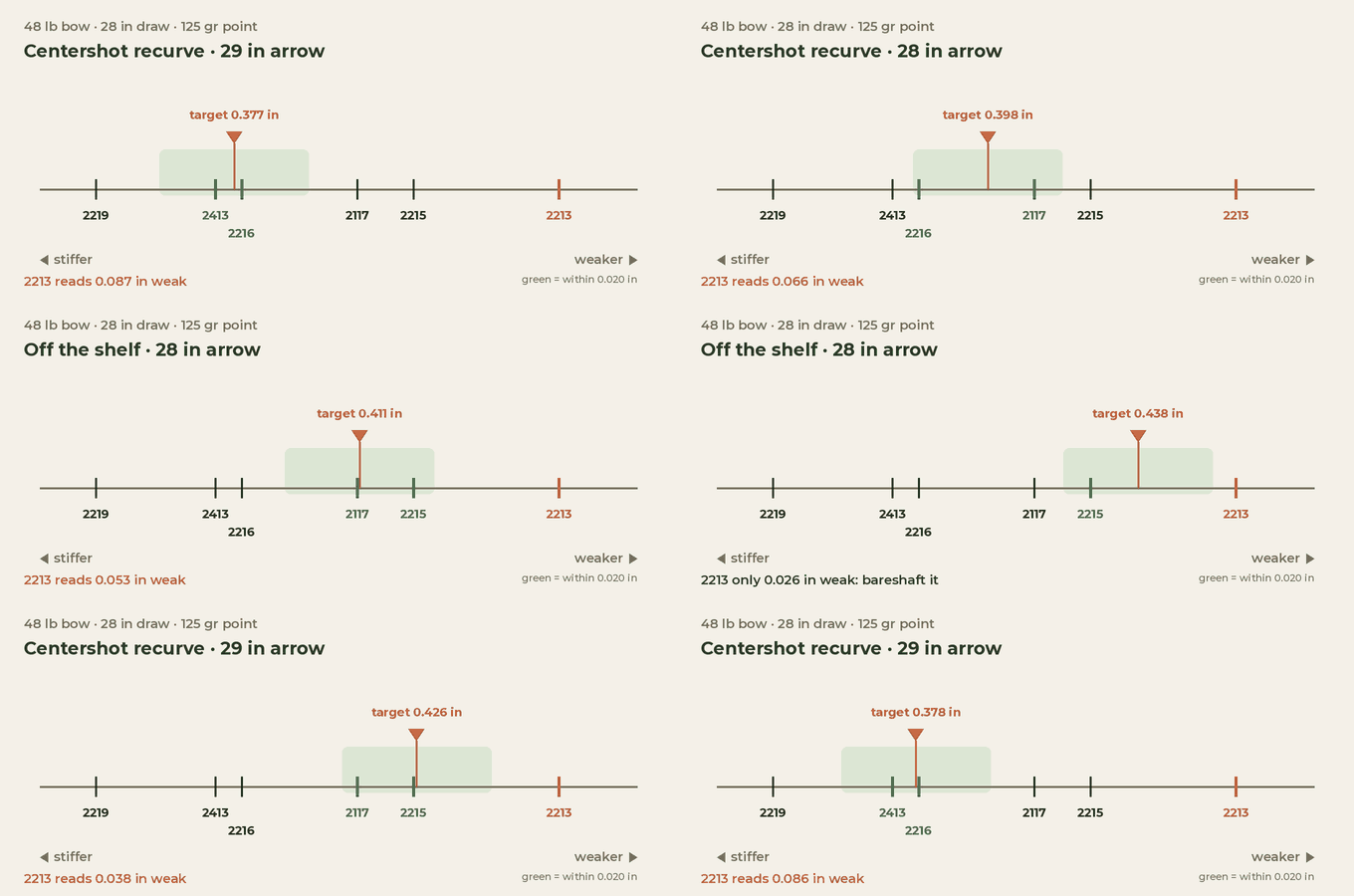
Easton’s own 2020 hunting chart backs the stiff end of that table. A 47–51 lb recurve at a 28–29 in arrow lands on 400/390 carbon, and a 2117 at 0.407–0.413 in is its aluminum twin. But that chart assumes a modern riser cut past center. A stickbow shot off the shelf has to let the arrow bend around the riser, and it wants a weaker shaft.
So my answer to the poster: if it is a longbow or a traditional recurve shot off the shelf and you can live with a 28 in arrow, bareshaft those 2213s before you buy anything. If it is a centershot recurve, or you need a 29 in arrow, expect them to read weak. Start with a 2117.
If I were buying used XX75s for a 45–50 lb bow and did not know yet which bow they would go on, I would hunt for 2117s. They land within one step on a centershot recurve and on an off-the-shelf stickbow. The 2213 is a lovely light shaft, but it only fits 45–50 lb when the bow is shot off the shelf and the arrow stays at 28 in. For heavy-arrow hunters, the 2219 at 13.8 gpi builds a 500+ grain arrow without a single brass insert.
How Does XX75 Spine Compare With Carbon?
Directly, because both are deflection at a 28 in span. Multiply the aluminum number by 1000: a 2117 at 0.407 in behaves like a 400–410 carbon, a 2016 at about 0.537 in like a 540. The difference is weight. At the same spine the XX75 usually runs 2–4 grains per inch heavier than a standard-diameter hunting carbon, so a 29 in shaft adds roughly 60–110 grains before you touch the point.
If you are moving between the two, the carbon vs aluminum arrows guide covers durability and straightness. My page on why spine charts disagree explains why two charts might put you a size apart.
- Check straightness. Roll each shaft on a flat table. A bend changes flight far more than a spine step.
- Check the size stamp. Used sets often mix sizes. Weigh a few at the same length, or run a bare one through the shaft identifier.
- Avoid kinked shafts. A gentle bow in aluminum can be pulled straight on an arrow straightener rated for aluminum. A sharp kink means the metal has yielded, and that shaft is done.
- Order inserts by the full size. A 2213 and a 2216 are both 22/64 outside, but the bore differs (0.318 vs 0.312 in). Inserts are sold against specific four-digit sizes (some packs cover two neighbors, such as 2213 and 2215), never by the first two digits alone.
- Look at the nock end. Older shafts often carry a swaged taper for glue-on nocks; others take a press-in nock through a bushing. Match the nock system before you order parts.
What Is the Bottom Line on XX75 Spine?
Read the code first: diameter in 64ths, wall in thousandths. No stamp? A caliper and a grain scale get you there. Look the size up in the table, or trust the prediction within about 4% if it is missing. Then check the draw-weight table, run your exact setup through the matcher and finish with a bareshaft tune. The shelf matters as much as the pounds. If the arrow is for hunting, run the finished weight through FOC vs penetration to see what the extra aluminum mass buys you.
Frequently Asked Questions
What do the numbers in an Easton aluminum arrow size mean?
The first two digits are the tube’s outside diameter in 64ths of an inch. The last two are the wall thickness in thousandths. A 2213 is 22/64 in (0.344 in) across with a 0.013 in wall. That matches Easton’s published diameter for every size except the tiny 1214.
What is the spine of an Easton XX75 2213?
Easton publishes 0.464 in of deflection at a 28 in span for the 2213 in both the Camo Hunter and Platinum Plus lines, at 9.8 grains per inch. In carbon terms that is roughly a 460 spine.
What draw weight is a 2213 aluminum arrow good for?
With a 125 gr point and a 28 in draw, the ArcheryEra spine engine puts the 2213 (0.464 in) at about 40–42 lb on a centershot recurve with a 28 in arrow, and about 45–47 lb on a bow shot off the shelf. Each extra inch of arrow drops the window about 5 lb. Confirm with a bareshaft tune.
What draw weight is a 2117 aluminum arrow good for?
A 2117 deflects about 0.407–0.413 in, close to a 400 carbon. With a 125 gr point and a 28 in draw, the ArcheryEra spine engine puts it at about 46–50 lb on a centershot recurve with a 28 in arrow and 41–45 lb with a 29 in arrow. Off-the-shelf bows carry it about 5 lb heavier. Use the matcher above for your exact setup, then bareshaft tune.
How can I tell what size an unmarked aluminum arrow is?
Measure the outside diameter with a caliper and round to the nearest 64th of an inch: that gives the first two digits (0.344 in is 22). Then weigh the bare tube and divide by its length for grains per inch. At a given diameter, the GPI points to the wall, which gives the last two digits. The identifier on this page does the math.
Can you compare aluminum and carbon spine numbers directly?
Yes, when both are measured the same way. Easton lists aluminum spine as deflection at a 28 in span, the same test behind carbon numbers like 400 or 500. Multiply the aluminum deflection by 1000 to read it as a carbon-style number. Aluminum is heavier per inch at a given spine, so the finished arrow will weigh more.
Why does the same XX75 size show different spine values?
Easton’s product lines do not always publish the same number for one size. The 2016 is listed at 0.531, 0.537, 0.537, 0.567 in across Legacy, Camo Hunter, Platinum Plus and Jazz. Easton does not explain the spread. I use the median, and I treat any single value as ±0.01 in anyway.
Are old XX75 arrows still worth shooting?
If they are straight, yes. Roll each shaft on a flat table and check for a wobble before you trust its spine. A bent aluminum shaft can be straightened, but a kinked one cannot. Weigh a few too, since used sets often mix sizes.
Hey, what's up? Burak here. Archery addict, board game geek, Daft Punk fan.