Where to Practice Archery: Six Spots, the Real Rules, and How Far a Miss Flies
An archery shop lane, a club, a state wildlife-area range, a park that has a real archery range, BLM or National Forest land, or your own yard once the local code says yes. Which one fits comes down to the distance you need and whether broadheads are coming along. After that, it's about room: how far your missed arrow keeps going.

For field points at 20 yards, an archery shop's indoor lane is the easiest legal spot. For 40 yards and beyond, look for a club or a state wildlife-agency range; many state ranges want a hunting license, a fishing license or a pass. BLM land generally allows target shooting done safely, and National Forest rules ban shooting within 150 yards of homes, campsites and developed sites. City parks without a marked archery range usually ban it. Your yard is a local-code question first, and a physics question second: on my trajectory engine, a 70 lb compound arrow that sails just over a 20-yard bag lands about 55 yards behind it.
Jump to: 1-minute matrix · Practice Spot Finder · how far a miss flies · BLM & National Forest · state ranges · broadheads · checklist · FAQ
Which Practice Spot Fits What You Need?
Here are the six options side by side, sorted by what archers ask most on the forums: how far they can shoot and whether broadheads are allowed. Read across the row you care about.
| Spot | Typical distance | Broadheads | Who sets the rules | Check first |
|---|---|---|---|---|
| Archery shop lane | Usually 20 yd indoor | Usually no | The shop and its insurer | Lane hours, crossbow policy |
| Archery club | Indoor 20 yd, outdoor field and 3D courses farther out | Ask; some have a pit | Club rules | Membership, range days |
| State wildlife-area range | Varies by range | Varies: PA allows on marked targets, NJ and NC ban them | State wildlife agency | License or pass, hours |
| Park with a marked archery range | Varies by park | Usually no | City or county parks dept. | Posted rules at the range |
| BLM / National Forest land | Whatever the terrain and your backstop allow | Yes, with a backstop | BLM or Forest Service office, plus fire closures | 150-yd rule (USFS), local closures |
| Your yard or private land | Limited by the room behind the target | Yes, into a broadhead target | City or county code, HOA, the landowner | Discharge ordinance, what's behind the target |
Practice Spot Finder
Answer six questions. It ranks the six kinds of practice spots for you and tells you what to check before you go. It doesn't know your state's rules; it points you to the people who do.
How Far Does a Missed Arrow Fly?
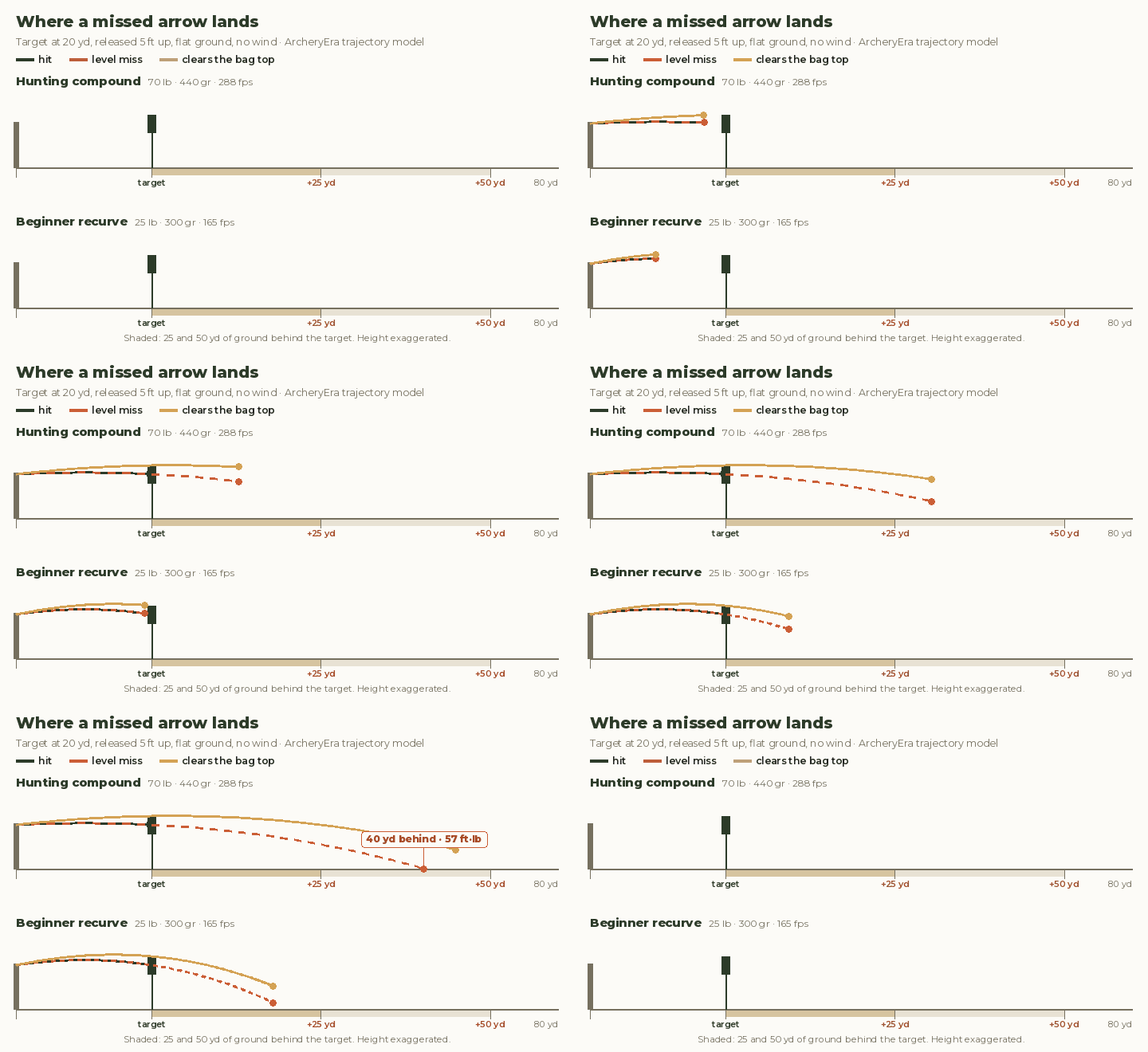
Every outdoor spot on this list has the same question hiding behind it: what happens to the arrow that doesn't hit the target? I wanted a number instead of a rule of thumb, so I ran five bow setups from my trajectory visualizer presets through a full 2-D flight solve on the same speed and drag model. Target at 20 yards, arrow released 5 feet off flat ground, no wind.
| Setup | Launch speed | Level miss lands behind target | Clears a 24-in bag, lands behind target | Energy left (bag-clearing miss) | Farthest throw |
|---|---|---|---|---|---|
| Hunting compound, 70 lb, 440 gr | 288 fps | 40 yd | 55 yd | 52 ft·lb | 333 yd at 38° |
| 3D compound, 60 lb, 380 gr | 260 fps | 36 yd | 49 yd | 40 ft·lb | 327 yd at 39° |
| Barebow recurve, 38 lb, 380 gr | 188 fps | 25 yd | 32 yd | 23 ft·lb | 224 yd at 41° |
| Trad hunting, 52 lb, 560 gr feathers | 181 fps | 22 yd | 29 yd | 28 ft·lb | 176 yd at 40° |
| Beginner recurve, 25 lb at 26 in, 300 gr | 165 fps | 20 yd | 25 yd | 13 ft·lb | 158 yd at 40° |
"Clears a 24-in bag" means the arrow left the bow about 1° higher than it should have, just enough to pass over the top of a bag aimed at its center. One easy way to get there is the wrong pin. Hold your 60-yard pin on a 20-yard bag and the model has the arrow leaving about 1.6° high, passing roughly 20 inches over your aim point and landing 85 yards from you. The hunting compound arrow still carries 52 ft·lb when it comes down, more than the 42 ft·lb my trajectory tool labels deer-class. You can check any arrow's number in the kinetic energy calculator.
Compare that with the distances people quote. A backyard guide on Bowhunters United suggests about 25 yards of safe area behind the target. Mississippi State University Extension's archery basics guide calls for a minimum of 50 yards behind targets and 45 feet on each side, and World Archery's range guide uses a 50-metre overshoot area. MSU's 50 yards covers a beginner recurve with room to spare, and 25 yards holds its level miss, with the bag-clearing miss right at the line. For a 70 lb compound, 25 yards doesn't even hold a level miss, and 50 yards holds a level miss but not one that clears the bag. World Archery's 50 m is about 55 yards, which leaves the compound's bag-clearing miss right at the edge.
The worst case is uglier. Launched at about 38°, the same hunting arrow comes down roughly 333 yards away in the model. Change the drag constant 20% either way and it's still 302 to 373 yards. That's more than twice the Forest Service's 150-yard distance. You might think nobody launches at 38°. Sky-drawing gets close: raising the bow well above the target while you draw. If a release fires at 20° up, the compound arrow lands about 284 yards out in the model. That's the reason New Jersey's range rule makes archers keep the arrow point below the top of the backstop while drawing.
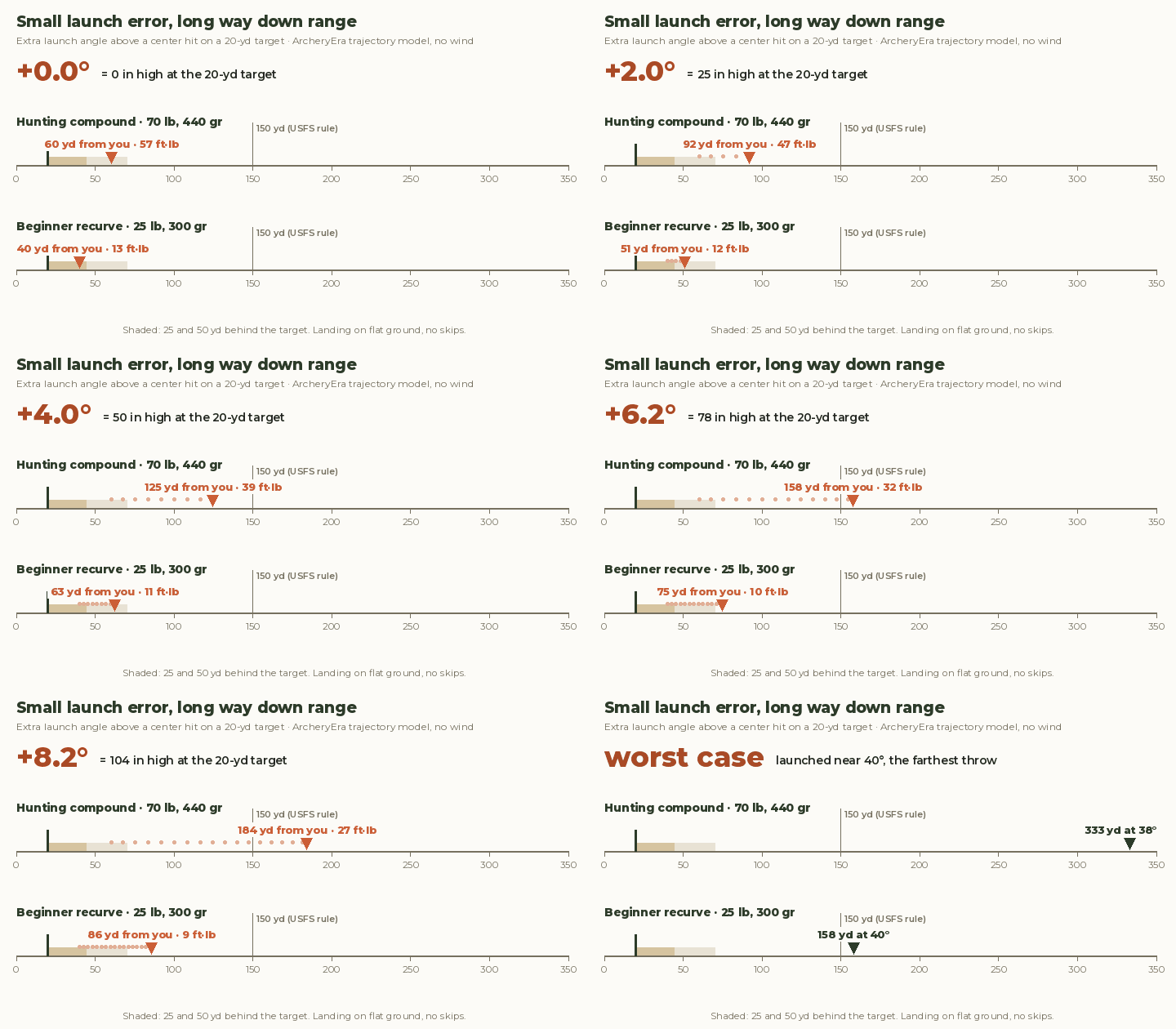
So I treat open ground behind a target as the backup plan. The plan is a backstop that physically stops the arrow: a berm, a hillside of dirt with no rocks, or a target with a big enough face that a bad shot still lands in it. And check the target itself. A worn bag at close range with a fast compound can let an arrow pass straight through, and then every number above applies anyway.
Overshoot & Backstop Planner
Pick a setup or enter your own, then set your target distance and how much clear ground is behind it. The planner shows where a miss comes down and how high a miss your clear zone can absorb.
Model: speed from ArcheryEra's shared bow model, drag from the same fletching constants as the trajectory tools, 2-D flight to the ground. No wind, no skips, no deflection. Treat every distance here as a minimum.
Can You Shoot a Bow on BLM or National Forest Land?
Usually yes, with conditions, and the two agencies word them differently. The Bureau of Land Management manages 245 million acres, about one-tenth of the country's land. Its recreational shooting page says target shooting is generally allowed on BLM-administered public lands as long as it's done safely, then lists the limits: not on developed recreation sites unless one is designated for shooting, not from or over a road, no targets set against rocks or plants, pack everything out. The developed-site ban is in federal code as "firearms, other weapons, or fireworks", so a bow doesn't slip through it. The same BLM page even has a line for archers about staying alert around broadheads.
National Forest land has the rule the "150-yard" number comes from. Under 36 CFR 261.10(d) you can't discharge "a firearm or any other implement capable of taking human life, causing injury, or damaging property" within 150 yards of a residence, building, campsite, developed recreation site or occupied area, across or on a Forest Service road or an adjacent body of water, or in any way that exposes people or property to injury. A bow is an implement capable of causing injury. I'd plan as if the rule covers you, because there's no reading of it that helps you if an arrow goes wrong.
The Forest Service's own recreational shooting page says target shooting is allowed on national forests and grasslands unless restricted, asks for a safe backstop, and links a list of archery-only target ranges by region. That list is worth checking before you set up a bag on dispersed ground.
Two things trip people up. Forests near cities often add closures; one Colorado Springs archer in the ArcheryTalk thread "Where can I practice outside?" wrote about National Forest closures to target shooting near him. And fire season closes areas to target shooting on BLM ground, according to the same BLM page. Call the local office before you drive out.
Do You Need a License to Use a State Wildlife-Area Archery Range?
Often, yes, and the rules aren't the same from one state to the next. I pulled the actual range rules for five states so you can see how far apart they are:
| State | Access requirement | Broadheads | Other rules |
|---|---|---|---|
| Georgia | Hunting license, fishing license or Lands Pass (J.L. Lester range) | Not stated on the range page | Sunrise to sunset, unstaffed |
| Pennsylvania | No permit stated for archery ranges (the range permit or license applies to firearm shooters) | Only on targets designated for broadheads | Archery ranges dawn to dusk; under 16 with someone 18+; 58 Pa. Code §135.183 |
| New Jersey | At least one person in each group holds a NJ hunting license | Banned on archery training ranges | No target practice on WMAs outside designated areas |
| Colorado | Hunting or fishing license, or SWA pass, age 16+ | Not stated on the range page | Chaffee County SWA range; other SWAs post their own rules |
| North Carolina | Not stated on the range rules sheet | Not allowed (Holly Shelter range) | Crossbows only on the practice range, not the 3D range |
Notice what that table means for a bowhunter in September. A state range is often the best long-distance spot you have, but it may be the one place your broadheads can't go. If your state's range page doesn't say, assume field points only until someone at the agency tells you otherwise.
To find ranges, start with your state wildlife agency's "shooting ranges" page, then the NFAA range finder (filters for indoor, outdoor target, field and 3D), USA Archery's club finder, and the ATA store locator, which lets you filter shops by the ranges they run.
Can You Practice Archery in a Public Park?
Only where the park has a marked archery range. That's where the forum threads landed, too. I read 15 ArcheryTalk threads from 2007 to 2025 where someone asked where or how to practice: 333 posts from 232 members. The two park threads ("Archery Practice in Park", 2025, and "Shooting in public places like a city park?", 2011) ran 88 posts between them, and the advice pointed one way: check the code, then go somewhere built for it.
Members in Houston, Salt Lake and Longmont each pointed to a city rule that covers shooting where they live. Eight members named parks near them that do have a dedicated archery range, from San Diego's Balboa Park to three county parks around Milwaukee. That's the version of "park" that works.

Six members described being told to stop, warned, or reported to police while shooting somewhere not built for archery: a park ranger in a Nashville park, a sheriff's call about a school football field, an officer at a village sand bed, a town officer, a Maryland city park, and a neighbor who called police on a backyard. One more described a backyard miss that went through a high fence and stopped in a berm. He quit shooting there.
The counterexamples were real too. One member's sheriff OK'd soccer fields with 100 to 150 yards of open ground, and another checked with his city and got approval before shooting there. Both asked first.
Is It Legal to Shoot a Bow in Your Backyard?
That's decided by your city or county code, not by state archery law, and I cover the legal side in Are Bows and Arrows Legal? Some towns ban any projectile inside city limits; others are silent. One member put it plainly: his city bans projectiles but allows bowhunting on 5+ acres. So read the actual ordinance, and look for the words "projectile" and "discharge" as well as "firearm."
If the code allows it, the physics still has to. Use the planner above with your real yard depth. With a compound, most suburban yards can't hold a miss on open ground, so the backstop does all the work: a target face big enough for your worst shot, and behind it something dense that won't let an arrow through. A fence isn't that.

For daily form work, distance matters less than people think. A Dallas apartment thread asked the same tight-space question. A bag or a box of rags at 3 to 5 yards, with a stall mat or plywood behind it in case of a miss, is enough. That's blank-bale practice: you're grooving the shot, not checking your pins. Keep sight work for a real range. If you're building pins or a sight tape, you need real 20- and 60-yard marks anyway. Before you cut arrows shorter for a tight space, read how to cut carbon arrows, since length changes dynamic spine.
On your own land, practice the shot you'll actually take. Shooting down from a stand or a ladder is the one setup where the ground does most of the backstop work, since a miss heads into the dirt near the target instead of downrange. Put a stand at your real hunting height and shoot the angles you'll see in September; the trajectory visualizer shows how much an angled shot changes your hold.
Can You Stump Shoot or Rove on Public Land?
Stump shooting means walking the woods and shooting at stumps, dirt clods and leaves at unknown distances. Legally it falls under the same rules as any other target shooting. On National Forest land the 150-yard rule and the road rule still apply, and you'll be shooting toward things you can't always see past, so pick shots with dirt behind them. On BLM land the same safe-shooting conditions apply. State wildlife areas are stricter: New Jersey, for example, bars target practice on its WMAs outside designated areas, so roving there is out.
Use blunt or judo points so arrows don't bury in the duff, and shoot only your field arrows. Clubs with 3D courses give you the same unknown-distance practice with the safety already built in, and the types of archery guide explains how field, 3D and target rounds differ.
- Any park, school field or open lot without a posted archery range, unless the managing agency told you yes.
- Within 150 yards of a residence, building, campsite, developed site or occupied area on National Forest land.
- From or over a road, on any public land.
- Toward anything you can't see past. A berm you can see over isn't a backstop.
- With the bow pointed at the sky while you draw. Draw on the target or not at all.
Where Can You Practice With Broadheads?
Expect indoor lanes to say no. In a 2007 ArcheryTalk thread started by a club deciding its broadhead policy, five members gave insurance or liability as the reason, and two pointed to target and backstop damage. Two described indoor ranges that do take broadheads on a separate target. The club went with a flat no.
Outdoors, the rules split as shown in the state table. On your own ground or BLM land, you need a target made for broadheads and enough backstop behind it. In a 2023 to 2025 thread, 10 of 26 repliers said they only shoot a handful of broadheads to confirm impact, and 11 named a foam target they shoot them into. Two shot into a dirt bank, and another warned that sand and dirt dull the blades. Whatever you use, shoot a practice set of heads and keep your hunting heads sharp for the season. If you're still choosing between head types, the mechanical vs fixed broadheads comparison covers how each flies.
That handful only means something if the bow is tuned first. Get there with the paper tuning guide and the Bare Shaft Tune Assistant, check that your arrow's spine fits with the carbon arrow spine calculator, then compare broadhead and field-point impact with the broadhead flight checker.
How Do You Check a Spot Before You Shoot There?
- Find out who manages the ground. City, county, state wildlife agency, BLM or Forest Service. On private land, the owner.
- Read that manager's rules for that exact place. Range pages, closure orders and fire restrictions, plus your local discharge or projectile ordinance at home.
- Check what you need to carry. A hunting or fishing license, a pass or a range permit, and who has to come with anyone under 16.
- Walk behind the target. Look for roads, trails, houses, livestock and rocks out to the farthest distance the planner gives for your bow.
- Set a backstop that stops your worst shot. A berm or dirt bank with no rocks, and a target face big enough for a bad release.
- Decide on broadheads before you leave home. If the place doesn't say yes in writing, bring field points only.

Do your weekly shooting at a shop lane or a club, because someone already solved the backstop and the legal question there. Use a state range or public land for long distances and broadhead checks, after reading that range's rules or the local closure orders. Only shoot in your yard once the code says yes and you have a backstop that stops every miss, because with a compound the planner usually shows your clear ground can't.
Frequently Asked Questions
Can I practice archery on BLM or National Forest land?
Generally yes on BLM land, as long as you shoot safely, stay off developed recreation sites, don't shoot from or over a road and pack out your targets. On National Forest land you can't shoot within 150 yards of a residence, building, campsite, developed site or occupied area, and many forests near cities add their own closures. Fire season can close either one. Call the local office before you go.
Are broadheads allowed at indoor archery ranges?
Rarely. Most indoor lanes ban them, and the reasons archers and range owners give are insurance, safety and backstop damage. A few shops keep a separate broadhead target. Ask before you bring them, and plan to check broadhead flight outdoors.
Do I need a hunting license to use a state wildlife-area archery range?
Often. Georgia's J.L. Lester range takes a hunting license, fishing license or Lands Pass. Colorado's Chaffee County SWA range asks everyone 16 or older for a hunting or fishing license or an SWA pass, and New Jersey wants one NJ hunting license holder in each shooting group. Read your own range's page, because the rules differ by state and sometimes by range.
What is the 150-yard rule for shooting arrows?
It's a National Forest rule, 36 CFR 261.10(d). It bars discharging a firearm or any other implement that can cause injury within 150 yards of a residence, building, campsite, developed recreation site or occupied area. It isn't a nationwide archery overshoot standard. In my model a hunting compound can throw an arrow more than twice that far when launched high.
How far behind a target does a missed arrow go?
On my trajectory model, a 70 lb compound arrow that just clears a 24-inch bag at 20 yards lands about 55 yards behind it, still carrying about 52 ft-lb. A 25 lb beginner recurve lands about 25 yards behind. The worst-case throw is about 333 yards for the compound. Those are flat-ground numbers with no skips, so treat them as a minimum.
Can I stump shoot on public land?
On National Forest and BLM land it follows the same rules as other target shooting: stay 150 yards from homes, campsites, developed sites and occupied areas on Forest Service ground, don't shoot from or over roads, and only shoot at things with dirt behind them. Many state wildlife areas ban target practice outside their ranges, New Jersey among them, so check before you rove there. Blunt or judo points keep arrows from burying.
Can I set up an archery target in my backyard in the suburbs?
Only if your city or county code allows it. Look for rules on discharging weapons or projectiles, not only firearms, and check HOA covenants too. If it's allowed, the backstop has to stop every miss, because most suburban yards are shorter than the distance a compound arrow travels after missing.
Hey, what's up? Burak here. Archery addict, board game geek, Daft Punk fan.