
Bow Draw Length by Height: Height ÷ 2.5 Lands an Inch Short of Wingspan for 37% of People
Every draw length chart online starts from your height. I ran that shortcut against the wingspan of 6,068 people who were actually measured with a tape. For more than a third of them it lands an inch or more away from the wingspan method bow shops start from — almost always on the short side. Here is the corrected chart, the math behind it, a calculator that adds your release and bow type, and the full-draw checks that should have the final word.

Core Insight: Draw length comes from wingspan, not height: fingertip-to-fingertip span ÷ 2.5. Height ÷ 2.5 only works if your arms span exactly your height, and in a 6,068-person data set that was rare — the median wingspan ran 1.8″ longer than height. The result: height ÷ 2.5 put 37% of people 1″ or more short of their wingspan number. If you have no tape, use height ÷ 2.5 + 0.75″; it halves those big misses. A hinge often wants about 0.5″ less than a wrist strap. Treat every formula as the starting module, and let a full-draw check make the final call.
Jump to: height chart · calculator · measure at home · too long or too short?
Ideal for: first compound buyers
Pick a bow whose module range covers your real number, not the height-chart guess.
Ideal for: long-armed shooters
Ape index +3″ or more? The height formula shorts you by 1.2″+ — and a short-ATA bow gets tight fast.
Ideal for: hinge switchers
See how much a release change should move your module before you buy new mods.
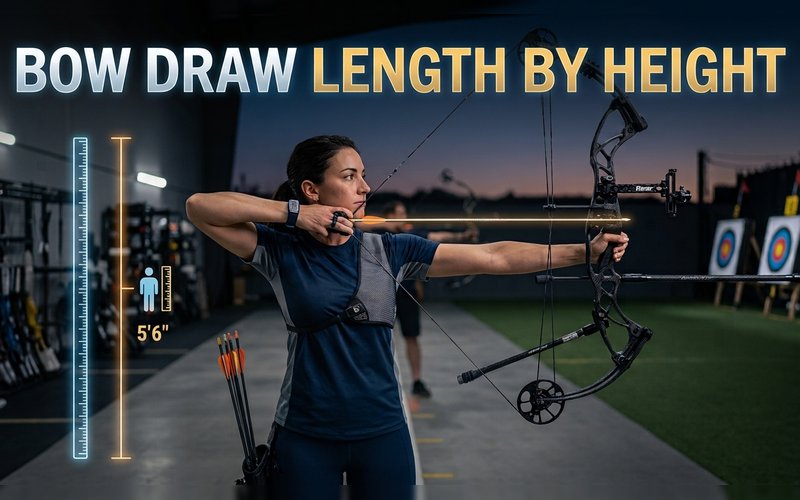
Why Does Height ÷ 2.5 Get Draw Length Wrong?
Because it quietly assumes your wingspan equals your height. That is the old Vitruvian square. Real bodies ignore it.
The ANSUR II anthropometric survey measured 6,068 US Army soldiers (4,082 men, 1,986 women) in 2012, including standing height and span — fingertip to fingertip, arms out, taken by trained measurers. The Army released the raw file publicly. I ran every one of those bodies through both formulas.
Average wingspan beat average height by 1.9″. Men ran +2.3″, women +1.3″. Divide that gap by 2.5 and height ÷ 2.5 starts about 0.8″ short for the typical shooter before anything else goes wrong.
The spread matters more than the average. Among the 602 people who stand 5′10″, wingspan draw length runs from 26.6″ to 31.2″. Ninety percent of them sit between 27.7″ and 30.2″. That is five half-inch modules for one height.
I’m 178 cm — 5′10″. Every height chart I have ever looked at hands me 28.0″ and moves on. So I pulled everyone in ANSUR II measured at my exact height (177.5–178.5 cm): 255 people, 248 of them men.
Their wingspans run from 66.6″ to 78.0″. On wingspan ÷ 2.5 that is 26.6″ to 31.2″ of draw length, with the median at 28.9″ — nearly a full inch past the chart. Only about 1 in 6 of them would land on a 28″ module or shorter.
| ANSUR II subject | Sex | Age | Height | Wingspan | Ape index | Wingspan ÷ 2.5 | Height ÷ 2.5 |
|---|---|---|---|---|---|---|---|
| #10710 | Male | 22 | 70.2″ (178.2 cm) | 66.6″ | −3.6″ | 26.6″ | 28.1″ |
| #13183 | Male | 32 | 70.0″ (177.9 cm) | 72.3″ | +2.2″ | 28.9″ | 28.0″ |
| #13774 | Male | 40 | 70.2″ (178.4 cm) | 78.0″ | +7.7″ | 31.2″ | 28.1″ |
Shortest, median and longest wingspan among the 255 people at 178 cm. Subject ID, sex, age (years, at measurement in 2012), stature and span are copied from the public ANSUR II male file; inches are converted from its millimeter values.
Same height as me, within a quarter inch. Their bows would need modules 4.5″ apart. That is the whole case for a tape measure, and it is why I would never set my own bow from a height chart.
- It compares two estimates. Nobody in ANSUR II drew a bow. Wingspan ÷ 2.5 is the method shops and manufacturers start from, not a measured full-draw length.
- What holds up: the direction and size of the gap. Height cannot stand in for wingspan, and when it misses, it misses short.
- What it can’t settle: your exact number. Anchor style, release and shoulder mobility move the last half inch, which is why the checks further down exist.
What About Chest Depth, Neck Length and Jawline?
I checked the two torso numbers ANSUR has. Chest depth barely matters: it correlates at r = 0.06 with the part of wingspan that height does not explain (95% of people fall between 8.2″ and 11.7″). Shoulder breadth does (r = 0.26). Broad shoulders push span out, so broad-shouldered archers are the ones height charts short the hardest.
Neck length and jaw shape are different animals. They do not change wingspan at all — they change where your anchor lands. A long neck with a sharp jawline lets a wrist-release knuckle tuck deep; a short neck and a heavy jaw stop it earlier. Wingspan gets you to the right module. Your face decides the last quarter inch, and that is a D-loop job.
How Much Does Ape Index Change Draw Length?
Every inch of ape index shifts draw length by 0.4″. Watch what that does to one 5′10″ archer:

Here is the full correction matrix, with the share of real people in each band:
| Ape index (span − height) | Share of adults | Average ape index in band | Add to height ÷ 2.5 | A 5′10″ archer lands at |
|---|---|---|---|---|
| below −1″ | 5.8% | -1.7″ | -0.66″ | 27.3″ |
| −1″ to 0″ | 9.4% | -0.5″ | -0.18″ | 27.8″ |
| 0″ to +1″ | 17.2% | +0.5″ | +0.21″ | 28.2″ |
| +1″ to +2″ | 21.2% | +1.5″ | +0.60″ | 28.6″ |
| +2″ to +3″ | 18.6% | +2.5″ | +0.99″ | 29.0″ |
| +3″ to +4″ | 13.3% | +3.5″ | +1.38″ | 29.4″ |
| +4″ to +5″ | 7.4% | +4.4″ | +1.78″ | 29.8″ |
| +5″ and up | 7.1% | +6.0″ | +2.38″ | 30.4″ |
Correction = ape index ÷ 2.5. Shares add to 100% across 6,068 adults. The 5′10″ column starts from 28.0″, the height-formula answer.
Only 15% of the sample had arms shorter than their height. Those are the only people height ÷ 2.5 over-sizes, and even then by a quarter inch or so. The +5″-and-up crowd — 7% of adults, roughly one adult in fourteen — gets shorted by more than two inches.
What Is the Right Draw Length for My Height?
Here is the chart the height formula should have been. For each height, the median is where a typical person lands on wingspan ÷ 2.5, and the range covers the middle 80%. You can also download the full table as a CSV.
| Height | Height ÷ 2.5 | Median wingspan draw length | Middle 80% range | Height formula runs short by | Adults measured |
|---|---|---|---|---|---|
| 5′0″ (152 cm) | 24.0″ | 24.5″ | 23.7–25.3″ | +0.5″ | 86 |
| 5′1″ (155 cm) | 24.4″ | 24.9″ | 24.0–26.0″ | +0.5″ | 145 |
| 5′2″ (157 cm) | 24.8″ | 25.3″ | 24.3–26.3″ | +0.5″ | 245 |
| 5′3″ (160 cm) | 25.2″ | 25.7″ | 24.9–26.6″ | +0.5″ | 343 |
| 5′4″ (163 cm) | 25.6″ | 26.1″ | 25.2–27.1″ | +0.5″ | 413 |
| 5′5″ (165 cm) | 26.0″ | 26.6″ | 25.7–27.8″ | +0.6″ | 466 |
| 5′6″ (168 cm) | 26.4″ | 27.1″ | 26.2–28.2″ | +0.7″ | 591 |
| 5′7″ (170 cm) | 26.8″ | 27.7″ | 26.7–28.7″ | +0.9″ | 545 |
| 5′8″ (173 cm) | 27.2″ | 28.0″ | 27.1–29.1″ | +0.8″ | 660 |
| 5′9″ (175 cm) | 27.6″ | 28.4″ | 27.6–29.5″ | +0.8″ | 669 |
| 5′10″ (178 cm) | 28.0″ | 28.8″ | 28.0–29.8″ | +0.8″ | 602 |
| 5′11″ (180 cm) | 28.4″ | 29.2″ | 28.3–30.4″ | +0.8″ | 472 |
| 6′0″ (183 cm) | 28.8″ | 29.7″ | 28.7–30.8″ | +0.9″ | 332 |
| 6′1″ (185 cm) | 29.2″ | 30.0″ | 29.1–31.1″ | +0.8″ | 212 |
| 6′2″ (188 cm) | 29.6″ | 30.6″ | 29.6–31.5″ | +1.0″ | 108 |
| 6′3″ (190 cm) | 30.0″ | 30.8″ | 29.8–32.1″ | +0.8″ | 56 |
| 6′4″ (193 cm) | 30.4″ | 31.4″ | 30.7–32.3″ | +1.0″ | 35 |
Draw length here is wingspan ÷ 2.5 (ATA-style, to the pivot point + 1.75″). Each row groups everyone within ±0.5″ of that height. Source: ANSUR II, 6,068 US Army personnel measured in 2012; my calculations.
Read that chart twice. At every height from 5′0″ to 6′4″, height ÷ 2.5 lands near the 10th percentile — nine out of ten people at that height draw longer. Shorter people miss by less (0.5″ at 5′0″) because women, who run a smaller ape index, dominate that end of the sample.
Enter height and, if you have it, wingspan. The engine estimates what you leave blank from the 6,068-body fit, applies your release and bow type, and returns a range, a module setting, a D-loop note and your string angle.
Output is ATA draw length. Confirm at full draw with a marked arrow or at a shop before buying mods. Ape index percentile uses all 6,068 ANSUR II bodies.
How Does the Dynamic Draw Length Engine Calculate It?
The calculator above runs five steps. Nothing hidden, no machine learning, just arithmetic you can check with a pencil.
Positive means arms longer than height. Median in the data: +1.8″; 5th–95th percentile: -1.1″ to +5.3″.
ATA draw length: nock groove to the grip pivot point plus 1.75″, the industry definition that bow specs use.
Least-squares fit to all 6,068 bodies (±1.9″ span, ±0.76″ draw). Sex-specific fits: men 1.16 + 1.016×H, women -2.50 + 1.059×H. Pencil version: height ÷ 2.5 + 0.75″.
Release (compound): wrist index 0, thumb button −0.25″, hinge/back-tension −0.5″. Bow: compound 0, Olympic/barebow recurve +0.5″, traditional corner-of-mouth 0 with a wider ±0.75″ band.
Simplified full-draw geometry, used to flag bows that will feel cramped at your draw length.
The release and bow offsets are my starting values, not laws. Switching release styles can make draw length feel shorter or longer depending on where the release head sits at anchor, so treat the offset as the first guess you confirm at full draw.
Do Release Type and Bow Type Change the Number?
Compound: the cam sets the wall
- Draw length is fixed by the module, in half-inch steps.
- Wrist-strap index: anchor with a knuckle behind the jaw; no offset.
- Thumb button or hinge: the release sits in the hand, and most shooters settle 0.25–0.5″ shorter to keep the draw elbow on line.
- Let-off stops can shift the wall by fractions of an inch too.
Recurve & barebow: you set the wall
- No wall, so draw length is a form result, not a setting.
- Under-chin Olympic anchor or string-walking face anchor: usually a touch longer than wingspan ÷ 2.5.
- Corner-of-mouth trad anchor with a canted bow: often shorter.
- What you pick with it: arrow length and effective draw weight, since limbs are rated at 28″.
For recurve shooters the number matters for two things: arrow length (see arrow length vs draw length) and the draw weight you will actually hold. A 40 lb limb at 28″ pulled to 30″ is closer to 45 lb. That ties straight into recurve arrow spine.
What Do Mathews, Hoyt, PSE and Bear Specs Actually Tell You?
A draw length range on a spec sheet tells you whether your number fits. It does not tell you how the wall will feel. I pulled current specs for four cam systems:
| Bow & cam | Draw length range | How it adjusts | Let-off | ATA / brace | What moves the draw you actually feel |
|---|---|---|---|---|---|
| Mathews LIFT X 33 SwitchWeight-X (SWX) cam | 26–31.5″ | Draw-length-specific mods; LIFT and LIFT X share the SWX mod family (23.5–33.5″ across the line) | 80% or 85% | 33″ / 6.5″ | Each half-inch is its own part. If you sit between two, the mod decides; the D-loop fine-tunes. |
| Hoyt Carbon RX-7 HBX Pro cam | 25–28″ & 28.5–30″ | Two modules, half-inch positions on each | 80–85%, slide the stop | 30″ / 6.25″ | Stop position moves the wall. Stop charts for the HBX family show +5/32″ to −9/16″ of draw change from stop choice alone. |
| PSE Mach 34 E2 cam | 29–33″ | Rotating modules | 80–90% | 34″ / 7.125″ | Starts at 29″. A 5′8″ neutral-ape archer (27.2″) is off the chart before tuning starts. |
| Bear Divergent EKO EKO cam | 26–30″ | Rotating module, no bow press | 75 / 80 / 85 / 90% | 30″ / 6.5″ | Four let-off positions. Higher let-off, deeper valley; the wall location is what your anchor feels. |
Specs from the maker or retailer pages linked in each row, checked September 2026. The LIFT X 33’s 26–31.5″ range, 80/85% let-off and 6.5″ brace are Mathews’ own figures; the Divergent EKO’s 30″ axle-to-axle and 6.5″ brace come from a published first-look review.
Two things jump out. First, the PSE Mach 34 starts at 29″. Check the chart: that is roughly the median for a 5′11″ person. In the ANSUR sample, 70% of adults have a wingspan draw length under 28.75″ — below the bow’s first module. Second, let-off hardware moves draw length. The HBX stop charts show up to 9/16″ of change from stop choice alone — more than a full module step. If a bow “feels long” after a let-off change, it may be.
When Should the D-Loop Fix Draw Length Instead of a Module?
When the gap is under a quarter inch. A D-loop tied longer moves the release jaw back by nearly the same amount, so 1/8″ of extra loop ≈ 1/8″ of extra draw at anchor. Past about 1/4″ you are building torque into the string and hiding a module problem. Change the module.
Why Do Long-Draw Archers Struggle on Short Bows?
String angle. The longer you draw, the sharper the angle the string makes at your nock — and a short axle-to-axle bow sharpens it further. Tight angles move where the string meets your face: the nose and corner-of-mouth references you had on a longer bow shift, the peep sits at a different distance from your eye, and finger shooters feel the arrow pinch. On a 62″ wood takedown the same squeeze shows up as stack, which is why long-draw owners move from the Samick Sage to the 64″ Spyder XL.
| Draw length | 28″ ATA | 30″ ATA | 32″ ATA | 34″ ATA |
|---|---|---|---|---|
| 26″ | 73° | 77° | 81° | 84° |
| 27″ | 71° | 74° | 78° | 81° |
| 28″ | 68° | 72° | 75° | 79° |
| 29″ | 66° | 69° | 73° | 76° |
| 30″ | 63° | 67° | 70° | 74° |
| 31″ | 61° | 65° | 68° | 71° |
Included string angle at the nock, 6.5″ brace height, simplified geometry (same as the calculator). Orange cells are 65° or less, my own line for “expect your anchor references to move.” Not an industry standard.

My opinion, and plenty of shop techs will argue with it: if your draw is 30″ or more, skip bows under 31″ ATA for anything but tree-stand work. Short bows are easy to carry. With long arms they are harder to anchor on the same way every shot.
How Do I Measure My Draw Length at Home?

- Get a helper and a tape. A carpenter’s tape beats a sewing tape; sewing tapes stretch.
- Stand with your back flat to a wall, heels touching it, arms straight out at shoulder height, palms facing forward. Don’t reach. Reaching adds an inch.
- Mark both middle fingertips on the wall with painter’s tape and measure between the marks. That is your wingspan.
- Repeat twice and average. If the two readings differ by more than half an inch, you reached on one of them.
- Measure height the same session, barefoot, flat book on your head. Now you have your ape index.
- Divide wingspan by 2.5, or drop both numbers into the calculator above for the release and bow-type offsets.
- Check the anchor. Wall method: make a fist with your bow hand, stand side-on to a wall with the fist pressed into it, draw your other hand to your anchor, and have your helper measure from the wall to the corner of your mouth — the wall stands in for the back of the bow, so no 1.75″ is added. It should agree with the wingspan number within about half an inch.
Is My Draw Length Too Long or Too Short?
Half an inch is enough to show up at full draw. These are the tells:

| Check | About 0.5″ too SHORT | About 0.5″ too LONG |
|---|---|---|
| Bow arm | Elbow bent or hinged; arm feels jammed | Arm locked straight, elbow rolled in, string slaps the forearm |
| Draw shoulder & elbow | Elbow swings past the arrow line; the shot feels cramped and over-rotated | Elbow never reaches the arrow line; draw shoulder rolls up |
| Head & anchor | Head pushes toward the string; anchor crowds the jaw | Head leans back; you reach for the anchor or lose kisser contact |
| Peep | You crane forward to line up the peep | You lean back or tilt your head to find the peep |
| Release | A hinge tends to go off quickly, before you are settled | A hinge is hard to fire without pulling or rolling the wrist |
| Groups | Groups open up as the anchor shifts shot to shot | Groups open up and string slap shows up on the forearm |
Symptoms overlap with form faults. Change one variable at a time and film yourself at full draw from above and behind before touching the bow.
How Does a Bow Shop Confirm the Number?
- Draw-check arrow. A long, marked arrow drawn to your real anchor gives an actual ATA reading: the mark at the grip’s pivot point, plus 1.75″.
- Video from above and behind. The elbow line in the illustration above is easy to see on a phone clip. Shops judge it the same way.
- Try half an inch each way. On rotating-module bows it takes minutes. The setting that puts the elbow on line with a relaxed bow arm wins, whatever the formula said.
Set draw length in the clothes you hunt in, not a T-shirt. A puffy jacket, a bino harness and a chest-heavy late-season layer all take up room between your arm and your face, and a draw that felt perfect in August can feel long in November. Shoot a few arrows in full kit before the season and, if it feels long, test a quarter inch shorter on the D-loop first.
Practice the way you will shoot, too. Bending at the waist from a tree stand keeps your T-form; dropping the bow arm doesn’t. That is form, not draw length, but a draw that is already a touch long makes it harder to hold.
- Forum sentiment: The same questions keep coming back — why different draw length methods disagree, what “actual” vs ATA draw length means, and what happens to draw length when you move from a wrist strap to a handheld.
- What the data adds: Wingspan is already the industry starting point. The numbers above show why height can’t replace it: it ignores the 1.9″ average ape index.
- Common friction point: The words. “Draw length” on a spec sheet is the ATA number (pivot point + 1.75″), which is not the same thing as the arrow you pull or where you anchor.
Retire height ÷ 2.5. Against the wingspan method it is not just rough, it is biased, and the bias nearly always points the same way — short. If a shop still sizes you off a height chart, ask them to put a tape across your arms. If you are between modules, go to the shorter one and lengthen the D-loop. A slightly short draw costs a little speed. A long one costs your form every single shot.
- Youth archers still growing. Re-measure every season; ape index shifts during growth spurts.
- Shoulder injuries or limited mobility. Draw to what the shoulder allows, not to the tape.
- Outside the data. ANSUR II covers military adults aged 17–58. Very tall, very short or older archers may fall outside its patterns.
What Is the Bottom Line on Draw Length by Height?
Height is a weak proxy. Wingspan ÷ 2.5 is the real starting point, release style trims it, and the D-loop fine-tunes it. If height is all you have, add three-quarters of an inch. Then set your arrow length with the draw length calculator and check the build in the arrow weight calculator.
Frequently Asked Questions
What draw length should I have for my height?
Start with the chart on this page: for most adults the wingspan draw length lands 0.5–1.0″ above height ÷ 2.5, because the median person’s wingspan is about 1.8″ longer than they are tall. At 5′10″ the median is 28.8″ and the middle 80% spans 28.0–29.8″. Measure your wingspan to know where you sit.
Is height divided by 2.5 accurate for draw length?
Not very. Across 6,068 measured adults it landed 37% of them a full inch or more away from their wingspan draw length, and 67% at least half an inch away. It almost always errs short, because most people’s arms span wider than they are tall.
What is ape index and how does it affect draw length?
Ape index is wingspan minus height. Every inch of ape index moves draw length by 0.4″ (1 ÷ 2.5). The median adult in the data sits at +1.8″, so a neutral ape index of zero is below average, not typical.
Does a hinge release need a shorter draw length?
Often, but not always. A handheld release changes where the release head sits relative to your anchor. As a starting point the calculator trims 0.25″ for a thumb button and 0.5″ for a hinge compared with a wrist-strap index release, then you confirm at full draw. The D-loop is the fine adjustment.
Is recurve draw length the same as compound draw length?
The measurement standard is the same (to the pivot point plus 1.75″), but the anchor is not. Olympic-style and barebow shooters with an under-chin or face-walk anchor usually draw a little further than the wingspan number; traditional shooters anchoring at the corner of the mouth often draw less. Confirm with a marked arrow at full draw.
Can I measure my draw length without a bow shop?
Yes. Stand against a wall, arms straight out at shoulder height, palms forward, and have a helper mark fingertip to fingertip. Divide that span by 2.5. Take it twice, keep the average, and run it through the calculator on this page.
Hey, what's up? Burak here. Archery addict, board game geek, Daft Punk fan.