
Takedown vs. One-Piece Recurve: What the Specs, the Tape Measure and 254 Owner Posts Show
Most comparisons stop at “takedowns travel, one-pieces look nice.” I measured how small each one packs, collected every published mass I could verify, ran a draw-weight progression through ArcheryEra’s spine engine, and coded 254 owner posts to see which advantages people actually use.

Short answer: the arrow can't tell them apart, but your truck, your back and your next draw-weight jump can. When a maker builds the same limb both ways, the shot doesn't change. Black Widow says its 1-piece and 3-piece recurves show “minimal performance difference” because they share one limb design, and two owners who shoot matched pairs report the same arrow speed. What does change is packed length (about 62″ vs. about 24″), mass (1.45–1.86 lb for the one-piece bows I could find published, while 11 of 14 hunting ILF risers weigh more than that with no limbs on), and whether a draw-weight change means new limbs or a new bow. Fly, pack in or still climbing in weight: buy a takedown. Settled weight, long walks, nothing you want to check before the shot: buy a one-piece.

This page started with a question that keeps coming back on the forums. In an ArcheryTalk thread with 2.1K views a new hunter asked whether a takedown or a one-piece is better for hunting, “or is it just up to preference?” Most replies said preference. I wanted something more useful than that, so I pulled the published specs, ran the bows through ArcheryEra's recurve speed and spine engines, measured what each design actually packs down to, and hand-coded what 254 owner posts say.
What's the 1-Minute Answer: Takedown, Bolt-Down or One-Piece?
“Takedown” covers two different systems. A lot of buyers don't know that (one ArcheryTalk poster thought ILF and takedown were the same thing), so the matrix splits them.
| What you care about | One-piece | Bolt-down takedown | ILF takedown |
|---|---|---|---|
| Longest piece in the case | ≈ the bow's AMO length (58–66″) | ≈24″ (a limb) | ≈23–25″ (a limb, up to a 23″ riser) |
| Published mass | 1.45–1.86 lb complete | 2.2 lb complete (two Galaxy models) | 1.54–2.57 lb for the riser alone |
| Change draw weight | Buy another bow | Buy limbs from the same maker | Buy limbs from any ILF maker, plus a few % on the limb bolts |
| Tune tiller and limb alignment | No | No (pin and pocket fit) | Yes |
| Parts that can loosen | None | 2 bolts or latches | 2 limb bolts, alignment screws |
| Arrow speed, same limb | No published difference. Arrow weight, draw weight and draw length move speed; construction type doesn't (see the speed section) | ||
| Fits best | Settled weight, long walks, classic feel | Travel, a wood riser, simple setup | Travel, climbing in weight, tinkerers, barebow crossover |
Which One Fits How You Shoot? (Interactive)
Six questions. Every point the engine gives comes from a measured spec or a reason owners named in the coded threads below, and it tells you which.
Does a Takedown Shoot Slower or Louder Than a One-Piece?
Not in any data I could find. No maker I checked publishes a speed penalty for its takedown version, and the one maker that sells the same limb both ways says the difference is minimal. The owner reports line up with that. On TradTalk, one owner with two identical 64″ 50# @ 29″ bows from the same bowyer, one-piece and three-piece, same woods, said the only difference he could find was the mass. Another who shoots six Bear takedowns and six one-piece Bears sees no speed difference at the same poundage and arrow.
So I ran the question the other way: what does move recurve speed? In ArcheryEra's recurve model, the same one behind the Arrow Speed & Performance Calculator, a 45 lb bow at 28″ with a 405 gr arrow launches at about 198 fps.
Myth: a one-piece is faster because there's no joint to soak up energy.
Reality: the energy goes into the limbs and the arrow, not the riser joint.
A limb pocket that moves under load would show up as noise, wear and tuning drift long before it showed up on a chronograph. If one bow out-shoots another, look at limb design, string material, brace height and arrow weight first.
Is a takedown louder?
Only 5 of the 254 posts in my main sample said the one-piece was quieter. The TradTalk thread on the quietest recurve setup (37 replies) is more useful, because owners argue the cause there. I counted 10 replies that put noise on arrow weight, limb speed, string slap or tune, against 5 that blamed the limb connection or extra parts. One poster with two metal ILF risers wearing static limbs said they hunt without silencers.
The fair reading: a well-built takedown isn't louder by design, but it has more places for a rattle to start. If yours ticks, check the limb bolts, the pocket pads and anything screwed into the riser before you buy silencers.
How Small Does a Takedown Actually Pack?
Smaller than the riser length suggests, and not for the reason most people think. The longest piece of a takedown is usually a limb, not the riser.
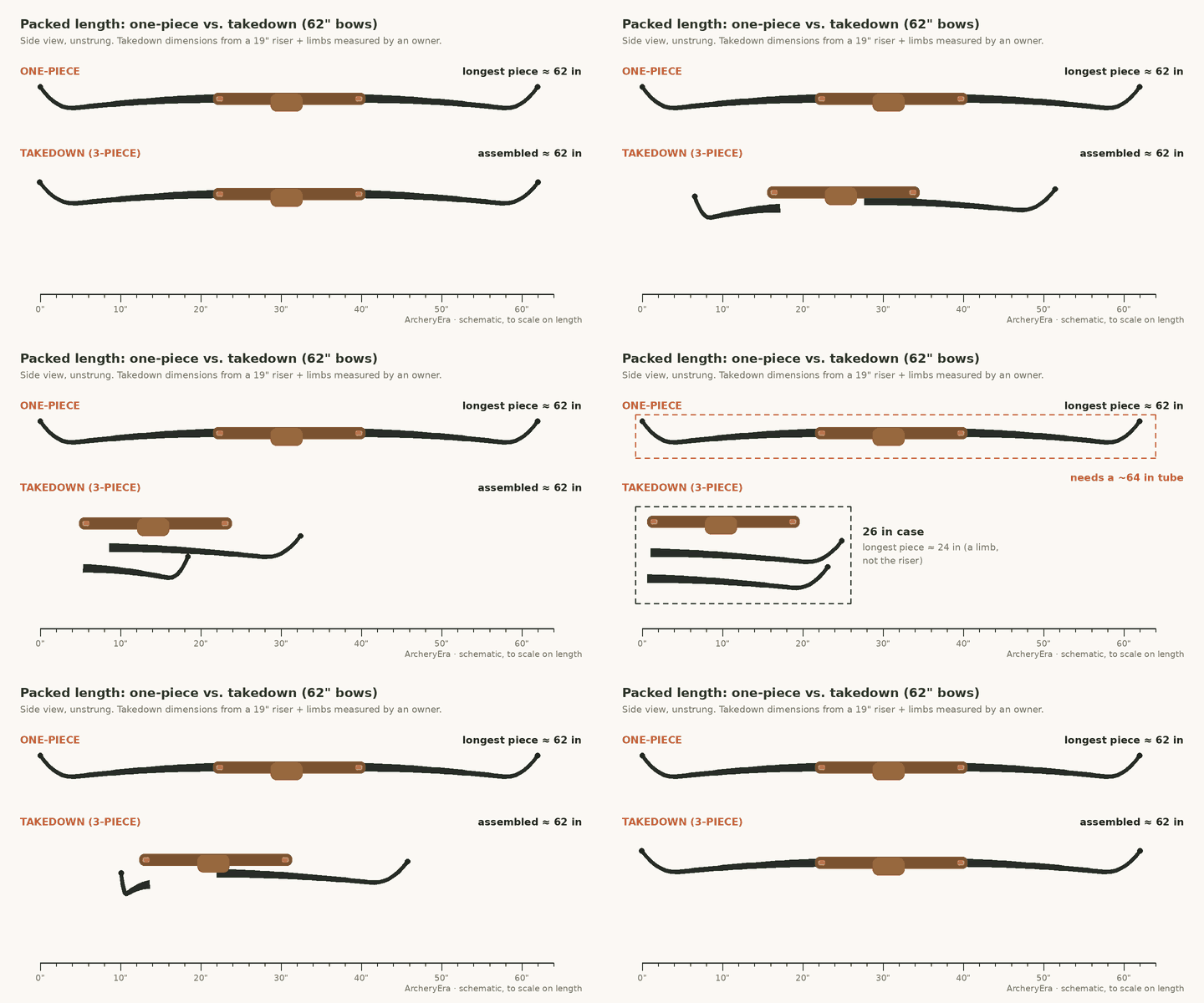
No maker I checked publishes how long a bare limb is, so I built it from the one owner measurement I found. On TradTalk, a Samick Sage owner measured his limbs: about 22″ straight from the bolt center to the tip unstrung, about 24″ along the curve. Add the butt behind the bolt and a 62″ Sage limb is roughly 23.5″ long. That fits a simple rule: limb length ≈ (AMO length − riser length) ÷ 2 + 2.25″. Treat it as ±1″. It's calibrated on one measured bow.
| Configuration | Riser | Limb (modeled) | Longest piece |
|---|---|---|---|
| Galaxy Ember 60″ | 15″ | ≈24.8″ | limb, 24.8″ |
| Bear Take-Down, A riser + #3 limbs = 60″ | 16.75″ | ≈23.9″ | limb, 23.9″ |
| ILF 17″ + medium = 60″ | 17″ | ≈23.8″ | limb, 23.8″ |
| Sage 62″ / ILF 19″ + medium | 19–19.5″ | ≈23.5–23.8″ | limb, ≈23.8″ |
| Bear Take-Down, B riser + #3 limbs = 64″ | 20.5″ | ≈24.0″ | limb, 24.0″ |
| ILF 25″ + medium = 68″ | 25″ | ≈23.8″ | riser, 25″ |
A shorter riser does not make a smaller package. On a 60″ bow, Galaxy's 15″ Ember riser just hands the length to the limbs, so its case has to be longer than for a 17″ ILF build. Every 60–64″ configuration in the table packs to 24–25″, on risers from 15″ to 21″. Riser length changes how the bow shoots and holds. It barely changes how it packs.
What does that mean at the airport?
The TSA lists bows and arrows as checked-bag items, not carry-on, and owners in a 2025 TradTalk thread describe a riser getting pulled at the checkpoint and moved to checked luggage. Delta's oversize rules start at 63 linear inches (length + width + height). A one-piece 62″ bow in a 64″ tube with a 5×5″ cross-section comes to about 74 linear inches, so it's an oversize item every trip. A takedown in a 26″ soft case rides inside a normal duffel, which is exactly what one ArcheryTalk hunter did on two Alaska flights.
Uses the limb model above (±1″). Linear inches assume a 5×5″ tube for a one-piece and a 4×9″ soft case for a takedown.
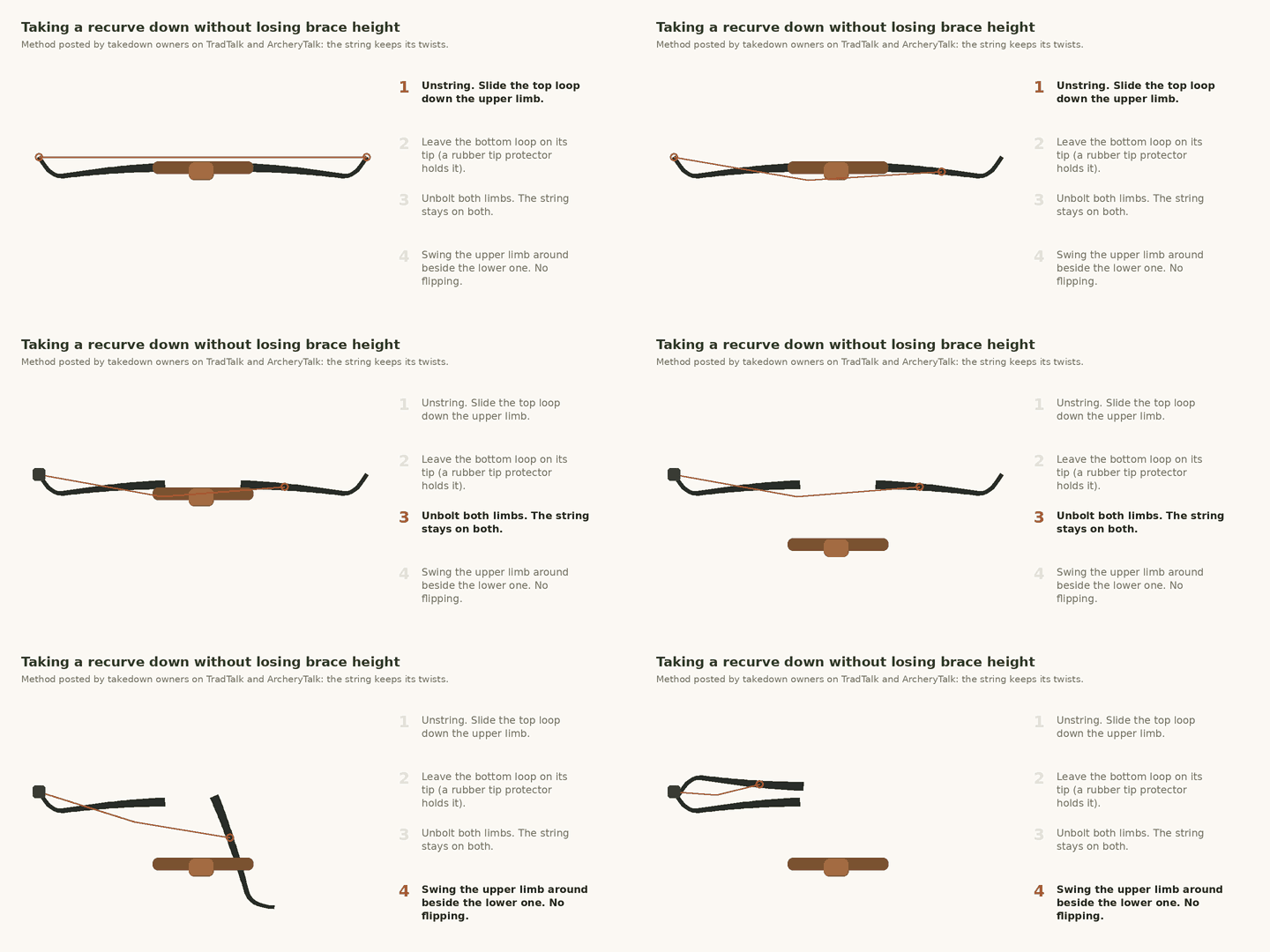
One complaint about takedowns is having to re-check brace height after every trip. Owners in this ArcheryTalk thread and this one solve it the same way: leave the string on both limbs and lay them side by side without turning either one over. One owner also ties the two loops together so the twists can't run out.
How Much Heavier Is a Takedown Recurve?
Few makers publish mass for one-piece bows, so this set is small. I used every listing I could verify, mostly from Lancaster Archery Supply's spec blocks.
| Bow or riser | Type | Length | Published mass |
|---|---|---|---|
| Buck Trail Antelope | One-piece | 60″ | 1.45 lb complete |
| SAS Gravity | One-piece | 60″ | 1.6 lb complete |
| Galaxy Black Ridge | One-piece | 62″ | 1.86 lb complete |
| Galaxy Ursa | Wood takedown | 62″ (18″ riser) | 2.2 lb complete |
| Galaxy Luna | Wood takedown | 64″ (20″ riser) | 2.2 lb complete |
| Bear Take-Down, B riser | Latch takedown | 20.5″ riser | 1.75 lb riser only |
| Hoyt Satori 17 / 19 / 21 | ILF riser | 17 / 19 / 21″ | 2.25 / 2.40 / 2.54 lb |
| EXE Scream 17 / 19 / 21 | ILF riser | 17 / 19 / 21″ | 2.12 / 2.34 / 2.46 lb |
| TradTech Titan II / Titan III | ILF riser | 17 / 19″ | 2.1 / 2.3 lb |
| Bearpaw Penthalon Shadow | ILF riser (wood) | 17″ | 1.54 lb |
| WNS Black Wolf | ILF riser (carbon) | 17″ | 1.6 lb |
| Galaxy Sear | ILF bow | 60″ (17″ riser) | 3 lb complete |
Two numbers stand out. Within one maker, Galaxy's 62″ one-piece Black Ridge lists 1.86 lb and its 62″ Ursa takedown lists 2.2 lb: +0.34 lb, or 18%, for the same length. And within one riser family, every 2″ of riser adds about 0.12–0.22 lb (0.14–0.15 lb per step on the Satori).
Whether that mass helps depends on the hunt, and the owners split almost evenly. In the coded threads, 30 posts call the heavier riser steadier and 24 call the lighter one-piece easier to carry. One TradTalk hunter who walked and stalked pigs for four days said he'd have traded his metal-riser takedown for a one-piece to save weight, then added that for 3D or stand hunting he'd pick the takedown. That's the pattern in a sentence.
What Do 254 Owner Posts Actually Say?
I read every post in 13 threads that compare takedown and one-piece recurves head to head (9 on ArcheryTalk, 4 on TradTalk, 2006–2025) and coded each reason a poster gave. One post can carry several reasons. Off-topic replies got no code.
The finding I didn't expect is the gray bar. Nine posts came from takedown owners saying they rarely take the bow apart or never bought a second set of limbs. One long-time ArcheryTalk poster put it bluntly: most people who buy takedowns never own a second set of limbs, and he didn't either until he moved to ILF. The two biggest takedown reasons (44 travel, 39 limb swaps) are real, but they're options. If you don't fly and your weight is settled, you may be buying an advantage you won't use.
Show the 13 threads and how I coded them
Posts read per thread, then a reason code for each claim (travel/storage, limb or draw-weight change, damaged-limb replacement, adjustability, heavier = steadier, lighter = easier carry, looks/feel, simplicity or fewer parts, one-piece quieter, no performance difference, rarely takes it apart). Posts only about brands or jokes were left uncoded.
- ArcheryTalk: Takedown or one piece? (2022, 6 posts), Preference? Take-Down vs One piece (2006, 8), take down vs solid (2011, 9), One piece vs take down (2009, 9), What's better 1pc or take down (2018, 19), Take-Down or Non Take down (2019, 49), Takedown versus trad bow? (2014, 33), ILF vs one piece (2012, 43), Take-Down Bows Intimidate Me (2020, 8)
- TradTalk: Is there an advantage shooting a one-piece vs a takedown (2014, 28), Bear one piece vs Bear take down (2023, 19), One piece or ILF for hunting (2025, 15), Take Down Recurve Advise (2009–2015, 8)
- Noise was read separately in quietest recurve configuration (2012, 37).
Bolt-Down or ILF: Which Takedown Are We Talking About?
The two systems share a case size and little else. A bolt-down limb (Sage, Spyder and most wood takedowns) sits on a pin and one bolt; its angle is cut into the riser. An ILF limb hooks into a dovetail and rests on a limb bolt you can turn.
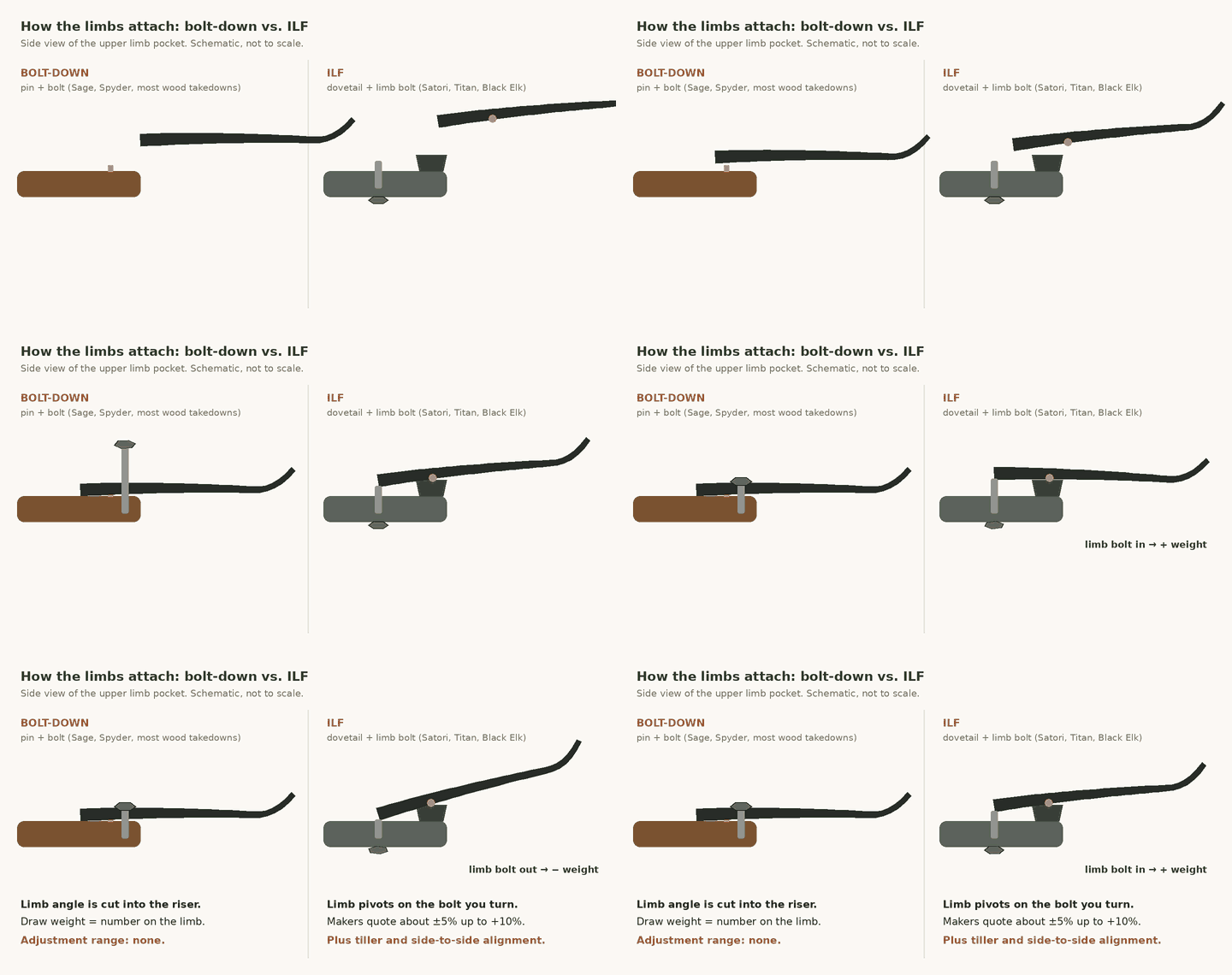
| System | Draw-weight adjustment on the bow | Where that number comes from |
|---|---|---|
| One-piece | None | Fixed by the limbs |
| Bolt-down / latch | None on one riser; the riser length changes it | Bear: limbs draw 2 lb less on the B riser than on the A riser |
| ILF, hunting riser | ±5% | WNS Black Elk listing |
| ILF, hunting riser | +1 to +10% up from base | TradTech Titan II listing |
| ILF, rule of thumb | ≈1.5 lb per three turns from the middle | Archery 360 (ATA) ILF guide |
The ILF side also has the parts market. On October 2, 2026 I pulled Lancaster Archery Supply's whole recurve collection through its product feed.
Bolt-down limbs mostly come from the riser's maker (Sage and Spyder limbs are an exception and cross-fit, as I covered in Samick Sage vs. Spyder). An ILF riser takes limbs from any ILF maker. That's the real upgrade path, and the reason several owners in the coded threads said they'd only buy a recurve if it's ILF.
Why does a crooked limb matter more on a takedown?
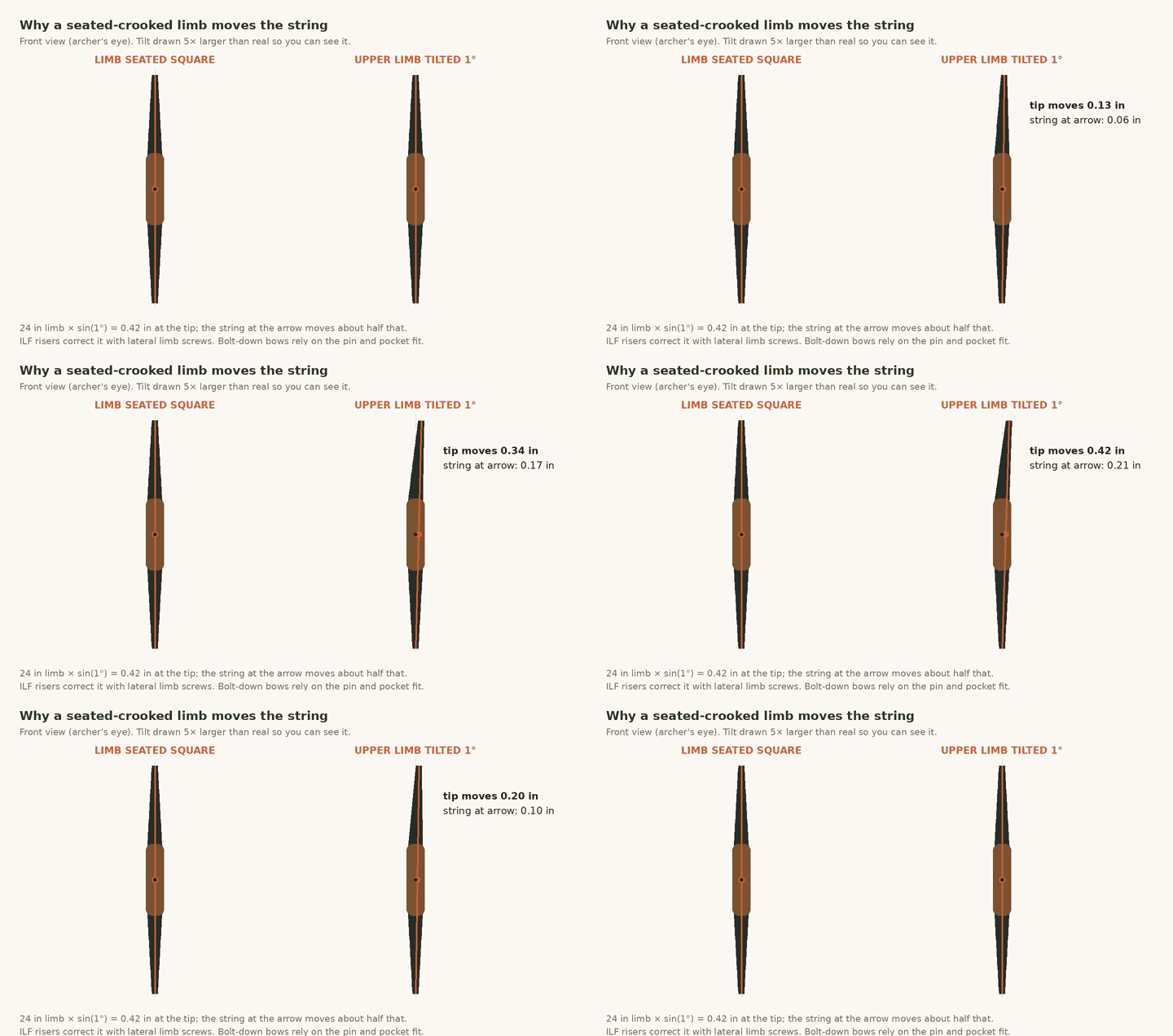
A one-piece bow's limb alignment is fixed at the factory. A takedown re-seats its limbs every time you assemble it, so pocket fit matters. The geometry is simple: a 24″ limb seated 1° off moves its tip 24 × sin 1° = 0.42″, and the string at the arrow moves about half that. ILF risers fix it with lateral limb screws. On a bolt-down bow, check that the string still splits the limbs after every assembly, then paper tune if arrow flight changed.
Does a Takedown Save Anything as Your Draw Weight Goes Up?
It saves bows. It doesn't save arrows. I ran a 30 → 50 lb path through ArcheryEra's recurve spine engine (Easton's finger-release chart, the same math as the Recurve Arrow Spine Calculator) for a 28″ draw, 29″ arrow and 125 gr point on wood/glass limbs.
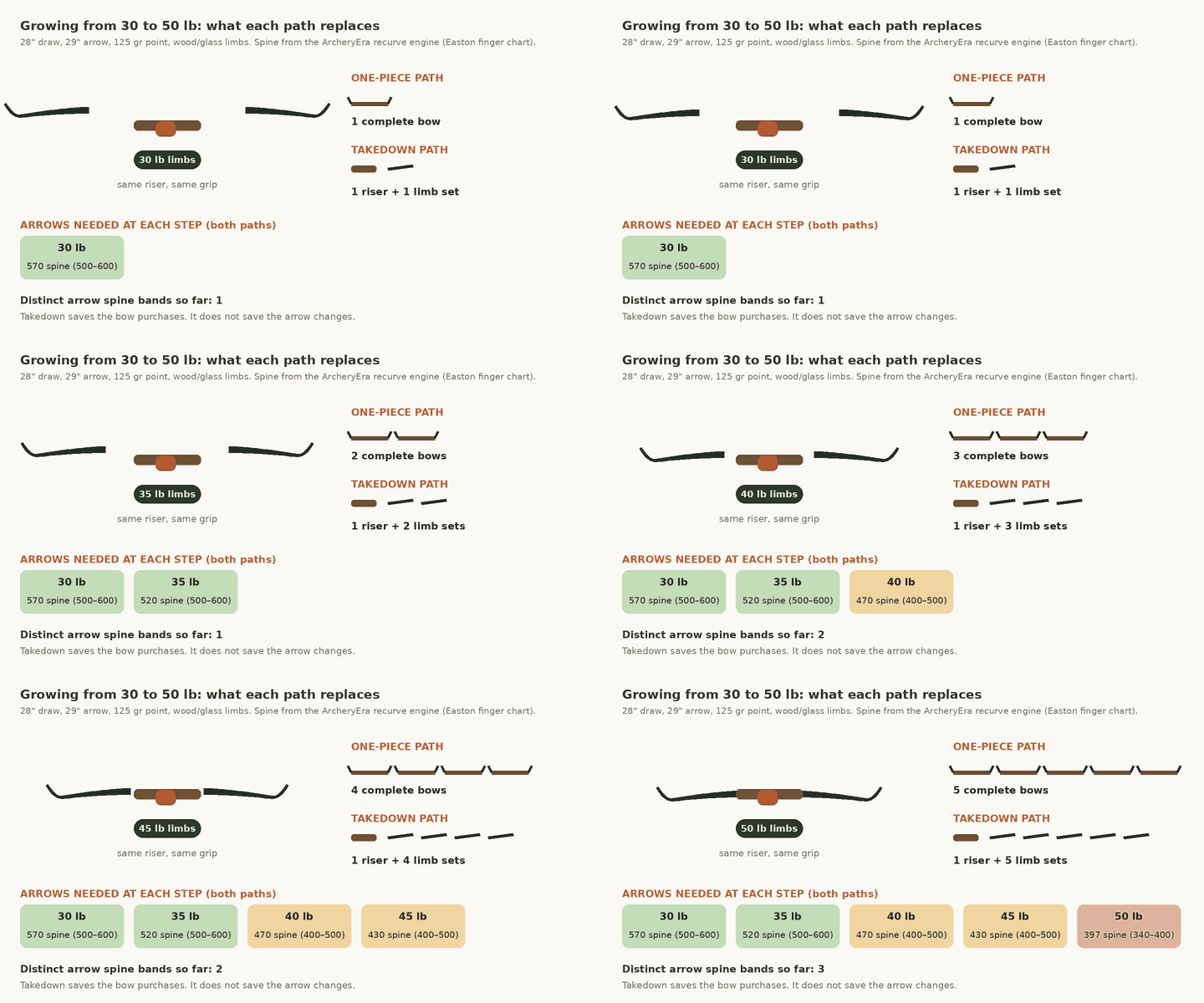
Five draw weights cross three arrow spine bands (500–600, 400–500, 340–400). A takedown turns five bow purchases into five limb sets, but you'll re-arrow about every 10 lb no matter what. Plan the arrows along with the limbs. Plug your own numbers in here.
Marked limb weights in steps. Spine from ArcheryEra's recurve engine; speed from the site's recurve model with the arrow weight you enter. Limb weights are marked at 28″.
| Marked limb | Effective weight | Target spine | Spine band | Speed, same arrow |
|---|
Is a Takedown Less Durable?
The design has more joints, and 14 posts in the sample named “nothing to loosen” as a one-piece reason. But I found no post describing a coupling that failed on its own. The failure owners did describe was assembly: one ArcheryTalk poster cracked a limb after putting it back on without tightening it properly. An older reply in another thread argued that on most takedowns a limb will delaminate before the coupling fails. That's an opinion, but nothing in the sample contradicts it.
- Limb bolts or latches fully seated and snug, both sides.
- If your limbs are marked top and bottom, they're on the right ends.
- String in both tip grooves, checked by eye, before the first draw. Use a stringer every time.
- String still splits both limbs at the tips (see the alignment section).
- Brace height back in your range. If it moved, the string lost twists.
When is each one the wrong choice?
Skip the one-piece if…
You fly to hunt, ride or pack in, or you're a new archer who'll move up 10–20 lb in the first seasons. Every step is a new bow.
Skip the bolt-down if…
You want to tune tiller, mix limb brands or add a plunger later. The limb angle is cut into the wood and the limbs come from one maker.
Skip the ILF if…
You walk all day and want the lightest bow in the hand. Most hunting ILF risers outweigh a whole one-piece before limbs go on.
The spec table, the packed-length model and the forum coding counts in one CSV, with a source link on every row.
Download CSV ↓Next steps: size the bow with the Bow Size Calculator and your draw length, then match arrows with the Recurve Arrow Spine Calculator. Still choosing the bow family? Recurve vs. longbow and barebow vs. Olympic recurve pick up from here.
Frequently Asked Questions
Is a takedown recurve as good as a one-piece?
Yes, for shooting. When the same limb is built both ways, makers and owners report no measurable speed difference, and Black Widow calls the difference between its 1-piece and 3-piece models minimal. What changes is packed length, mass and how you change draw weight.
Is a takedown recurve louder than a one-piece?
Not by design. Noise mostly follows limb design, string, brace height and arrow weight. A takedown has more parts that can rattle if a bolt or pocket pad works loose, so check those before adding silencers.
How much heavier is a takedown recurve?
In published specs, one-piece bows run 1.45 to 1.86 lb complete, two wood takedowns list 2.2 lb, and hunting ILF risers weigh 1.54 to 2.57 lb before limbs. In Galaxy's own line, the 62-inch takedown is 0.34 lb (18%) heavier than the 62-inch one-piece.
How small does a takedown recurve pack?
About 24 inches for a 60 to 64 inch bow, and the longest piece is usually a limb, not the riser. A one-piece needs a case about as long as the bow itself.
Can you fly with a recurve bow?
Yes, in checked baggage; TSA does not allow bows in carry-on bags. A takedown in a soft case fits inside a normal checked bag, while a one-piece in a tube usually travels as an oversize item.
Can you change the draw weight of a one-piece recurve?
Not on the bow. A one-piece pulls its marked weight at 28 inches and only changes with your draw length. A bolt-down takedown changes weight with new limbs, and an ILF takedown also adjusts a few percent on its limb bolts.
Should a beginner buy a takedown or a one-piece recurve?
Usually a takedown, because most new archers move up in draw weight. Plan new arrows too: a 30 to 50 lb path crosses three spine bands in ArcheryEra's recurve spine engine.
Do ILF limbs fit a bolt-down takedown riser?
No. ILF limbs need an ILF dovetail pocket. Bolt-down limbs only fit risers built for that pin-and-bolt pattern, usually from the same maker.
My take: Stop asking which one shoots better. Same limb, same arrow, same result, and nobody I found has data saying otherwise. Ask which problems you actually have. If you fly, pack in or haven't settled your weight, the takedown solves real problems, and ILF solves them best. If you drive to the woods, know your weight and carry the bow all day, the one-piece is lighter, simpler and has nothing to check.
👉 Recommendation: First recurve with any chance of climbing in weight: a takedown, and ILF if you'll ever want to tune. Your forever hunting bow at a settled weight: a one-piece is the lighter, simpler choice. Plenty of owners in these threads ended up with one of each.
Burak here. I’m a mechanical engineer (MSc) and lifelong archer, and I write and build ArcheryEra on my own. I check what archers report on ArcheryTalk and TradTalk against manufacturer data and physics, then turn it into calculators like the ones on this page.