
IBO vs. ATA in Compound Bows: The Chronograph Reality, String Angle Physics, and Axle-to-Axle Selection
Two letters get printed on every compound bow spec sheet, and most buyers read straight past what either one is actually testing. IBO is a velocity rating — run near an 80-lb draw with no fixed draw length. ATA does double duty: it's also the Archery Trade Association's own, stricter speed standard (70 lb, 30 in, 350 grains), and separately the axle-to-axle length printed on the same spec line, a pure geometry number with zero direct connection to fps. Mixing the three up is exactly how a shooter ends up disappointed at the chronograph, or buying a bow whose string angle punishes a draw length it was never built around. This report separates all three, with a calculator, two technical diagrams, and a scenario matrix for picking axle-to-axle length on purpose instead of by accident.

Short answer: IBO and ATA aren't measuring the same thing, and "ATA" itself means two different things. IBO speed is tested near an 80-lb draw with no fixed draw length and a 400-grain arrow — the loosest of the common speed standards, which is why it's the number every catalog leads with. The Archery Trade Association's own speed standard is stricter: a fixed 70 lb, 30 in, 350-grain arrow. Separately, "ATA" also names the axle-to-axle length printed on that same spec line — a physical dimension that decides string angle, maneuverability and forgiveness, with no direct link to either speed number. Chase IBO fps alone and you can end up with a bow whose dynamic spine and string-angle geometry fight your actual draw length.
- IBO is the loosest speed standard, not the strictest. It's tested near an 80-lb draw with no fixed draw length and a 400-grain arrow — that's why it's higher than what most other ratings would show for the same bow.
- "ATA" is ambiguous on purpose, in effect. It's the Archery Trade Association's own stricter speed standard (70 lb / 30 in / 350 gr) and the axle-to-axle length spec — two unrelated numbers sharing three letters.
- Axle-to-axle length sets string angle, not speed. A shorter ATA (28–32 in) sharpens the string angle at full draw; a longer ATA (33–38 in+) opens it up for easier peep alignment and a steadier hold.
- Real hunting setups lose 60–80 fps off the advertised number. Lower draw weight, shorter draw length and a heavier hunting arrow each subtract speed on top of each other — run your own numbers instead of trusting the catalog figure.
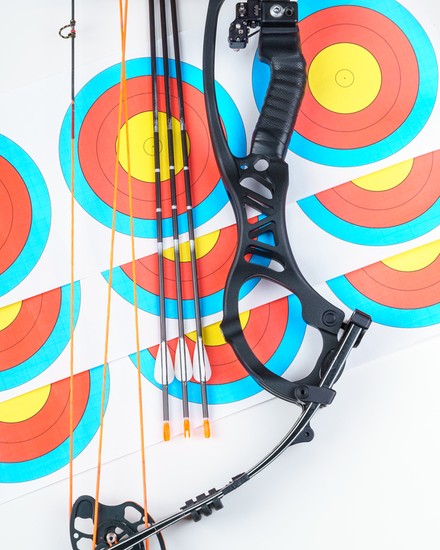
What's the 1-Minute Answer — Short ATA or Long ATA?
Work down this matrix before reading anything else — it condenses the geometry half of this report into a single scan.
| Criteria | Short ATA (28–32″) | Long ATA (33–38″+) |
|---|---|---|
| Best for | Tree stands, ground blinds with tight footprints, spot-and-stalk mobility through brush | Open ground blinds, 3D and target work, archers with a 29 in-plus draw length |
| String angle at full draw | Sharper (more acute) — more string-to-face contact, touchier peep rotation | Wider (more obtuse) — easier peep alignment, more consistent anchor |
| Stability & forgiveness | Lower — a small hand-torque error moves the sight picture more | Higher — forces spread across a longer moment arm, steadier hold |
| Limitation | Can feel cramped or face-slappy for long-draw archers | Bulkier through tight cover, more limb clearance needed in a stand |
The Core Physics Paradox: What Do IBO and ATA Actually Measure?
IBO stands for the International Bowhunting Organization, and its speed standard is the one printed on almost every hunting bow's spec sheet. The test allows a peak draw weight near 80 lb (±2 lb), sets no fixed draw length — manufacturers test at the bow's longest available module — and uses an arrow at 5 grains per pound of that draw weight, which works out to roughly 400 grains at 80 lb.
The Archery Trade Association runs a tighter version of the same idea: a fixed 70-lb draw weight, a fixed 30-in draw length, and a 350-grain arrow — also 5 grains per pound, just at a lower weight and a shorter, standardized draw. Because IBO's draw weight ceiling runs higher and its draw length isn't capped, an IBO number for the same physical bow almost always reads faster than an ATA-standard number would. That's not a conspiracy; it's just a looser test producing a bigger number, and it's the reason the industry gravitated to IBO for marketing long before anyone in a shop mentions the ATA alternative exists.
Two completely different things share the letters "ATA." One is the Archery Trade Association's own stricter speed-testing standard (70 lb / 30 in / 350 gr) — a number almost nobody prints, because it's lower than IBO. The other is axle-to-axle length, the physical distance between cam centers, which has no direct relationship to either speed rating. When a bow buyer asks "IBO vs ATA," they're almost always really asking about the second one — and that's the number this report spends the most time on.
Neither IBO nor the ATA speed standard is enforced by an outside lab. Both are self-reported by the manufacturer under the stated conditions, which is a limitation the archery press has been pointing out for years — a bow tested at 82 lb instead of 80, or at a 31-in module instead of 30, can still get marketed under the same "IBO" label. Treat every advertised number as a ceiling under ideal, stripped-down conditions, not a promise about your own setup.
How Fast Does Your Bow Actually Shoot? Real-World Speed Calculator
ArcheryEra already runs a physics-based speed engine — it's the guts of the Arrow Speed & Performance Calculator, and it adjusts a rated speed number for draw length, draw weight, arrow mass and string accessory weight on a real energy curve rather than a flat subtraction. The version below runs that exact same engine with fewer inputs; punch in your own numbers before reading further.
The same physics engine as the full calculator, just fewer inputs. Draw length and draw weight adjust the baseline speed linearly (10 fps/in, 2 fps/lb); arrow and string weight then scale that number through a virtual-mass curve — not a flat per-grain subtraction — so it stays accurate well past a light target arrow. Enter whichever number is on your bow's spec sheet, usually IBO, and treat the result as a ceiling: a true ATA-condition (70 lb/30 in/350 gr) rating would already start a little lower.
For the full model — plus kinetic energy and momentum output — use the complete calculator:
Open the Full Arrow Speed & Performance Calculator → Open the Kinetic Energy & Momentum Calculator →The IBO Efficiency Index: Why a 340 IBO Bow Doesn't Chronograph at 340
ArcheryEra's own synthesized metric for this comparison is the IBO Efficiency Index — advertised IBO speed divided by brace height in inches. A 350 fps bow on a 6 in brace scores 58.3; the same 350 fps rating on a 7.5 in brace would score 46.7, if such a bow existed, because a shorter brace height is doing more of the work to hit that number. A high Index means the manufacturer leaned on a short, less forgiving power stroke to post the number; a lower Index means more of that speed came from cam efficiency rather than punishing brace geometry.
Run a common hunting scenario through the calculator above and the gap is not subtle. Start at a 340 fps rated flagship, then apply a realistic setup: a 28.5 in draw and a 67-lb draw weight subtract linearly — 15 fps and 6 fps — down to a 319 fps baseline. Swap in a 430-grain hunting arrow plus 20 grains of peep, D-loop and silencer weight, and the virtual-mass curve scales that down to roughly 278 fps. Not from a flat per-grain rate — because a heavier arrow keeps more of the bow's stored energy instead of losing it to the limbs and string, so each extra grain costs a little less speed than the one before it. That result lands right inside the 270–285 fps window bow techs commonly report for hunting setups — 60 fps under the number on the box.
| Spec | Rated Test Condition | Realistic Hunting Setup |
|---|---|---|
| Draw weight | 80 lb (IBO ceiling) | 67 lb |
| Draw length | Longest available module | 28.5 in |
| Arrow + string weight | 400 gr (5 gr/lb), no accessories | 430 gr + 20 gr accessories |
| Modeled speed | 340 fps (advertised) | ~278 fps |
A formula-derived illustration run through the site's own speed engine (draw length and draw weight adjusted linearly, arrow and string mass scaled through the virtual-mass curve), not a chronograph test of a specific bow. Run your own numbers through the calculator instead of treating this row as gospel for your setup.
Recent flagship-class hunting bows cluster in a tight IBO band, with axle-to-axle length varying more than the speed number does — a useful reminder that ATA length is the more meaningful choice between similarly fast bows, not the fps rating itself.
| Flagship-Class Model | Advertised IBO | Axle-to-Axle |
|---|---|---|
| Mathews Phase4 | 342 fps | 33″ |
| Hoyt RX-8 | 342 fps | 30.5″ |
| Bowtech SR350 | 350 fps | 30″ |
| PSE Levitate | 338 fps | 33″ |
Recent flagship-class specs, per published manufacturer spec comparisons — confirm current-year numbers against the manufacturer's own catalog before buying, since flagship lineups refresh annually.
ATA Geometry, String Angle Physics & Ergonomics
Axle-to-axle length is measured cam-center to cam-center with the bow at rest, not at full draw. It says nothing about speed directly — what it decides is the angle the string makes at your anchor point once you pull it back.
A longer ATA spreads the cams farther apart, so at the same draw length the two string legs meet your anchor at a wider, more obtuse angle — easier peep alignment, less string-to-cheek contact, a steadier hold because the forces are spread across a longer moment arm. A shorter ATA pulls the cams closer together, sharpening that angle into something more acute, which is exactly what shows up as string slap or a peep that won't settle for archers running a longer draw.
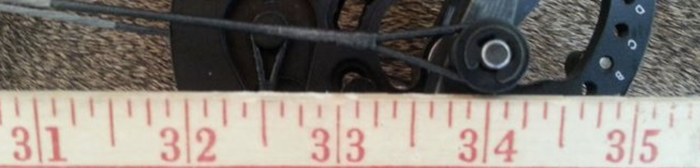
Rest and peep clearance interact with this the same way arrow length interacts with broadhead clearance — a geometry check that has to be confirmed at full draw with your own anchor, not assumed from the catalog spec. Archers who move from a short-ATA speed bow to a longer target-style axle-to-axle model consistently describe the anchor as feeling less crowded, which tracks with the geometry: the wider angle simply asks less of the peep and less of the archer's face.
Master Use-Case Comparison Matrix
Four common scenarios, matched against the ATA range, target IBO band and brace height that the geometry above actually supports.
| Scenario | Ideal ATA Range | Target IBO Band | Brace Height Sweet-Spot | Core Advantage |
|---|---|---|---|---|
| Ground Blind | 33–38″ | 320–340 fps | 6.5–7.5″ | Stability and a wide string angle with no space constraint to fight |
| Tree Stand | 28–32″ | 320–340 fps | 6–7″ | Maneuverability through limbs and a confined platform |
| Spot & Stalk | 30–33″ | 330–350 fps | 5.5–6.5″ | Compact enough for brush, fast enough for a flatter trajectory at range |
| 3D & Long-Draw Archers | 33–38″+ | 300–325 fps | 7–9″ | Wide string angle and forgiveness over raw speed, especially past a 29″ draw |
A Note on Outliers
Not every axle-to-axle number on a hangtag fits the ranges above. Compact hybrid sling-bows — part slingshot, part compound — get marketed with axle-to-axle figures as short as 24 in, alongside specs like "steel ball speed" that have nothing to do with arrow flight physics.
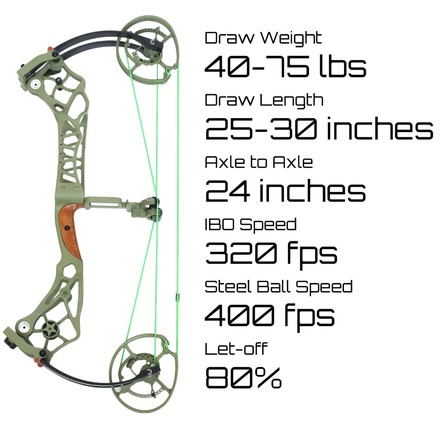
If a listing quotes a metric this guide hasn't mentioned, it's very likely describing a different product category entirely — not a standard vertical compound bow built around the IBO and ATA standards above.
Speed and geometry are only two pieces of a hunting arrow build. Run the arrow you'll actually shoot through the Dynamic Spine & Shaft Flex Calculator to confirm it matches your draw weight and cam profile, then check downrange performance with the Kinetic Energy, Momentum & Pass-Through Calculator and broadhead choice against the Mechanical vs. Fixed Broadheads comparison.
Frequently Asked Questions
Is a shorter ATA bow always worse for long draw lengths?
Not always, but the trade-off is real. A short axle-to-axle bow (28–32 in) creates a sharper, more acute string angle at full draw, and that angle gets more pronounced the longer an archer's draw length runs. Archers pulling 29 in or more tend to feel more string-to-face contact and a touchier peep rotation on a short-ATA bow than on a 33 in-plus model. It's manageable with peep tuning and D-loop placement, but a longer ATA removes the problem at the geometry level instead of compensating for it.
Why can't I reach the advertised IBO speed on my compound bow chronograph?
Because the IBO number was never built to match a hunting setup. IBO speed is tested near an 80-lb peak draw weight (±2 lb), with no fixed draw length — manufacturers use the bow's longest available module — and a 400-grain arrow (5 grains per pound). Drop to a real 65-lb draw, a 28.5 in draw length, and a 450-grain hunting arrow with a peep and D-loop, and it stacks up fast: draw length and draw weight subtract linearly (roughly 10 fps per inch under 30 in, 2 fps per pound under peak), then arrow and string weight scale that number down through a non-linear mass curve — not a flat per-grain rate — because a heavier arrow keeps more of the bow's stored energy instead of losing it to the limbs and string.
How does brace height interact with the IBO vs ATA trade-off?
It's a separate axis from axle-to-axle length, but the two often travel together. A shorter brace height (5–7 in) keeps the string in contact with the arrow longer, which adds speed but punishes inconsistent form — exactly what a bow needs to post a high IBO number. A longer brace height (7–9 in) gives up speed for a shorter power stroke and more forgiveness. Speed-class bows tend to pair a short ATA with a short brace height; both choices push the same direction, toward fps over comfort.
What is the ideal ATA length for tree-stand and ground blind bowhunting?
For a tree stand, 28–32 in keeps the bow maneuverable through limbs and a confined platform without the cams catching on rails or your climbing gear. A ground blind removes most of that spatial constraint, so a longer 33–38 in bow becomes the community-favored choice — the wider string angle and steadier hold matter more than compactness once the bow isn't fighting a tree stand's footprint.
Does a higher IBO rating mean a harsher draw cycle?
Not directly, and treating them as the same thing is a common misread. Draw cycle harshness comes from cam aggressiveness, let-off percentage, and the draw-force curve — not the fps number printed on the spec sheet by itself. That said, the cam profiles manufacturers use to chase a higher IBO number (more aggressive, less circular) do trend harsher in practice, so a high-IBO flagship and a harsh draw cycle correlate more often than not, even though one doesn't strictly cause the other.
Our Final Take: Treat the IBO number as a ceiling under conditions your setup will never match, not a promise. Pick axle-to-axle length on its own merits — against your draw length, your hunting style and how much string angle you're willing to live with — instead of letting a higher fps rating pull you toward a shorter, sharper-angled bow you didn't actually need.
👉 Recommendation: If your draw length runs 29 in or longer, or you hunt mostly from a ground blind, lean toward 33 in-plus axle-to-axle and let the calculator above tell you what speed you're actually giving up. If you're squeezing through brush or a cramped stand, the shorter bow earns its trade-offs — just confirm string clearance at full draw before the season starts, not after.
Hey, what's up? Burak here. Archery addict, board game geek, Daft Punk fan.
Your turn
Join the Conversation
If your own chronograph numbers disagree with the deductions above, that's the most useful thing you could leave here. Your bow, your draw length and what actually happened beats a rule of thumb every time — and corrections get the page changed.