Arrow Nock Size Chart: Groove & Throat Specs for 44 Nocks by Shaft ID

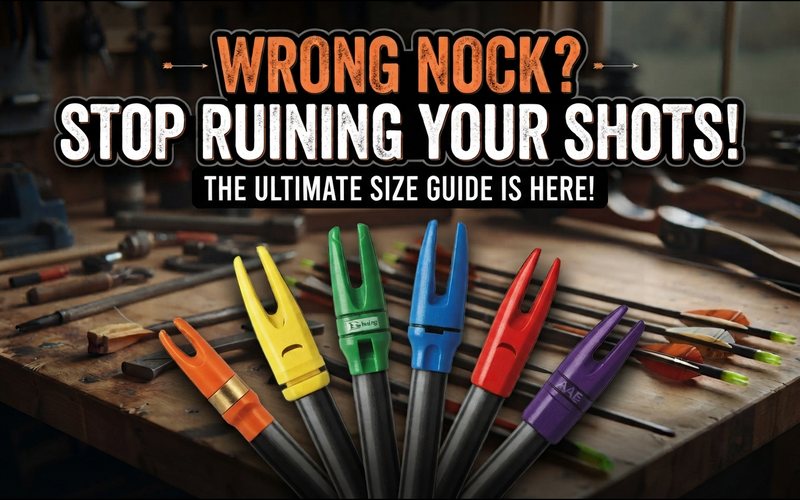
A nock has to fit twice: its shank has to match your shaft's inside diameter (.166″, .204″, .233″ or the .244–.246″ family), and its groove has to match your bowstring's center serving. For the string side, the serving should measure larger than the nock's groove (so it snaps on) but no larger than its throat (so the string can slide out clean). Across the 44 nocks below, published grooves run from 0.074″ to 0.105″ and throats from 0.098″ to 0.120″. That spread is why a nock that clicks perfectly on one string falls off another.
Does Your Nock Fit Your String? Check It in 30 Seconds
Pick your nock (or type in its groove and throat), enter your center-serving diameter from a caliper, and the check tells you where the serving sits between the nock's groove, where it snaps on, and its throat, where it rests. Not sure how to measure? The four-step method is right below the tool.
Nock Fit Check
Measure the center serving where the nock actually sits, after the serving has broken in. Inches or millimeters both work.
The zone names are my own labels for position in the window, not a pass/fail spec. The final judge is Easton's hang test: the arrow hangs from the string under its own weight and drops off with a light tap on the string near the nock.
What does a lighted nock do to this arrow?
Same FOC engine as the Arrow FOC & Balance Point Optimizer: 3 vanes at 8 gr, field point. Lighted-nock mass is placed deeper in the shaft, as the engine models it.
Speed estimate uses the shop rule of about 1 fps lost per 5 grains added, the same comparison rule shown on Arrow Weight vs Speed. For a full build, run it in the FOC optimizer.
Under the hood
Fit: interference = serving − groove; throat room = throat − serving; window position = (serving − groove) ÷ (throat − groove). Below 0 is "no snap", above 100% is "wider than the throat". I split the rest at 20% and 80% into light, mid-window and firm snap. Those two split points are my convention, not a published standard, so let the hang-and-tap test overrule them.
Cold: groove change = groove × α × ΔT, with α = 67.5 × 10⁻⁶ per °C, the middle of polycarbonate's published 65–70 range. The serving shrinks in the cold too, so the real change in fit is smaller than this number; treat it as an upper bound.
FOC: calls the site's shared AEFOC.build() engine: standard nock mass at 0.20″ ahead of the throat, lighted nock at 0.55″.
How Do You Measure Your Center Serving?
- Measure where the nock actually sits. On a release bow that's the short stretch of serving between your D-loop knots, not the serving above or below them.
- Close the caliper jaws gently. Serving is soft and flattens under pressure, and a hard squeeze can read a couple of thousandths small, which is the whole width of some snap windows.
- Take two readings 90° apart and average them. A served string is rarely perfectly round.
- Measure after break-in. OCD Strings tests fit only after the center serving has settled, and so should you.
No caliper? Skip the numbers and use the hang-and-tap test plus the troubleshooting table further down. It tells you which direction to move (smaller or larger groove), just not by how much.
- Groove and throat are two different numbers. The groove is the narrow lip the serving snaps past; the throat is the wider seat it rests in. Your serving diameter belongs between the two.
- Measure the serving, don't guess it. A caliper reading at the nocking point, compared against the table below, tells you more than strand count ever will. Easton's hang-and-tap test then confirms it.
- Cold barely moves a polycarbonate nock. I ran the thermal-expansion math: a 0.100″ groove loses about 0.0003″ going from 70°F to 0°F. That's smaller than the disagreement between published specs for the same nock.
- Lighted nocks change two things at once. In the site's own FOC engine they cost a typical hunting arrow about 2 points of FOC, and they bring their own groove, so the string fit you had with standard nocks no longer counts. Re-run the hang test after the switch.
Where Do These Numbers Come From?
I wrote this after the same question kept showing up in threads like a recurve shooter whose .246 Gold Tip nocks were loose on a new 16-strand string, an ArcheryTalk request for a nock fitment chart that lists throat sizes, and another asking which center serving size goes with which nock. Nobody in those threads had a single table that put the string side and the shaft side in one place, so I built one from Lancaster Archery's published groove and throat measurements, cross-checked the lighted-nock weights against each maker's own product pages, and put a calculator on top.
In that Rokslide thread on a loose .246 nock, two stopgaps came up: wrapping the nock area of the serving with waxed dental tape or floss, and ordering two or three different nocks to find one that clicks before reserving. The same thread gives the proper fix: moving from 0.014″ to 0.018″ Halo center serving to bring the diameter up to roughly 0.114″. Run 0.114″ through the Nock Fit Check with a Gold Tip GT nock (0.101″ groove, 0.115″ throat) and it lands at the firm end of the window, which is what that shooter needed after a nock that fell off. A floss wrap is a temporary patch on a serving that's too thin, so re-check fit often and plan a reserve.
What Do "Groove" and "Throat" Actually Mean on a Nock?
Look into the slot of any modern nock and it narrows before it widens. That narrow point is the groove: the lips the serving has to squeeze past, and the reason you hear a click. Behind it sits the throat, the rounded seat the string rests against while you draw and the surface it slides off at release.
So the fit window is simple geometry. Serving smaller than the groove? No click, no retention. Serving bigger than the throat? The ears stay spread around the string the whole time, and the string has to drag its way out.
Makers don't all use these two words the same way. Easton's retail listing for the 5mm X nock calls 0.098″ its "throat size (large groove)", while Lancaster's measurement table lists the same nock with a 0.096″ groove and a 0.112″ throat. When a spec sheet quotes one number, it is almost always the snap point, the groove.
Arrow Nock Size Chart: Which Nock Fits Which Shaft ID?
Sorted by the bore each nock is made for, then by maker. Groove and throat are Lancaster Archery's published measurements. The last column is mine: throat minus groove, in thousandths of an inch. I call it the snap window, and it tells you how forgiving a nock is of serving variation. A wide window tolerates a range of servings; a narrow one wants a serving sized for it.
| Nock | Fits | Groove (in) | Throat (in) | Snap window (thou) |
|---|---|---|---|---|
| .166″ ID · 4mm / micro-diameter | ||||
| Easton G (small groove) | .166″ | 0.088 | 0.098 | 10 |
| Easton G (large groove) | .166″ | 0.098 | 0.110 | 12 |
| Easton 4mm Microlite | .166″ | 0.090 | 0.107 | 17 |
| Easton N | .166″ | 0.081 | 0.100 | 19 |
| AAE IP4 | .166″ | 0.098 | 0.111 | 13 |
| Gold Tip GTO | .166″ | 0.102 | 0.114 | 12 |
| Black Eagle M | .166″ | 0.103 | 0.114 | 11 |
| Bohning F | .166″ | 0.096 | 0.117 | 21 |
| Altra Nexum 166 | .166″ | 0.103 | 0.114 | 11 |
| .204″ ID · 5mm / small-diameter | ||||
| Easton X | .204″ | 0.096 | 0.112 | 16 |
| Easton 5mm Microlite | .204″ | 0.097 | 0.112 | 15 |
| AAE IP5 | .204″ | 0.099 | 0.113 | 14 |
| Gold Tip Accu-Tough | .204″ | 0.104 | 0.115 | 11 |
| Black Eagle R | .204″ | 0.103 | 0.114 | 11 |
| Bohning A | .204″ | 0.095 | 0.117 | 22 |
| Altra Nexum 204 | .204″ | 0.101 | 0.113 | 12 |
| Easton 6mm · .231–.233″ ID (FMJ 6mm, Hexx, Sonic) | ||||
| Easton H | Easton 6mm | 0.092 | 0.110 | 18 |
| Bohning H.E. | Easton Sonic | 0.090 | 0.113 | 23 |
| .244–.246″ ID · standard diameter | ||||
| Easton Super | .245″ | 0.081 | 0.107 | 26 |
| Easton 3D Super | .245″ | 0.103 | 0.112 | 9 |
| Easton S | .245″ | 0.085 | 0.112 | 27 |
| Easton 6.5mm Microlite | .245″ | 0.085 | 0.110 | 25 |
| AAE IP6 | .245″ | 0.097 | 0.111 | 14 |
| Gold Tip GT | .245″ | 0.101 | 0.115 | 14 |
| Gold Tip Accu-Lite | .245″ | 0.100 | 0.112 | 12 |
| Black Eagle STD | .245″ | 0.104 | 0.115 | 11 |
| Bohning Signature (B) | .245″ | 0.103 | 0.111 | 8 |
| Bohning Blazer | .245″ | 0.095 | 0.118 | 23 |
| Bohning Smooth Release Insert | .245″ | 0.094 | 0.117 | 23 |
| Carbon Express Launchpad | .245″ | 0.074 | 0.099 | 25 |
| Bearpaw Heavy Hunter | .245″ | 0.105 | 0.118 | 13 |
| Pin nocks (fit a pin or bushing, not the bore) | ||||
| Beiter Pin #1 (asymmetric) | Pin | 0.088 | 0.106 | 18 |
| Beiter Pin #1H | Pin | 0.084 | 0.104 | 20 |
| Beiter Pin #2 (asymmetric) | Pin | 0.098 | 0.118 | 20 |
| Beiter Pin H | Pin | 0.099 | 0.117 | 18 |
| Easton G Pin | Pin | 0.099 | 0.113 | 14 |
| Easton Pin (small) | Pin | 0.084 | 0.099 | 15 |
| Easton Pin (large) | Pin | 0.096 | 0.111 | 15 |
| AAE IP Pin | Pin | 0.100 | 0.114 | 14 |
| Gold Tip HD Pin | Pin | 0.101 | 0.112 | 11 |
| Gold Tip HD Mini Pin | Pin | 0.098 | 0.112 | 14 |
| Bohning Pin M | Pin | 0.101 | 0.119 | 18 |
| Bohning Pin R (Blazer small) | Pin | 0.087 | 0.106 | 19 |
| Bohning Pin V (Blazer standard) | Pin | 0.097 | 0.120 | 23 |
Groove and throat values from Lancaster Archery's nock measurement table; snap window is my own subtraction. Beiter insert nocks (#1, #1H, #2, H) share the groove and throat of the matching pin nock. Lancaster lists every standard-diameter nock as ".245" fit; the makers split that family into .244″ and .246″ parts (see the next table), so check your shaft's own published ID before you order.
Treat every number as good to about ±0.002″. In the two places I could cross-check, published figures for the same part disagree by that much: Easton X at 0.096″ vs 0.098″, and Beiter #1 at 0.088″ in Lancaster's table vs 0.086″ on Beiter's own 19/1 small-groove listing. Molded plastic, measured by hand, from different production runs. A table can put you in the right family; only your caliper and a hang test finish the job.
Can You Mix Nock Brands on the Same Shaft ID?
Usually, yes, as long as the nock is made for your shaft's exact published bore. Lancaster's guide says outright that many nocks cross over between arrow brands, and the table above bears it out: every .204″ nock listed shares one shank size. Where people get caught is the standard-diameter family, because .244″ and .246″ get lumped together as "6.5mm" when they're not the same hole.
| Shaft bore | Press-fit nocks built for it | Lighted options (maker's fit) | Watch out for |
|---|---|---|---|
| .165–.166″ | Easton G / 4mm Microlite / N, AAE IP4, Gold Tip GTO, Black Eagle M, Bohning F, Altra Nexum 166 | Nockturnal G (.165″) | Easton G comes in two groove sizes on the same shank. Buy the groove, not just the size. |
| .204″ | Easton X / 5mm Microlite, AAE IP5, Gold Tip Accu-Tough, Black Eagle R, Bohning A, Altra Nexum 204 | Nockturnal X, FIT (X), Lumenok X | The widest groove spread in one class: 0.095″ (Bohning A) to 0.104″ (Accu-Tough). Swap brands and you may need a different serving. |
| Easton 6mm (.231–.233″) | Easton H, Bohning H.E. (Sonic) | Nockturnal H (.233″), FIT with the H bushing | Easton lists the 6mm H nock for FMJ, Hexx and Aftermath. It is its own size, not a .244″ part. |
| .244–.246″ (standard) | Easton S / Super / 3D Super / 6.5mm Microlite, Gold Tip GT / Accu-Lite, AAE IP6, Black Eagle STD, Bohning Blazer / Signature, Bearpaw Heavy Hunter | Nockturnal S (.244″), Nockturnal GT (.246″), FIT with the S or GT bushing | Feradyne sells different FIT bushings for .244″ and .246″ shafts. Two thousandths is a real press-fit difference, so check your shaft's published ID, not just "6.5mm". |
| Bushing / pin systems | Beiter, Easton, AAE, Gold Tip and Bohning pin nocks | Varies by maker | The nock fits the pin, not the carbon. A dented pin is a replacement item (see the cracking section). |
Not sure which bore class your shaft is in? The Nock & Insert Fitment Finder maps 18 current hunting shafts to their nock and bushing sizes. This page handles the other half of the fit: nock to string.
How Different Are the .204 Nocks, Really?
The .204″ class is where most modern hunting arrows live, so I plotted the snap window of all seven .204 nocks on one scale. Each bar runs from the nock's groove to its throat. A serving diameter drawn as a vertical line through the chart shows which nocks will click on it, which won't, and which will clamp it.
Two things jump out. The Bohning A has a 22-thousandth window, twice that of the Accu-Tough and the Black Eagle R, so it accepts the widest range of servings of anything in the class. And the Gold Tip and Black Eagle nocks sit high: their grooves (0.104″ and 0.103″) are bigger than the throat of some small-groove nocks elsewhere in the chart. Switch from Easton X to Accu-Tough on the same string and a crisp click can turn into no click at all.
Beiter #1 vs #2: What's the Actual Difference?
Ten thousandths of an inch. The #1 groove measures 0.088″ with a 0.106″ throat; the #2 measures 0.098″ with a 0.118″ throat. Lancaster's guidance is that the #1 suits thinner serving, roughly 12 to 16 strands of string depending on material, and the #2 suits thicker serving, roughly 14 to 18 strands. Those ranges overlap on purpose, because strand count alone doesn't set the serving diameter. Serving material and winding tension do too.
The other difference matters just as much on a recurve. The standard #1 and #2 are asymmetric: built for a finger release and meant to be installed facing a set direction. The H and #1H versions are symmetric, for release-aid shooters. Beiter's nock datasheet notes that each size comes from a single mold, which is why a Beiter nock tends to match its neighbor in the bag so closely.
Which Nock-Fit Test Should You Trust?
Three reputable sources describe three slightly different tests, and they don't contradict each other so much as target different shooters.
| Test | Source | Pass looks like | Best for |
|---|---|---|---|
| Hang and tap | Easton's nock setup guide | Arrow hangs vertically from the string, then separates with a light tap on the string within 5–6 cm of the nock | Everyone. Start here. |
| Click and rotate | Bow International's nock fit feature | An audible clip on, and the nock turns around the serving without dragging the nocking points or string with it | Recurve and barebow, where the finger release rolls the string |
| Slide and pull | OCD Strings' nock fit post | Nock slides along the serving, won't rotate once clicked on, and pulls free after about ½″ of pull | Compound with a D-loop, where nock rotation isn't wanted |
Notice the rotation disagreement: Bow International wants a nock that turns, OCD Strings wants one that doesn't. That isn't sloppiness. Finger shooters roll the string at release, and a nock that grips can get twisted with it; a D-loop shooter wants the arrow locked in orientation. Pick the test that matches how you shoot.
Does Cold Weather Tighten or Loosen Nock Fit?
Cold weather gets blamed for a lot of fit problems, and the usual explanation is that plastic nocks shrink. I ran the math on that. Polycarbonate's linear thermal expansion coefficient is 65 to 70 millionths per degree Celsius. Take a 0.100″ groove from a 70°F shop to a 0°F stand: that's 38.9°C of cooling, and 0.100 × 0.0000675 × 38.9 ≈ 0.0003″ of shrinkage.
Put that next to the other numbers on this page. It is one-seventh of the ±0.002″ disagreement between published specs for the same nock, and one-thirtieth of the difference between a Beiter #1 and #2. The serving shrinks in the cold as well, which cancels some of it. And the same polycarbonate data lists a lower working temperature of −40°F.
Myth: Sub-zero temperatures shrink plastic nocks and change the fit.
Math: Polycarbonate geometry moves about a quarter of a thousandth between 70°F and 0°F. That won't turn a good fit into a bad one.
If your fit really does feel different in the cold, look for things the geometry math doesn't cover: ice or frost in the nock slot, moisture in the serving, or serving wax that has stiffened. I can't rule those out from spec sheets, and I'm not going to put a number on them. The calculator's cold-day column is there so you can see the size of the thermal effect for your own nock.
What Makes a Nock Pinch the String at Release?
A pinch means the string can't leave the nock freely. From the sources above there are three mechanical causes, in order of how often they're the answer:
- Serving at or above the throat. The ears never close back around a free-sliding string; they clamp it. Run your caliper number through the Nock Fit Check.
- Nocking points too close. Easton recommends 1–2 mm of clearance between the bottom of the nock and the top of the bottom nocking point. Clamped between two brass or tied points, even a correctly sized nock can't release clean.
- An asymmetric nock turned the wrong way. On a finger bow, a standard Beiter #1 or #2 is built to face a set direction. The symmetric H versions don't have this problem.
A pinched release also shows up in tuning. OCD Strings points out that a nock that holds on too long can make the arrow behave as if it were stiffer than it is, so fix fit before you chase a paper tear with the Paper Tune Root-Cause Diagnostic.
What Cracks a Nock, and When Should You Replace One?
No nock maker I found publishes a shot-count life. So I won't give you one. What the manufacturers do document is what cracks nocks, and every item on that list is an event you can spot:
- A damaged pin. Easton: a scored or dented nock pin can cause stress cracking of the nock, and should be discarded and replaced.
- A fit that's too tight. Bow International warns a tight nock can crack over time and fail during a shot. That's the serving-above-throat case again.
- Chemicals. Easton lists cleaning solvents, gasoline and DEET-type insect repellents as things to keep off polycarbonate nocks. Worth knowing in bug season.
- Bent ears. Easton and Bow International agree: never bend nock ears to change the fit.
- Impacts. A hit from another arrow is the obvious one, and the reason to check nocks after a tight group.
- Tools. Easton: no pliers (and no teeth) for installing or turning nocks. Use a nock tool.
⚠️ Why a Cracked Nock Is a Dry-Fire RiskEaston warns that a poor fit can let the nock "squirt" off the string and cause a dry fire. A cracked nock is worse, since it can split at full draw. Inspect nocks after every shooting session and after any impact, which is Easton's own interval, and flex each one gently while you look for cracks, spread ears or a nock that turns loose in the shaft. Replace anything doubtful. A dozen nocks is a small thing to throw away next to a bow's limbs.
How Much FOC Does a Lighted Nock Cost You?
A lighted nock puts its extra weight at the worst possible spot for FOC: the very back of the arrow. I ran a common hunting build through the site's FOC engine: 28″ shaft at 8.5 grains per inch, 12-grain insert, 100-grain point, three 8-grain vanes. Weights are from each maker's product page.
| Nock | Weight | Total arrow | FOC | vs standard |
|---|---|---|---|---|
| Easton 5mm X (standard) | 9 gr | 383 gr | 11.2% | — |
| Nockturnal S | ~20 gr | 394 gr | 9.6% | −1.6 pts |
| Lumenok X | 24 gr | 398 gr | 9.0% | −2.2 pts |
| Nockturnal FIT | ~25 gr | 399 gr | 8.8% | −2.3 pts |
Two points of FOC off a 16-grain change, while the arrow gets heavier. On a heavier build (29″, 9.5 gpi, 25-grain insert, 125-grain head) the same swap moves FOC from 13.5% to 11.4%. At the 1-fps-per-5-grains shop rule, 16 extra grains also costs about 3 fps. I'd call neither number a deal-breaker for a hunter who wants to see the hit, but both are worth knowing before you tune broadheads, not after. I couldn't find a manufacturer-published weight for Firenock lighted nocks, so they're not in the table.
Does a Lighted Nock Fit Your String the Same Way?
Not necessarily. A lighted nock has its own molded groove and throat, and I couldn't find published groove or throat sizes for Nockturnal, Lumenok or Firenock nocks, so none of them are in the size chart above. Treat the switch like a new nock: hang-and-tap test every lighted nock on your actual string before it goes in the quiver.
If you'll hunt with lighted nocks, paper tune and broadhead tune with them installed. A standard nock on the practice arrows and a lighted one on the hunting arrows puts two different balance points in your quiver.
1-Minute Troubleshooting: Symptom → Cause → Fix
| Symptom | Most likely cause | Fix |
|---|---|---|
| Arrow falls off the string when you let it hang | Serving smaller than the groove | Nock with a smaller groove (e.g. Beiter #2 → #1, Easton G large → small), or thicker center serving |
| Arrow won't come off with a light tap | Serving near or above the throat | Nock with a larger groove and throat, or thinner serving |
| Fit changed after a new string | Different serving material or diameter | Re-measure with calipers after break-in; re-run the Nock Fit Check |
| Fit changed on the same string | Serving worn or loose at the nocking point | Inspect the center serving; reserve if it's separating |
| Nock turns or walks out of the shaft | Nock made for a slightly larger bore (.244 vs .246 class) | Match the nock's listed ID to the shaft's published ID |
| Crack, spread ears or white stress lines | Impact, tight fit, damaged pin or chemical exposure | Replace the nock; replace a scored pin too |
Frequently Asked Questions
What is the difference between Beiter #1 and #2 nock groove sizes?
About ten thousandths of an inch. Lancaster Archery's measurements put the Beiter #1 groove at 0.088 in with a 0.106 in throat, and the #2 groove at 0.098 in with a 0.118 in throat. The #1 is meant for thinner center serving (roughly 12 to 16 strands of string) and the #2 for thicker serving (roughly 14 to 18 strands).
Can I use a Gold Tip nock on an Easton shaft without a bushing?
Only when the nock's listed inside diameter matches the shaft's published inside diameter. A Gold Tip GT nock is built for a .246 in bore, and even inside the .244 to .246 in family a two-thousandths difference changes press-fit tightness, which is why Feradyne ships separate bushings for .244 and .246 in shafts. If your Easton shaft is built around a UNI or Super UNI bushing, you need a nock made for that bushing, not a press-fit nock.
How do I know if my bowstring serving is too thick or too thin for my nock?
Measure the center serving with calipers where the nock sits and compare it to the nock's groove and throat sizes. If the serving is smaller than the groove, the nock has nothing to snap over and the fit is too loose; if it is larger than the throat, the nock clamps the string and the fit is too tight. Confirm with Easton's hang test: the arrow should hang from the string under its own weight but drop off with a light tap on the string near the nock.
Do cold temperatures change plastic arrow nock tolerances?
Barely. Polycarbonate expands and contracts about 65 to 70 millionths per degree Celsius, so a 0.100 in groove cooled from 70 to 0 degrees F shrinks by roughly 0.0003 in. That is smaller than the 0.002 in disagreement between published specs for the same nock, and polycarbonate is rated for use down to minus 40 degrees. If fit changes in the cold, check for ice, moisture or stiff serving wax before blaming the nock.
What causes an arrow nock to pinch the bowstring upon release?
Usually a serving that is at or above the nock's throat size, so the ears clamp the string instead of letting it slide free. The second cause is nocking points set too close, since Easton recommends one to two millimeters of clearance between the nock and the bottom nocking point. On finger bows, an asymmetric Beiter nock turned the wrong way can pinch as well.
How many shots before carbon arrow nocks develop micro-fractures?
No nock maker publishes a shot-count life, so any fixed number is a guess. Nocks fail from events more than from count: a hit from another arrow, a scored or dented nock pin, solvent or DEET exposure, or a fit that is too tight. Easton's guidance is to inspect nocks after every shooting session and after any impact, and to replace any nock that is cracked, loose in the shaft or sitting on a damaged pin.
Put a caliper on your center serving, find your nock in the chart, and run both numbers through the Nock Fit Check. If you land mid-window, confirm with the hang-and-tap test and go shoot. If you're at either edge, change the nock or the serving now, not the week before your hunt.
Building new arrows at the same time? Cut them with the carbon-cutting method that won't crack the shaft, glue the inserts with an adhesive matched to your shaft, and check the spine with the Carbon Arrow Spine Calculator, with the lighted nocks you'll actually hunt with already installed.
Hey, what's up? Burak here. Mechanical engineer by training, archery addict by habit.