
Can You Use a Bow for Home Defense?
A bow already in the house sounds like a reasonable backup plan. The axle-to-axle width, the setup time and the actual hallway it has to work in tell a less convenient story.

Quick Summary
Short answer: not well. Geometry's the problem here, not opinion. A hunting-length bow is nearly as wide as a code-minimum hallway. A compound can't be stored pre-drawn. A crossbow needs both hands and several seconds to reload. None of that lines up with a fast, close, low-light break-in.
I'm not telling you to get rid of the bow in your closet — I keep one strung in mine, same as plenty of archers I know. But there's a real gap between putting an arrow in a target at 20 yards under good light and doing the same thing at 2 a.m., off-balance, with someone already in the hallway. This page is the honest audit of that gap: what a bow can actually do inside it, and where it falls short of a tool built for the job.
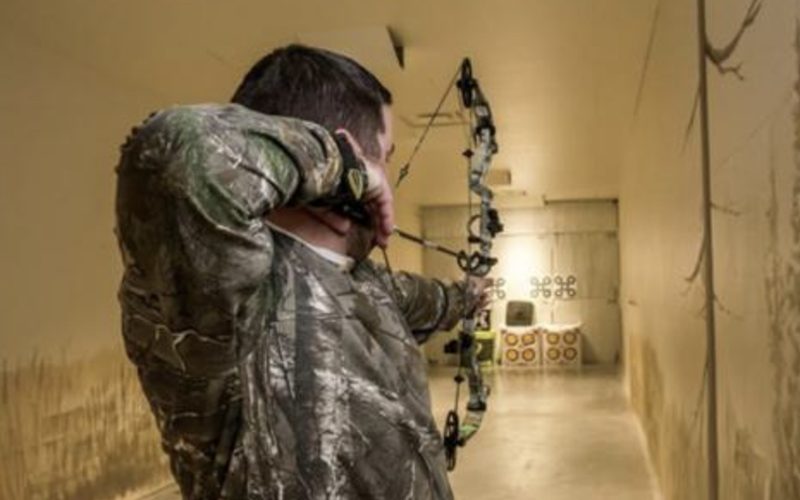
Educational equipment analysis only — not legal, security or defensive-use advice. This page examines archery-equipment mechanics, spatial clearance and manufacturer specifications. It does not cover how to confront an intruder, does not offer tactics, and creates no attorney-client or advisory relationship. For the legal ownership framework, see Are Bows and Arrows Legal?; for anything involving an actual threat, contact local law enforcement and a licensed attorney, not a website.
💡 Quick Takeaway
Core insight: A bow's own physical length is close to, or wider than, a lot of the spaces it would need to work in, it can't be pre-staged the way a loaded firearm can, and its noise is nowhere near the "silent" reputation it gets.
Ideal for: Bowhunters weighing whether the bow already in the closet is a reasonable backup, and anyone comparing home-defense options who wants the actual axle-to-axle, hallway and setup-time numbers instead of a forum opinion.
1. Why Would Someone Consider a Bow for Home Defense?
The appeal makes sense on paper. No background-check wait in most states. No permit hanging over the purchase. And for a lot of bowhunters, the thing's already leaning in a closet — it doesn't fire a projectile "by the action of an explosive," which is the exact line federal law draws between a firearm and everything else, bows included, per 18 U.S.C. § 921(a)(3).

Then there's the image itself. Movies, video games, half of streaming TV — a bow reads as the quiet, precise, always-ready option. I get the appeal; I've watched the same shows. But "I own one and I know how to shoot it" isn't the same claim as "I could use this one in my hallway tonight," and almost nobody runs the actual numbers before assuming the second follows from the first. That's what the rest of this page does.
2. What Makes a Bow Practical — or Impractical — Inside a Home?
Three problems stack on top of each other here. Not training issues — mechanical ones, the kind that don't improve with practice.
Indoor Spatial Constraints
Compound bows aren't small. The Bowtech SR350 — a genuinely short, hunting-class bow — still measures 33 inches axle-to-axle. Go looking for a target rig instead and Hoyt's own spec sheet lists the Concept XTS 40 at a full 40 inches. Recurves don't fare any better: the Samick Sage, a hunting-length recurve a lot of new archers cut their teeth on, runs 62 inches tip to tip, and a target recurve or longbow stretches to 68 or 70. None of it was drawn up with a hallway in mind.
Now compare that to the hallway itself. Residential code sets a 36-inch minimum (IRC Section R311.6), and a standard interior door commonly runs 30 to 32 inches — a range echoed by the ADA's own commercial doorway standard, which sets 32 inches as the functional minimum clear opening. A 33-inch ATA compound clears a 36-inch hallway. Technically. Turn a corner with it, draw at an angle, or try it in an older house with narrower doors, and that margin disappears fast. A vertical bow — recurve or longbow — is off the table before you've even left the room.
Setup Time & Readiness
Here's the part people skip over: a compound bow can't be stored at full draw. Let-off helps once you're back there — a 70 lb bow at 80% let-off is roughly a 14 lb hold, which isn't bad at all. But you still have to get there first. Draw, anchor, release or let down, every single time. It was never engineered to sit at full draw as a standby posture the way a chambered round just sits in a firearm. So that whole sequence happens in the moment — under stress, in the dark, hands not quite steady.
A crossbow trades one problem for another. Cocked and loaded, sure, it's genuinely ready. But TenPoint's own FAQ caps that at 24 hours before string and cable stretch start eating into performance, so staging one indefinitely — the way you'd leave a pistol loaded in a nightstand for years — just isn't how the tool is built to be used. Cocking one cold takes both hands, usually a cocking device, and several seconds you may not have.
Stress & Fine Motor Skills
Hitting anything with a bow is a fine-motor-skill chain — anchor point, peep alignment, a stable stance, a controlled release — built through hundreds of reps on a calm, lit range. Adrenaline goes after exactly that chain first. Anchor point drifts. Peep alignment gets rushed or skipped outright. The follow-through you'd swear you couldn't mess up falls apart anyway.
I've watched it happen to steady, experienced shooters at a tournament with nothing on the line but a score sheet. Nerves on a stage with a crowd watching are one thing. Nerves with an actual threat in the house are a different animal entirely — but the chain breaks the same way either time.
3. The Biggest Problem: Archery Range Performance vs. Indoor Real-World Chaos
A 20-yard indoor range is lit. It's quiet. Nothing moves that you didn't expect to move, and you've shot that exact lane a hundred times before. None of that describes an actual break-in. A hallway at night is dark, unfamiliar in the moment even in a house you've lived in for years, and it's sharing its width with furniture, doorframes, and whoever else happens to be home. Closing that gap is really the whole question this page is asking — and it's a spatial problem before it's ever a skill problem.

4. Bow Type Practicality Comparison
Compound, recurve, longbow, compact crossbow — each one fails this test differently. None of them pass clean.
| Factor | Compound Bow | Recurve / Longbow | Compact Reverse-Draw Crossbow |
|---|---|---|---|
| Length in Ready Position | 28–34 in ATA on hunting models (33 in on a Bowtech SR350), up to 40 in on target bows (Hoyt Concept XTS 40) | 58–70 in overall — see crossbow vs. longbow for the platform breakdown | 8–12 in ATA cocked on compact models; ~28.5 in overall length |
| Setup Speed From Rest | Seconds to draw — but can't be stored drawn | Seconds to draw and hold, at a lower sustainable poundage than a compound; also can't be stored drawn | Minutes to cock cold with a cocking device; instant if already staged |
| Storage-Ready Posture | Not possible — must be at rest or shot | Not possible at a meaningful defensive poundage | Possible for hours, capped at 24 by the manufacturer's own guidance |
| Noise at Release | Self-reported low-to-mid 80s dB on uncalibrated phone meters | Generally quieter than a compound — no cams or cables — but not silent | A mechanical trigger and limb report, on top of the same not-silent baseline |
| One-Handed / Confined Use | No — needs two hands, shoulder rotation and clearance on both sides | No — same two-hand, full-extension requirement | Closer to one-handed once cocked and loaded, but cocking itself needs both hands and a stable brace point |
⚠️ When Not to Count on a Bow
Avoid relying on a bow as your primary plan if: your home has narrow hallways or several doorway turns between the bow's storage spot and where you'd realistically need it, you haven't drawn that specific bow under time pressure in the dark, or your bow is a longer target-length model rather than a shorter hunting-class one. Every one of those turns a workable setup into an impractical one.
5. What Experienced Archers & Bowhunters Actually Say
🗣️ Community Consensus & Synthesis Grid
Forum/Discord sentiment: ArcheryTalk and Rokslide haven't organized around "bow for home defense" as its own topic — there's no deep, dedicated thread on the question the way there is for spine charts or broadhead tuning. What does exist is plenty of debate on the exact mechanics that would decide the answer: bow noise, how long a crossbow can sit cocked, and how much holding weight let-off actually buys you.
Top praised approach: On the noise question specifically, the recurring theme across measurement threads is that self-reported phone-app decibel readings vary too much between testers to trust as a hard number — worth flagging here, since "how loud is a bow" is the exact figure a silent-weapon claim leans on.
Common friction point: Crossbow owners argue constantly about how long a bow can realistically sit cocked before it's a problem. TenPoint's own 24-hour guidance settles the manufacturer's position, but plenty of forum posts describe going well past that window without a failure — which is a different thing from it being advisable, and not a basis for treating a cocked crossbow as permanently staged.
6. Common Claims vs. Reality
Five claims I keep running into on this topic. Here's what actually checks out.
| Claim | Evidence | Verdict |
|---|---|---|
| "A bow is a silent home-defense option" | The only public dB figures available are self-reported, uncalibrated phone-app readings in the low-to-mid 80s — no controlled acoustic study of bow-shot noise exists | Misleading |
| "You can keep a compound bow drawn and ready like a chambered firearm" | A compound is engineered to be shot or let down; parking it at full draw for standby duty isn't a supported use of the cams, limbs or string, and let-off only reduces holding weight, it doesn't remove the need to release it | Unsupported |
| "A cocked crossbow is fine to leave staged indefinitely" | TenPoint's own FAQ caps cocked storage at 24 hours before string/cable stretch degrades performance | Partly Supported |
| "Range accuracy carries over directly to a real threat" | No archery-specific study measures this; the closest analog is general reaction-time research like the Tueller Drill, which shows how fast close-range distance collapses regardless of weapon type | Insufficient Data |
| "A compact crossbow clears a hallway more easily than a compound bow" | A reverse-draw model like the TenPoint Phantom De-Cock measures 8.4 in cocked, against a 33-inch ATA hunting compound like the Bowtech SR350 — a real, citable gap | Supported |
7. Safety, Storage Rules and Legal Considerations
A bow kept ready for defense is still a stored weapon in a house, and it picks up every child-access and dry-fire concern that comes with that territory. I've written before about mounting a bow safely on a wall rack and about handling one on the move without stressing the limbs, and the same basic rules apply indoors: keep it off the floor, out of a kid's reach, and never resting under tension against a wall or door frame where one bump sends it off.

Legally, there are two separate layers here, and it's worth keeping them apart. Owning and keeping a bow at home is settled law — it isn't a firearm under federal statute, no special permit required, closet storage included. Actually pointing it at another person is a different question entirely. Most states judge lethal-force self-defense by the threat and the response, not by which weapon was in your hands, so a bow gets held to the same justification standard as a firearm rather than something lighter. That's a use-of-force call for a licensed attorney in your state to make. A mechanical breakdown like this one can't settle it, and I wouldn't try.
8. Frequently Asked Questions
Can a bow and arrow realistically be used for home defense?
Only as a fallback of last resort, and even then with real limitations. A bow's own length crowds most residential hallways and doorways, a compound bow cannot be stored pre-drawn the way a firearm is stored chambered, and a crossbow's reload takes both hands and several seconds — all working against a fast, close, low-light encounter.
Is a compound bow practical inside a hallway or room?
Not especially. Hunting-class compound bows run roughly 28 to 34 inches axle-to-axle, with some target models reaching 40 inches, against a residential hallway that's often close to the 36-inch code minimum (IRC Section R311.6) and a standard interior door that's commonly 30 to 32 inches wide. There's real clearance, but not much margin for turning a corner or drawing at an angle.
What are the main limitations of using a bow indoors?
Three compound-bow issues stack up: setup time (a bow can't be stored at full draw, so it has to be drawn from rest in the moment), clearance (limb and cam width in a hallway or through a doorway), and noise (self-reported readings from bowhunters land in the low-to-mid 80s decibel range on uncalibrated phone meters, nowhere close to silent). A crossbow trades the draw-time problem for a cocking-and-loading problem instead.
Is it legal to use a bow for self-defense?
Owning and using a bow is legal everywhere in the U.S., but deploying any weapon capable of lethal force in self-defense — a bow included — is generally evaluated under the same use-of-force legal standard as a firearm in most states, not a lower one just because a bow isn't legally classified as a firearm. See Are Bows and Arrows Legal? for the general ownership framework; the specific use-of-force question needs a licensed attorney in your state, not a website.
How does range performance differ from real-world indoor stress?
No archery-specific study measures this directly, so it's an open question rather than a settled one. The closest available analog is general reaction-time research such as the Tueller Drill, which found that a contact-range attacker can close roughly 21 feet in about 1.5 seconds. Worth noting, per USCCA's own breakdown of that drill, that the 21-foot figure gets treated as a hard rule far more often than the original research supports — the real point is how quickly close-quarters distance disappears at all, regardless of which weapon is waiting on the other end of it.
🎯 Verdict
My take: Owning a bow, keeping it strung, knowing how to shoot it — none of that's unreasonable. I do all three myself. But the axle-to-axle math doesn't move, a compound can't sit at full draw waiting for you, and the noise numbers never lived up to the "silent" reputation to begin with. Add it up and you get a poor primary tool for a threat that's over in seconds — not a quiet substitute for one.
👉 If a bow's part of your plan anyway, use the mechanical limits above as your starting point, not last weekend's range group. Put real thought into layered home security, a rehearsed safe-room plan, and maybe a conversation with local law enforcement about a home security assessment, before any of this stops being theoretical.
Educational equipment analysis only — not legal, security or defensive-use advice. This page covers archery-equipment mechanics and spatial practicality, not tactics, and creates no attorney-client or advisory relationship. Confirm ownership rules on Are Bows and Arrows Legal? and consult a licensed attorney in your state on any use-of-force question.
Hey, what's up? Burak here. Archery addict, board game geek, Daft Punk fan.
Your turn
Join the Conversation
If you've measured your own bow's actual clearance in your own hallway, or you've got a chronographed decibel reading with a real meter, that's the most useful thing you could leave here — corrections and real numbers get the page updated.