
HHA Optimizer Lite Sight Tapes: How to Choose the Right One
Short version: zero a blank tape at 20 yards, zero it again at 60, subtract the two scale numbers, and buy the pre-printed tape closest to that differential. Everything below exists to make that one subtraction easy and to get you to the actual tape — the calculator, the kit contents, and where to buy it.

ArcheryEra's calculators are built and maintained by a mechanical engineer with 8+ years of archery-domain experience. Models, assumptions and limitations are shown, not hidden.
If you buy through our links, we may earn a commission that helps support the work we do. Learn more.
💡 Quick Answer
The method: Install a blank setup tape. Zero it at 20 yards and note the scale number. Zero it again at 60 yards and note that number too. Subtract 20-yard from 60-yard — that's your setup scale differential. Buy the pre-printed HHA tape closest to it.
Worked example: Housing reads 7 at 20 yards and 27 at 60 yards. 27 − 7 = 20. That's a fast, flat-shooting differential — you'd be shopping the low end of HHA's tape range, not the high end.
Don't want to shoot a blank tape first? Move the sliders in the calculator below for a physics-based starting estimate of your own differential before you buy anything.
Interactive Tool
HHA Sight Tape Estimator & FPS Drop Calculator
Pre-Sets
Pick one to load a whole setup, then move any slider from there.
Useful? This one is free, and staying free. If it saved you a wasted tape, you can put a coffee towards the hosting.
Buy Me a Coffee🗣️ Calibrated an Optimizer Lite and want to compare your real differential against this estimate?
Join r/ArcheryEra →Your bow
Your arrow & broadhead
Drag rises slightly from field point to fixed-blade — dial your tape with the head you'll actually hunt with, not field points, if the two don't group together.
Drop Behind Line of Sight
20 yards: — · 60 yards: — · raw difference: —
This is straight-line drop with no housing compensation — it's the number the wheel dial exists to cancel out, converted here into the scale-unit estimate above.
Reading the Setup Scale Differential number
This is the ArcheryEra Scale-Differential Estimate — a physics-based comparison model built from real trajectory physics (arrow speed, drag and gravity drop), not HHA's own published conversion table. HHA doesn't publish the internal geometry of the Optimizer Lite wheel, so treat this number as a strong starting point for which tape family to pull off the rack, then confirm the real number with the 4-step calibration below before you commit to a permanent tape.
⚠️ Important: This Is Not HHA's System
The number above is an ArcheryEra estimate, built by us from public trajectory physics — it is not something HHA publishes or endorses, and it is not a substitute for the 4-step blank-tape calibration below. Use it to shortlist a tape family before you buy, not to skip zeroing your bow.
🛠️ Interactive Utility & Downloadable Asset
Included Asset: A one-page printable Setup Reference Card, generated live from whatever you've dialed into the calculator above — your inputs, estimated speed, scale differential and tape family, plus computed drop-compensation numbers at 20, 30, 40, 50, 60, 70 and 80 yards.
How to Use: Set your real numbers in the calculator, then hit the button below. It opens your browser's print dialog — choose "Save as PDF" to keep a digital copy, or print it to take to the range while you calibrate a blank tape.
How Does the 20-to-60 Yard Setup Tape Method Actually Work?
An HHA setup tape is numbered in equal increments from roughly 1 to 75 or more, and none of those numbers mean "yards" by themselves. What matters is the gap between two marks: where your housing sits when you're dead-on at 20 yards, and where it sits when you're dead-on at 60. That single gap — the setup scale differential — is what every pre-printed HHA tape is organized around, because it already reflects your exact bow, arrow and broadhead, not a reference bow on a chart.
📊 The 4-Step Calibration Method
| Step | What You Do | What You Mark |
|---|---|---|
| 1 · Zero at 20 yd | Install a blank setup tape, group at 20 yards, micro-adjust until dead-on. | The scale number under the housing indicator at 20 yards. |
| 2 · Dial to 60 yd | Step back to 60 yards, group again, slide the housing down until dead-on. | The scale number under the indicator at 60 yards. |
| 3 · Subtract | 60-yard number minus 20-yard number. | Your setup scale differential — the number that matters. |
| 4 · Cross-reference | Match the differential against HHA's pre-printed tape options. | The permanent, color-coded tape you install for good. |
Two housing positions, one subtraction — that's the entire method, and it's why it out-performs picking a tape off a generic speed chart. A wall chart assumes a reference bow, a reference arrow weight and a reference peep-to-pin distance. Your actual 20-and-60 gap assumes nothing; it's measured off the exact setup you're going to hunt with. HHA's own Optimizer Lite & Ultra installation instructions walk through the identical two-point method on their blank 0-80 setup tape, which is the primary source this section is built from.
🛠️ Worked Example, Step By Step
Zero at 20 yards: housing indicator sits on 7. Zero at 60 yards: housing indicator sits on 27. Subtract: 27 − 7 = 20. A differential of 20 falls at the fast end of HHA's tape range — a light, quick arrow build — while a differential in the high 30s to 40s points toward the heavy/steep end. Match your own number to the closest pre-printed tape and you're done with the math.
HHA Optimizer Lite Sight Tape Chart
HHA does not publish a public tape-number conversion chart that lets you pick a physical tape from bow FPS alone. The manufacturer's own 20-to-60 yard calibration procedure is the authoritative way to select the tape — the chart below is an ArcheryEra reference, not an HHA-issued list.
What it does show: draw weight and draw length held fixed at a common hunting reference (65 lb, 29 in draw, hunting vanes, fixed-blade broadhead), with only total arrow weight varied, so you can see how weight alone reshapes the differential you'd be matching a tape to.
📊 1-Minute Decision & Comparison Matrix
| Arrow Speed (FPS) | Total Arrow Weight (gr) | Sight Radius (Peep–Pin) | Scale Differential | Estimated Tape Range |
|---|---|---|---|---|
| 300 | 350 | 32 in (typical) | 26 | Fast / Flat |
| 290 | 375 | 32 in (typical) | 28 | Mid-Speed |
| 282 | 400 | 32 in (typical) | 30 | Mid-Speed |
| 274 | 425 | 32 in (typical) | 31 | Mid-Speed |
| 267 | 450 | 32 in (typical) | 33 | Mid-Speed |
| 260 | 475 | 32 in (typical) | 35 | Heavy / Steep |
| 254 | 500 | 32 in (typical) | 36 | Heavy / Steep |
| 248 | 525 | 32 in (typical) | 38 | Heavy / Steep |
| 243 | 550 | 32 in (typical) | 40 | Heavy / Steep |
What Comes In an HHA Optimizer Lite Replacement Tape Kit?
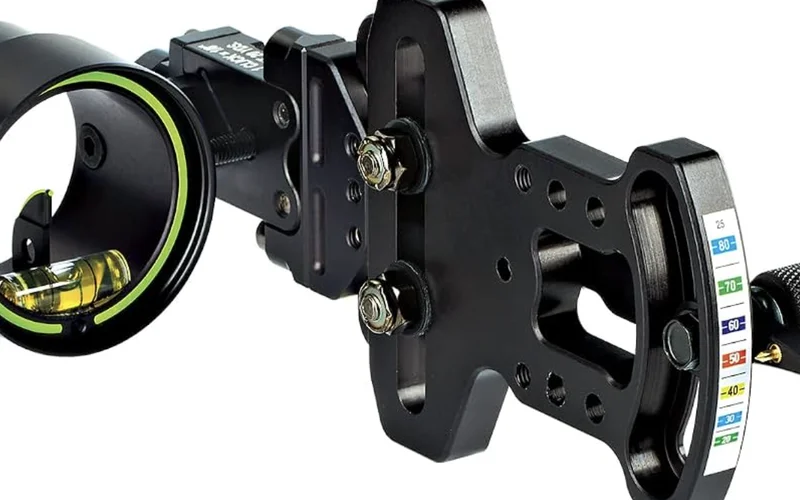
HHA's EZ Tape kit is the replacement tape line built for Optimizer Lite, plus the OL and XL 3000/5000 Series housings. It ships 43 color-coded, pre-printed tapes spanning 20 to 80 yards, each rated to hold point of impact within a quarter inch when you match it to the right differential — specs confirmed on Lancaster Archery's EZ Tapes for Optimizer Lite product page. That's the set the differential from the calculator above and the worked example are pointing you toward.
Where to Buy HHA Optimizer Lite Replacement Tapes
Three real sources, all carrying the same EZ Tape line: HHA's own replacement tapes page for buying direct from the manufacturer, Lancaster Archery Supply's EZ Tapes listing for a dedicated archery retailer, and HHA's EZ Tape Kit (part 32283) on Amazon if you'd rather order through a marketplace you already use. Check the listing photo against your housing series before ordering — an Optimizer Ultra (DS 5000 Series) sight takes the separate DS Tape line, not EZ Tape, covered below.
What If I Changed My Arrows Since Setting Up My Tape?
A new arrow build changes your true speed, and speed is the whole basis of the differential — so yes, a real arrow-weight or draw-weight change can move you into a different tape family. Run your updated numbers through the Arrow Speed & Performance Calculator first to get a precise fps for the new build, then feed that speed back into the calculator above (or straight into a fresh 20-to-60 blank-tape check) before you assume your old tape still tracks.
Can You Print Your Own HHA Sight Tape? Stock vs. Custom vs. Print-Your-Own
Not a finished, calibrated HHA tape — no outside source, including this one, has the Optimizer Lite's internal wheel geometry to print one that just works. Three real paths instead: buy HHA's own pre-printed tape closest to your differential, generate a fully custom tape from third-party software, or print the free reference card generated by the calculator above while you decide. Most first-time Optimizer Lite owners want the first option; unusual arrow builds are where the other two start to matter.
📊 Stock Tape vs. Custom Software vs. Printable Reference Card
| Criteria | HHA Stock Pre-Printed Tape | Custom-Printed Tape Software | ArcheryEra Printable Card |
|---|---|---|---|
| Accuracy basis | Nearest match to your measured differential | Your own logged point-of-impact data at each yardage | Physics estimate from your bow & arrow numbers |
| Where to get it | HHA's official replacement tapes page, or on Amazon | Archer's Advantage, The Archery Program (TAP) or OnTarget2 | Free, generated instantly above |
| Material | Laminated, weatherproof vinyl, factory die-cut | Printed adhesive label stock, laminate applied by hand | Plain paper — a reference to copy, not a finished tape |
| Best for | A first setup, or confirming a differential fast | An unusual arrow build the pre-printed sets don't cover well | Deciding what to buy, or a field-notes backup |
Surface prep matters more than which option you pick. Clean the housing with 91% isopropyl alcohol and let it flash-dry before applying either type — skipping this step is the single most common reason a tape starts lifting at the edges mid-season, stock or custom.
HHA Optimizer Lite vs. Optimizer Ultra Tapes: What's Actually Different?
Same method, different tape families. Both Lite and Ultra housings use the identical 20-to-60 yard differential process, and both tape lines cover the same 20-to-80 yard range at a quarter-inch point-of-impact accuracy standard. The difference is which physical tape fits which housing.
📊 Optimizer Lite (EZ Tape) vs. Optimizer Ultra (DS Tape)
| Spec | Optimizer Lite / OL / XL 3000–5000 (EZ Tape) | Optimizer Ultra / DS 5000 (DS Tape) |
|---|---|---|
| Tapes in the set | 43 | 48 |
| Yardage range | 20–80 yd | 20–80 yd |
| Point-of-impact accuracy | ±¼ in when matched correctly | ±¼ in when matched correctly |
| Setup method | 20-to-60 yard differential | 20-to-60 yard differential |
| Interchangeable with the other line? | No | No |
The two sets aren't interchangeable even at a matching differential number — they're built and cataloged as separate HHA product lines, EZ Tape for Optimizer Lite and DS Tape for Optimizer Ultra, so buying the wrong one won't fit the housing regardless of how close the numbers look.
Advanced: The Physics Behind Sight Tape Selection
Everything above is enough to buy and calibrate a tape. This section is for the "why" — the gravity-drop math, a worked case study on arrow-weight sensitivity, and a surface-prep note — open it if you want the derivation instead of taking the method on faith.
Show the full physics: gravity drop, a 70-grain case study, and a chart-only warning
Gravity pulls every arrow down at a constant 9.81 m/s² regardless of speed — what changes is how much time the arrow spends in the air to get downrange, and that time grows non-linearly because drag is eating velocity the whole way. I model velocity decay as v(t) = v₀ · e−kd, where k is a drag constant built from your vane profile and broadhead — hunting vanes alone run about k = 0.0033 per meter, and a fixed-blade head adds roughly another 0.0006 on top of that, both figures pulled from the same drag model documented on the Trajectory & Sight-Pin Visualizer.
Time of flight to a distance d then works out to t = (ekd − 1) / (k·v₀), and drop below line of sight is the ordinary 1/2·g·t² you'd get from a plain falling-object formula — the drag term only shows up in how long the arrow takes to arrive, not in how fast gravity pulls once it's there. That's the physical link between a number you can calculate (drop in inches) and a number engraved on a dial (scale units) — and it's why two bows with identical IBO speed but different arrow weights can still need two different tapes.
Case study — how a 70-grain swap can affect sight-tape selection: run two real builds on the same housing: a 400-grain hunting arrow at 280 fps, and a 470-grain heavy hunting arrow at 245 fps — a gap a lot of shooters would eyeball as "close enough" to share a tape. Modeled with the same drag constant, the lighter-faster build works out to roughly a 30-unit differential; the heavier-slower build works out to roughly 39 units — enough that the two builds could land in different tape families on HHA's own pre-printed set. Load those two weight/speed pairs into the calculator above yourself and watch the differential move in real time.
When not to trust a chart-only pick: your actual finished arrow weight is unmeasured (guessed off a shaft's advertised "base weight" instead of the whole build with point, insert, wrap and nock), your peep-to-pin sight radius is meaningfully longer or shorter than a stock housing, or you're switching between field points and a fixed-blade broadhead without re-checking the group.
Surface prep: clean the housing with 91% isopropyl alcohol and let it flash-dry before applying any tape, stock or custom — skipping this is the single most common reason a tape starts lifting at the edges mid-season.
🗣️ Community Experiences & Field Notes
What We Read: Two long-running threads from single-pin slider owners working through Optimizer Lite setup: this ArcheryTalk sight-tape setup discussion and a similar GON Forum thread on HHA setup tapes. That's a handful of individual accounts, not a systematic survey.
Top Praised Feature: In both threads, shooters report the 20-to-60 differential method gets them dead-on at every 10-yard mark faster than starting from a printed reference chart, because it skips guessing at their own arrow's true speed.
Common Friction Point: The same complaint shows up in both threads: applying a new tape over old adhesive residue without a proper alcohol wipe-down first — the tape looks fine going on, then lifts at a corner a few weeks later.
Related on ArcheryEra
Already know your arrow's real speed? Run it through the Arrow Speed & Performance Calculator for a second cross-check, or confirm downrange energy with the Kinetic Energy, Momentum & Pass-Through Calculator before you commit to a tape family. Not sure your draw length is right in the first place? Start with the Draw Length Calculator. Back in the Arrows hub for shaft, spine and weight guides that feed into the arrow-weight number this calculator asks for.
Frequently Asked Questions
How many sight tapes come in an HHA Optimizer Lite replacement tape kit?
HHA's EZ Tape kit for Optimizer Lite, OL and XL 3000/5000 Series sights ships 43 color-coded, pre-printed tapes covering 20 to 80 yards, each rated accurate to within a quarter inch of point of impact when matched correctly.
Where can I buy HHA Optimizer Lite replacement sight tapes?
Direct from HHA, through archery retailers such as Lancaster Archery Supply, or via HHA's own listing on Amazon — see the "Where to Buy" section above for exact links. Match the listing to your housing series before ordering.
What is the difference between HHA Optimizer Lite and Optimizer Ultra tapes?
Both series use the same 20-to-60 yard differential method, the same 20-to-80 yard range, and the same quarter-inch accuracy standard. They're still two separate, non-interchangeable product lines: Optimizer Lite/OL/XL takes the 43-tape EZ Tape set, Optimizer Ultra/DS 5000 takes the 48-tape DS Tape set.
What happens to my sight tape if I change my arrow point weight or draw weight?
Either change shifts your effective arrow speed and, with it, your setup scale differential. A small point-weight tweak rarely moves you off a tape family, but several pounds of draw weight or a different arrow altogether is worth re-running the 20-to-60 yard calibration.
Can I calibrate an HHA Optimizer Lite at 20 and 40 yards instead of 60 yards?
You can, but the differential comes out smaller and more sensitive to aiming error, since drop compounds non-linearly with distance. The 20-to-60 spread captures enough of the trajectory curve to keep your mid-range marks accurate too.
Are HHA Optimizer Lite sight tapes waterproof and UV-resistant?
The pre-printed tapes ship on laminated vinyl that sheds rain and resists fogging, and they handle normal in-season UV exposure fine. Multiple seasons of direct sun will fade the printed numerals before the adhesive itself fails — that's the more common reason to replace one.
How do I remove old sight tape adhesive without damaging the aluminum housing?
Peel the old tape slowly at a low angle instead of straight up, then wipe residue off with a cloth dampened in 91% isopropyl alcohol. Skip acetone or other harsh solvents on a painted or anodized housing — they can strip the finish along with the glue.
Where can I find printable PDF HHA sight tape templates?
HHA itself doesn't publish a generic printable PDF, since matching a differential to a tape is confirmed by the physical calibration process rather than read off a chart. This page's calculator will print a free Setup Reference Card built from your own numbers — see the "Print / Save My Setup Card" button above — and third-party software like Archer's Advantage or The Archery Program (TAP) can print a fully custom tape once you've logged real point-of-impact data at several yardages.
⚠️ Sight Clearance, Vane Contact & Dry-Fire Warning
Before you shoot a group at full dial extension, check arrow clearance through the sight window and riser — a housing racked all the way down the setup tape can put a fletched shaft close enough to clip the housing or riser shelf on release, which reads as an inexplicable flyer until you catch it. Never dry-fire a bow while walking the housing through calibration positions, even briefly between groups — a bow with no arrow on the string can suffer serious limb, cam or cable damage, and dry-fire injuries to the shooter are a real risk every time.
🎯 Verdict
Our Final Take: The calculator above gets you to a tape family fast; the 20-to-60 yard blank-tape method is what actually confirms it. Treat the estimate as a starting rack to pull from, not a purchase order.
👉 Recommendation: Run your real numbers through the calculator, buy the closest pre-printed tape to the estimate, then walk the 4-step calibration with the arrows and broadhead you'll actually hunt with before you call the setup finished.
Real-World HHA Tape Data From ArcheryEra Readers
This table is the crowdsourced complement to the estimate above: real, reader-submitted 20-to-60 differentials next to what the calculator would have estimated for the same bow and arrow numbers. It starts empty on purpose — every row below comes from a comment, not a guess.
📊 Community-Submitted Setup Differentials
| IBO / Draw Wt / Draw Len | Arrow Weight & Head | Real Differential (measured) | ArcheryEra Estimate | Delta |
|---|---|---|---|---|
| No community measurements yet. Be the first — drop your real numbers in the comments below and I'll add the row here. | ||||
Your turn
Join the Conversation
Calibrated your own Optimizer Lite and want to compare your real 20-to-60 differential against this estimate? That comparison is worth more here than anywhere else I could put it.
🔬 Real-World Validation
Drop a comment with these details and, once enough come in, I'll fold the pattern back into this page so the next reader benefits from it too.
- IBO speed, draw weight, draw length — exactly as you entered them here
- Total arrow weight & broadhead type
- Your real, measured 20-to-60 differential from the blank-tape method
- How far off the estimate landed — closer than a couple of units, or way off?